For posterity

I can’t imagine there’s a single TedQuarters reader who hasn’t seen this video yet, but for posterity, here’s David Wright’s silly Vitamin Water commercial with The Situation.

I’ve said my piece about both Wright and The Situation already in the past few weeks, and the video does little to change my opinion on either:

The curious case of Waylon Smithers

A huge hat tip to Joe Budd at Amazin’ Avenue for pointing me to this blog post from Masters of WAR, evaluating statistically The Simpsons’ Waylon Smithers’ ability to put together the best possible company softball team given a massive amount of resources at his disposal.

Smithers, the post points out, failed pretty miserably, frequently opting for players who were past their primes, who were about to regress, or who were simply overrated. It almost looks as if Montgomery Burns’ interminable yes-man put together a team built to win in the realm of public perception, more than one built to win games over Shelbyville.

It still should have been enough to easily beat Shelbyville in the episode, of course, but the players on Springfield’s club fell victim to a series of weird injuries and unforeseen circumstances, and Smithers had lined up no reasonable roster depth beyond scrubs like Lenny and Carl.

The happy ending, of course, is that even despite the misappropriation of resources in compiling the roster, despite the loss of so many star players, and despite a bizarre managerial decision based on maximizing platoon splits where none likely existed, Springfield prevailed in the end.

Homer Simpson earned the glory — when he came to, of course — but certainly Smithers ultimately earned a contract extension for his efforts, however ineffective.

BREAKING NEWS: Francoeur doesn’t walk Thursday

The streak is over.

If Jeff Francoeur had walked tonight, it would have represented a reasonably rare baseball event. By my count, Francoeur, in his 4 1/2-year career, has unintentionally walked in three consecutive games only five times — twice in 2007 and thrice in 2008.

So it has happened a little more than once per season across his career. In the game of baseball, Jeff Francoeur walking on three straight nights happens — very roughly — about as often as no-hitters. It’s not perfect-game rare or unassisted triple play rare, but it’s rare nonetheless.

And Frenchy thought he had it tonight, too. He looked at a pitch he was sure was ball four in the fourth inning, got a big grin on his face and started trotting down to first, only to be called back to bat by the home-plate umpire.

He ultimately doubled, driving in the Mets’ only run, so it was certainly better he didn’t take his base in this case — the novelty notwithstanding.

I’ve gotten a couple of Twitter messages and an email about Francoeur’s two-game season-opening walk streak. Nearly all of the notes are in jest, but I figured I’d address them because it makes for a neat example of how small sample sizes, taken in isolation, can be deceiving.

In his career, Frenchy has unintentionally walked, on average, 27 times per every 162 games. That’s exactly 1 in 6, which is amazingly convenient, and the reason I bothered with this.

It’s not a perfect analogy because Francoeur can — and has, in some instances — walk more than once per game. Plus he has walked more in some seasons than others.

But saying, for the sake of it, Francoeur walks once every six games, then the chance of him walking in a game is the same as a certain digit coming up on a dice roll — we’ll go with 4, in honor of the occasion — on consecutive rolls. Maybe you’d snicker if you rolled two fours on the first two of 162 rolls, but you certainly wouldn’t bat an eye if consecutive fours came up somewhere in the middle.

I certainly hope Francoeur’s walks are not random, and are an indication that he has finally made good on a career’s worth of promises to improve his plate discipline –weighting the dice, so to speak. Put me down for skeptical, though, especially since one of the walks came amidst Florida’s epic bullpen meltdown on Wednesday night.

He’s hitting, though, and that’s obviously what matters most. I’m sure being more selective helps.

Nathan’s Pretzel Dog < Biscuitdog

Sorry about the utter lack of posts this afternoon. I’m at Citi collecting some material for The Baseball Show and enduring more Internet difficulties.

Because I couldn’t get online until just now, I set out to enjoy my first Nathan’s Pretzel Dog, which I weighed in on a few weeks ago.

It was surprisingly hard to find — I went to three stands that sold Nathan’s Hot Dogs before I found one that sold Nathan’s Pretzel Dogs. It was on the Field level, just to the first-base side of the Jackie Robinson Rotunda, at a stand called “Hot Dogs.”

The product itself is good, but not all I hoped it would be. To be fair, probably nothing could live up to the expectations I set for the combination of pretzel and hot dog. I powered through it without thinking to take a picture, so you’ll have to just picture it in your head.

Probably better that way, anyway. It really doesn’t look as great in real life as it did in my mind. There were no beams of light emanating from it or anything, and it wasn’t presented to me accompanied by triumphant classical music. Just a hot dog wrapped in a pretzel.

It tasted like that, too. And I love both those things, so I thought it was good. No synergy, though. Nothing popped, you know?

It did remind me, though, of one of my great culinary experiments of yesteryear. Back before I moved to the suburbs and secured myself a backyard in which to grill stuff, I had to invent foodstuffs in various tiny Brooklyn apartments.

One such invention was Biscuitdog, which is exactly what it sounds like, except it’s not a dog biscuit. Oh, and I threw some bacon and cheese in there, too, because I’m like that.

It’s a hot dog, wrapped in bacon, covered in cheese, wrapped in a biscuit and baked. It tasted like a biscuit-wrapped-pork-wrapped beef miracle, and it looked like this:

Does that look a little too biscuity? Trick question: There’s no such thing as too biscuity. Also, I’ll thank you not to question Biscuitdog.

Former roommate Mike didn’t. Look at him tear into that sucker:

Well now I want Biscuitdog, or at least a biscuit.

At least I have the best Mets lineup we’ve seen so far this young season to tide me over. Angel Pagan and Ruben Tejada in the same game? Good night to be here. Beautiful night for baseball, too.

You tell ’em, Cowboy

“They’re two of the best teams in baseball. Why are they playing the slowest? It’s pathetic and embarrassing.”

Umpire Joe West, as told to the Bergen Record.

West’s comments are meant to defend his colleague, the widely reviled Angel Hernandez, for not granting time to several Yankees and Red Sox during Tuesday’s game in Boston.

I watched, and it did look weird to see Hernandez denying Derek Jeter time. How dare he! Then again, it looked pretty weird to see so many Yankees and Sox calling time so frequently, but I wasn’t sure if I was just noticing it more than I normally would because Hernandez wasn’t granting it, so I was paying attention.

Either way, West’s probably right. I’m not sure if the Yankees or Sox step out of the box or more frequently than any other teams, but if he and his crew are under the gun to speed up games, then by all means, deny Jeter his precious batting-glove adjustment time.

It’ll ameliorate all the sportswriters who are so bent out of shape about the length of the games, at the very least.

It does, however, fly right in the face of something Cowboy Joe West himself says on his spoken word album about baseball, Diamond Dreams:

It’s the only sport where you can manage right along with the manager. In no other sport can you do that.
You can’t do it in basketball, because you don’t know what play they called.
And in football, as soon as the ball is snapped, everybody’s running into each other.
But in baseball, it’s all pretty, and it’s all out there for you to see it.
And this game’s not run with a clock; it can last forever.

More importantly, umpire Joe West has a spoken word album. I’m obviously buying that.

UPDATE: I really thought I’d be the first to bring to the blogosphere, or at least refresh to the blogosphere, news of Joe West’s musical exploits. But then, upon finishing this post, I went to my Google Reader and noted that Big League Stew beat me to the punch. Check that site out for more on this West thing.

Talking about bullpens with John Franco

Before you kill me, I realize that John Franco never pitched 100 innings in relief. I realized that when I asked, too. You know what I was getting at if you read here regularly, I suppose:

On the intersection of Taco Bell and sports

A number of readers have emailed me wondering why I haven’t weighed in on Joey Porter’s arrest in a Taco Bell parking lot yet. Since, as they’ve pointed out, it represents the intersection of sports and Taco Bell, it does seem like perfect TedQuarters fodder.

I’m not aiming to make light of DUI, though, nor am I willing to pass judgment on an arrest with such vaguely reported details: Conflicting online news stories have it that Porter was at the wheel of his car, at the wheel of a friend’s car, and in the passenger’s seat of a friend’s car when he slapped the police officer in question, and absolutely none of the reports I’ve read even specify whether or not Porter ate delicious Taco Bell, nor what he ordered if he did.

Regardless, since Porter will not face charges, he will certainly not face criticism here. Let he who has not been drunk and belligerent in a Taco Bell parking lot cast the first stone.

I will say this, though: There seems to be something about Fourthmeal that brings out the worst in humanity. I don’t really get it, either.

The town where I grew up maintains an inordinately stupid rule under which fast-food restaurants can not keep drive-thrus open past 11 p.m.

Taco Bell is the only fast-food restaurant in the town proper, and so to stay open for Fourthmeal, the Taco Bell must keep its dining room open until the wee hours of the morning. At some point around midnight, it becomes a downright terrifying place.

The solution, of course, is to drive right past that Taco Bell, to the much better Taco Bell in the next town over, where there is no stupid rule about closing drive-thrus at 11 p.m.

But if by some chance the people you’re with aren’t willing to go the (literal) extra mile, or they want the luxury or novelty of enjoying Taco Bell in Taco Bell at 1 a.m., you’re heading right into the damn Wild West. No joke.

To me, it makes no sense. We’re all here for tacos, right? And Taco Bell makes me happy, and puts me at peace with my surroundings, even if those surroundings are a dingy suburban fast-food dining room off Sunrise Highway in the middle of the night.

But it’s littered with lunatics. Not actual crazy people — this is Long Island, so they go to diners since there are no Denny’s around. I’m talking drunken, ‘roided-up madmen, who must be looking to Taco Bell for a late-night protein fix and as a good place to find some asses to kick.

Seriously, about 50% of the time you enter that Taco Bell, some meathead tries to pick a fight with you on your way in or out. It sucks. I’m here for Gorditas, guy, not an ass kicking.

Mike Jacobs, cleanup hitter

And so, I started watching Jacobs a bit more closely. And suddenly, involuntarily, I found myself rooting for him. Like I said up top, I don’t know exactly why. But I think it’s because of this: There’s a certain thrill in watching a Mike Jacobs at-bat. He seems — and I have to say “seems” because I have never asked him about this — he seems to understand exactly what’s happening around him. There’s something in his body language, in the joy he seems to get out of baseball, in the way he holds his bat … he seems to be saying to the pitcher:

“You know, I know, everyone here knows that I have some holes in my swing. And you know, I know, everyone here knows where those holes are located. I’m not going to hit the good fastball up and in. I’m not going to hit the sharp breaking ball. I’ll probably chase a pitch when behind in the count — let’s face it, I can’t really help myself, those pitches really look good. So, yeah, let’s be perfectly honest here: If you throw good pitches, you’re probably going to strike me out. And if you’re left-handed, you don’t even need to throw especially good pitches, you’re probably going to get me.

“But …

“Actually, BUT — it’s a big BUT …

“But if you make a mistake, I’m going to freaking hit the ball 700 miles.”

Joe Posnanski, JoePosnanski.com.

I find Mike Jacobs’ at bats significantly less thrilling than Posnanski does, mostly because so far this season, they’ve all been tucked in between David Wright’s at-bats and Jason Bay’s at-bats.
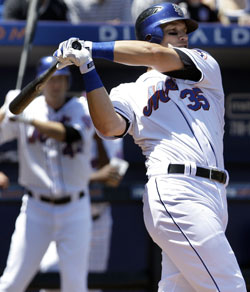
There’s a reasonable case to be made the Jacobs shouldn’t even be on the Mets’ roster, no less starting at first base in Daniel Murphy’s stead, and it seems downright absurd that he should be hitting between the two best hitters in the Mets’ lineup.

(One note on the upcoming: People always misuse sandwich terminology in metaphors. They’d say, here, that it’s a good-hitter sandwich with Mike Jacobs in the middle. That’s not how you name sandwiches, though. You never say you want a whole-wheat sandwich with turkey in it.)

Jerry Manuel is serving an out-machine sandwich on good-hitter bread.

Jacobs is coming off two straight seasons with a sub-.300 on-base percentage, and he’s hitting among the three Mets in the lineup — Bay, Wright and Luis Castillo — who have proved they can reliably get on base at an above-average clip.

And for what purpose? Platoon splits, so the Mets aren’t susceptible to a tough righty reliever? Bay and Wright are undoubtedly better hitters than Jacobs against any pitcher, regardless of handedness. (So, most likely, is Fernando Tatis, for what it’s worth.)

Interestingly enough, Joe Janish pointed out last week that Jacobs has, in his career, hit far better when batting elsewhere in the lineup than while batting cleanup. The data is intriguing, but I’m unwilling — and I’d guess Joe is too — to say Jacobs could be expected to post an .867 OPS simply by hitting anywhere but the four-hole in the lineup. From a quick glance at gamelogs, it appears Jacobs has hit fourth mostly later in his stint with the Marlins and in the second half of 2009 with the Royals. Maybe his struggles there are less about a psychological block against the cleanup spot and more about coincidentally moving into it only after his league has figured him out.

Regardless, the Marlins pretty clearly have the book on Jacobs. He sure crushed a few foul balls last night, which were pretty awesome, but, you know, don’t count for much besides strikes.

I don’t really know why I’m beating this drum. I can’t imagine there are a lot of people out there still holding the candle for Jacobs to be hitting fourth for the Mets after seeing what he did in the team’s first two games. So I’ll stop now. I’m just frustrated, is all.

The whole concept of No. 2 is No. 2

Until the Mets get serious about a No. 2 starter, they will have their troubles. They didn’t spend the money for John Lackey, who pitched six shutout innings in a loss to the Yankees, but somehow they have to find a No. 2 to fall in behind Santana.

Right now, it’s too much to ask Maine to be that pitcher. Based on spring training, the right-hander should be the No. 4 or No. 5. Manuel moved him up to the two spot, dropping Mike Pelfrey to No. 4 and Oliver Perez to five.

Kevin Kernan, N.Y. Post.

It’s almost unfathomable how much ink has been spilled analyzing the order of the Mets’ pitching rotation the first time through. Kernan’s main point — that the Mets could have massively benefited from signing a starting pitcher this offseason — is reasonable. Pointing to the order in which they’ll pitch their starters is not.

Again: It just doesn’t matter. Mike Pelfrey is not the Mets’ No. 4 starter. He is the starter pitching the fourth game of the season. If he stays healthy and effective, he will start 33 games. If he’s the second- or third-best of the guys who finish the season in the Mets’ rotation, people will label him the No. 2 or the No. 3, and that’s fine. But it will have nothing to do with when in the week he pitches.

The Mets, I’m nearly certain, pitched Maine the day after Santana and Perez the day after Pelfrey for a reason, and it had nothing to do with thinking Maine was their second-best starter. Maine and Perez, based on last year’s results, are the starters least likely to go deep in games and so most likely to tax the bullpen. Santana and, for better or worse, Pelfrey, can generally be counted on for innings.

Pitching Maine and Perez on back-to-back nights could have been damning for a bullpen already full of uncertainty.

I don’t imagine Jerry Manuel or anyone else would go on record saying as much, because doing so would be a slight to Perez and Maine. But ordering the rotation like the Mets did is actually, given the way the organization has handled minor decisions lately, a pretty clever one.

As for Lackey, he looked great last night. But I’m going to wait until at least the conclusion of Year 3 of his five-year, $81 million contract before I start saying for sure that the Mets made a mistake in not signing him. And if we’re going off samples this small, the Mets have a pretty solid case for choosing Jason Bay instead: He’s got a 1.413 OPS so far.

On Figgy the Phillie, briefly

So Nelson Figueroa is now a Phillie. Good for him, first of all.

Rob Neyer’s got a good post weighing in on Joe Janish’s post weighing in on the Mets’ failure to keep Figueroa in the first place, though — while Joe hints at it — neither really drives the issue home from the Mets’ perspective. Here’s that:

The Mets cut Figueroa — a known and decent, if unspectacular, commodity that likely represented their best rotation insurance policy for a rotation that desperately needs insurance — so they could carry three relievers who have never thrown a Major League pitch, all of whom had options on their contract, and one of whom could not reliably get the ball over the plate in Spring Training, and one of whom should almost certainly be in Double-A working to become a frontline Major League starter.

They cut Figueroa so they could carry Fernando Nieve, whom they were — perhaps justifiably — apparently more worried about losing through waivers.

They cut Figueroa so they could carry Sean Green, who also had options remaining on his contract, and who also could not reliably throw strikes in Spring Training while adjusting to a new arm angle.

No one expects Figueroa, who has been waived a billion times before this without being claimed, to go to Philadelphia and turn into Cy Young, or anything like it. They expect him to go to Philadelphia and continue pitching like Nelson Figueroa.

The gamble the Mets took — and the one I contend with — is that Green, Hisanori Takahashi, Ryota Igarashi and Jenrry Mejia, with a bunch of question marks attached to them, will pitch better than that, and better enough right out of the gate that it will have been worth parting ways with Figueroa despite all the uncertainty on their starting staff.

Color me skeptical.