Citi Field Museum tour
2

Not long ago The Rivalry was about Manny and Papi. Jeter and Mo. It was about bloody socks, Pedro tossing Zimmer and everyone hating A-Rod on both sides of the field.
Now the symbol of Yankees-Red Sox is Nick Johnson looking at pitches….
He fit the style the Yankees want to play, the style that now defines the Chinese Water Torture aspect of The Rivalry.
Johnson’s walk gave the Yanks the lead, Cano homered in the ninth, and Alfredo Aceves, Joba Chamberlain and Mariano Rivera delivered strong relief. So there is a rubber match tonight in this season-opening series. The over-under already has been established at 300 pitches, bring some Red Bull.
The Rivalry is now Nick Johnson. Walk don’t run.
OK, first of all — and maybe this is something personal, something about the way I enjoy baseball — I find walks plenty exciting. Maybe not exciting in the way I find a Jason Statham movie exciting, but there’s something thrilling about a marathon at-bat ending in a walk, like the one David Wright drew after nine pitches from Josh Johnson on Monday.
 Also, command of the strike zone is a big part of what made all the great players Sherman cites in the Rivalry so awesome — especially Pedro and Rivera.
Moreover — and this is the important part — taking pitches makes you a better hitter. Johnson’s ability to not swing at balls should be lauded, because it forces pitchers to throw him strikes, meaning he will either see pitches to hit or get on base via walk. That’s like the whole point.
That’s basically why they made the rule about walking in the first place, back whenever baseball was invented. Otherwise there’d be no impetus for pitchers to ever throw anything worth swinging at, and games would be way, way more boring than the ones Sherman laments.
I play in a pickup baseball game in Brooklyn on weekends. Many of the players involved — myself included — suck hilariously, but because the level is so low, it provides insight into the derivation of some of baseball’s fundamental logic, and how perfectly woven the rules of baseball really are.
Because, in this game, everyone prefers putting the ball in play to taking a base on balls, early on — before I started playing — the game’s organizers decided that batters should have the option to not take a walk if they earned one, instead resetting the count so they would have the opportunity to swing the bat more.
Unbeknown to me, walks became stigmatized, and so when I started jogging down to first base upon looking at a 3-1 pitch well off the plate in my first plate appearance, the catcher followed me and gently told me that no one really ever takes bases in the game — everyone opts to reset the count, especially the first time through.
That remained the norm for a while. But in time, guys who had no business being on the mound started pitching more frequently, since there was no penalty for wildness. At-bats and innings became interminable, and playing the field downright boring. Eventually, the leader dudes decided we had to eliminate the resetting rule and force people to walk again.
After a few Ollie Perez-style walk-fests, the wildest “pitchers” quit trying.
Now, only pitchers who can get the ball over the plate pitch, and so every player gets what the guys were hoping to achieve with the optional-walk rule in the first place: a whole lot more good opportunities to swing the bat and put the ball in play. Walks fundamentally make baseball more exciting.
Obviously Nick Johnson is playing baseball on a whole different level than I am, but Red Sox pitchers — like everyone else — know by now that he won’t swing at a pitch that’s not over the plate. He forces them into a decision: They can nibble around the corners and risk handing Johnson a free pass, or put pitches over and hope Johnson doesn’t beat them swinging.
Johnson might not always make the most of his opportunities when he does swing the bat. He doesn’t have the power of Manny or Ortiz or the speed of Jeter. But Johnson, thanks to his discerning eye, secures better opportunities for himself to drive the ball and, by getting on base so much, for his team to score runs.
That’s exciting, I think.
With players from Venezuela, Japan, the Dominican Republic, Puerto Rico, Canada and Mexico, as well as a 20-year-old rookie Panamanian shortstop, the Mets are the center of baseball’s melting pot….
According to baseball, 27.7 percent of the 833 major league players on opening day (a total of 231, including 83 on the disabled list) were born outside the 50 states, representing 14 countries and Puerto Rico. The Dominican Republic has the most, with 86; followed by Venezuela (58), Puerto Rico (21) and Japan (14).
There are more Mexicans (12) than Cubans (7), and more Australians (4) than Koreans (2).
– David Waldstein, the New York Times.
The cited MLB study is noted in just about all the papers today, so I look prescient for mentioning the 7 Nation Army scenario again yesterday. Massive ups to Joaquin for reminding me about that.
Just off first impressions, it’s interesting to see that so few Puerto Ricans are on Major League rosters. I guess my perspective is skewed by following the Mets, who have four guys from Puerto Rico.
I’m going to try to get my hands on a copy of the study, or at least some more information from it. I wonder if it compares year-to-year data of MLB players by birth, as I’m interested to see if and how there’s a way to demonstrate that the game is spreading out around the world.
Also, apropos of nothing, the phrase, “According to baseball,” makes me laugh.
Amazing story from a hilarious raconteur. Some language mildly NSFW:
“It’s hard to date someone who isn’t living my lifestyle — they don’t understand what comes with the job…. Having a girlfriend in the spotlight, like Reggie Bush did with Kim Kardashian, would actually be a pretty ideal situation for me.”
– Kerry Rhodes, Arizona Cardinals, via NY Daily News.
 If Rhodes is looking for a girlfriend who understands his lifestyle, Kim Kardashian might be a perfect fit. She, too, knows what it’s like to be cast aside by an NFL runningback.
HEYOOO!
Seriously, though, Rhodes is so much easier to bear now that I know I won’t have to watch him not tackle people. What sucks for him is that he’s probably in the wrong town if he’s looking for a famous girlfriend. This Wikipedia page shows that most female celebrities from Phoenix have relocated.
At 5 p.m. Monday, a little over a half hour after the Mets beat the Marlins and a few minutes after Jerry Manuel and Johan Santana addressed members of the press in Citi Field’s media room, 23 members of the media huddled around David Wright’s locker in the Mets’ clubhouse.
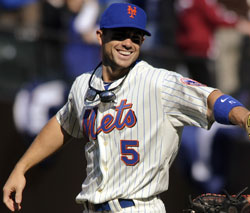 Wright was not there. Veteran columnists stood closest to his locker, looking entitled. They had been there the longest, like fans camped out for tickets to a rock show.
As the group grew, it grew restless.
“I’m closer to you than I ever get to my husband,” quipped one female reporter to the stranger she was pressed up against.
By 5:10 p.m, the crowd had at least doubled. Reporters jockeyed for position, subtly boxing one another out for prime placement in the scrum. A cameraman pulled over a step-stool for a clean shot of a guy who wasn’t even there yet.
And they waited.
“What is this, Paul O’Neill?” someone asked. No one has ever accused the New York media of patience.
Soon, Wright emerged from somewhere in Citi Field’s bowels. He walked the length of the clubhouse, negotiated his way through the crush of reporters, stood facing his locker for just a moment, and turned around.
Wherever Wright had been while the crowd waited, he wasn’t showering. His face was still marked with smudged eye black and he was still wearing his sweat-soaked undershirt. Maybe he was eating, or, who knows, lifting weights or watching film or whatever it is David Wright does when he’s not playing baseball.
Maybe he was preparing. Maybe he was conjuring up the words he’d use to downplay the home run he’d hit in his first at-bat of the year, at the park everyone said was in his head, after the toughest season of his big-league career. Maybe he was riding out the excitement from that moment, waiting until he could put on a brave face and go out and tell all the reporters it wasn’t too big a deal and pretend like he didn’t feel super f@#$ing awesome about it.
Because that’s just what he did. Soon after the cameras’ lights went on and he turned around to face them, Wright began repeatedly reminding everyone that Josh Johnson is good and hitting home runs is fun but the most important thing is that the Mets won the game, and that it’s only one game and they’ve got a long way to go.
It continued like that, some bizarre tango, reporters coming up with new and creative ways to ask Wright if there was anything special about the home run or the win, and Wright coming up with polite and respectful ways to tell them there wasn’t.
And maybe he believes that. Maybe Wright’s is not a guarded performance aimed at protecting himself from media spin, but a reasonable attempt to drop perspective on a horde that appeared to want none of it.
Wright’s right, after all. It was one home run, and it was one win, and Opening Day means no more in the standings than any of the other 161 games the Mets will play this season. It’s not farfetched to assume David Wright understands a thing or two about baseball.
Or maybe he was hiding something, not giving in, carefully avoiding anything that might make him seem boastful or unfocused or, heaven forbid, emotional.
In time, one by one, the cameras turned down and the journalists ducked away as they got what they needed, if maybe not quite all they hoped for, from the Mets’ young star.
All part of a day’s work, for everyone involved. They’ll dance again on Wednesday.
Something in John Harper’s column about Jorge Posada today caught my eye:
Molina, the Blue Jays’ backup this season, is one of the best in the game at such subtleties. Last season David Cone, the ex-Yankee pitcher and broadcaster, said of Molina, “I think he gets more borderline strikes for his pitchers because he’s so good at framing them than just about any catcher in the game.”
Reading it, I realized that with pitchFX data widely available and the sample of pitches even a backup catcher receives so great, this must be something that might be measured with some reasonable degree of accuracy.
And lo, it has. Two weeks ago, to be specific, by Bill Letson at Beyond the Boxscore.
The Internet rules.
And perhaps the real winner here? David Cone. By Letson’s comprehensive study, Jose Molina ranked first among all catchers who received at least 1000 pitches in framing pitches in 2008 and second in 2009. Good eye, Coney.
What’s more, the data seems to show that the difference between the best and worst catchers at framing pitchers could make a pretty significant impact on a team across the course of a season — as in multiple, perhaps even double-digit wins.
That seems nuts, I realize. Letson admits he has no way to separate the catchers in the study from the set of pitchers they’re receiving, and admits there’s work to be done in the study to see how it holds up over time. But it’s a remarkably thorough piece of analysis, much of which flies way over my head.
As for the guys on the Mets these days? Both Rod Barajas and Henry Blanco ranked out slightly above average in 2008 and 2009. Both Josh Thole and Omir Santos were slightly below in 2009. Thole was a bit worse than Santos, but still not as bad, according to the study, as a good number of more established Major League catchers like Gerald Laird, Kenji Johjima, Rob Johnson and Ryan Doumit.
Brian Schneider, incidentally, ranked ever-so-slightly below average in 2008 and 2009, closer to the middle of the pack than Thole and Santos. It will be interesting to see how he fares compared to the rest of the Phillies’ catchers in 2010 — it could be that he’s actually good at framing pitches but something about the movement of balls thrown by pitchers on the Mets’ staff made them difficult to frame.
Ted, after all the time you devoted to the concept, to have the roster miraculously shake out the way it has, I am surprised to see that you haven’t gone back to the concept of the 7 Nation Army.
Plus, I am not sure if you noticed, but during Dan Warthen’s visit to the mound in the 4th inning the organist actually played 7 Nation army (I immediately thought of your post and remembered that Tejada actually did make the team), and still no mention?
– Joaquin, via email.
That is an excellent point, and my bad. The Mets currently have players from seven sovereignties: the U.S., Dominican Republic, Venezuela, Japan, Canada, Mexico and Panama.
Until, presumably, Jose Reyes returns from the Disabled List and Ruben Tejada heads to the Minors, the Mets will battle as a 7 Nation Army. And if by some chance Cuban lefty Raul Valdes ends up with the big club, recently claimed Panamanian reliever Manny Acosta finds his way to Queens, or German-born Tobi Stoner winds up back with the Mets, they’ll again represent seven nations.
So here’s this. Sorry I didn’t bring it up sooner:
The 2010 Mets are undefeated. Alex Cora grittily took one for the team in the bottom of the first, then Luis Castillo avoided being doubled off at first base on a ground ball, then David Wright smacked a home run just inside the right-field foul pole to give the Mets a lead they would never relinquish in their 7-1 Opening Day win over the Marlins.
 Johan Santana held the powerful Florida lineup to four hits and one run over six innings, striking out five. Fernando Nieve tossed two shutout innings in relief, and the Mets tacked on a slew of late runs thanks in part to a Marlins club clearly working as a unit to make Dan Uggla feel better about his defensive inadequacy.
In the press box after the game, reporters — no kidding — compared the 2010 Mets to the 2009 Mets, and stressed how last year’s version never would have blown the game open in the sixth. They would’ve missed those opportunities. Apparently the 2009 Mets never played in strong wind.
Jerry Manuel was more realistic about the win.
“We’re out of the gate,” he said. “But we haven’t gone anywhere.”
Not technically true. The Mets are one percent of the way toward 100 wins and a sure ticket to the NLDS.
“We have to continue playing the game the right way,” said Santana. “Pitching, playing defense, and having the guys hit the ball.”
Yeah, that’s pretty much it. Pitching, playing defense, and hitting the ball are important elements of winning baseball. This is another important distinction between the 2010 Mets, to date, and last year’s squad. The 2009 Mets didn’t often pitch, play defense, or hit the ball.
Today — and at least until Wednesday — the Mets stand unblemished. A team that pitches, defends and hits.
And though someone — me, for example — could probably lament their bizarre batting order or flawed roster or warped set of organizational priorities, it seems like bad business as long as their record remains perfect.
 Tedquarters