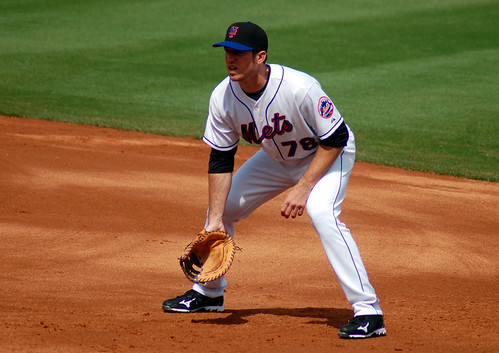
Watch out, world: Bengie Molina plays hardball

The Internet is atwitter with this report from Jesse Spector in the Daily News, in which Bengie Molina weighs in on what he feels happened between him and the Mets this offseason. Check it out:

“Right from the beginning, I told them, I said, ‘Hey, listen. You’re gonna have to give me two years at least, because that’s the only way I’m going over there.'”

Oooh, look out, world: Bengie Molina plays hardball. Unless you’re willing to commit more than one year to him, at 35, he’s just going to continue getting on base at a sub-.300 clip, being the worst baserunner in baseball, and impressing coaching staffs with nebulous leadership and staff-handling abilities in San Francisco, where he’s comfortable.

What’s hilarious about the article is that Molina accuses the Mets of not really being interested in him, and only pretending to have interest to show fans they were pursuing big-name free-agents like Bengie Molina. Molina doesn’t even consider the possibility that the Mets might have been smart enough to not want to sign a 35-year-old catcher who isn’t all that good to a two-year, multi-million dollar contract.

Just like, you know, all the other teams in the Majors that weren’t willing to meet Bengie Molina’s two-year contract demand. Namely all of them.

Since Molina, in the article, exposes himself as something of a jackass, I’m even happier that the Mets didn’t extend him that two-year contract offer. Plus, though Molina’s a better player than Rod Barajas, the Mets got Barajas at such a massively discounted rate — especially compared to the one it would have taken to land Molina — that the ultimate outcome was a decent one.

What’s funny, to me, is that the Giants’ biggest offseason need clearly should have been adding an offensive weapon. They posted a team OPS+ of 81 last year, falling just below Omir Santos’ 82.

They have, in catching prospect Buster Posey, an offensive weapon that appears nearly ready for prime time. Posey did spend most of 2009 in High-A ball, but hit .321 with a .391 on-base percentage and a .511 slugging in 151 plate appearances in Triple-A.

The fifth-overall pick in the 2008 draft and Baseball America’s No. 7 overall prospect might have represented the Giants’ best opportunity to improve their offense, but instead, they’ll again start the season with Molina behind the plate.

So though the Giants may have gotten Molina at a reasonable price, he might not actually improve their team much over the in-house alternative. He would have improved the Mets at that price, but likely wouldn’t have been a good deal at the price he was demanding of the Mets.

On Jose Reyes, this sucks

So Jose Reyes’ blood test yesterday revealed a thyroid imbalance and he is traveling to New York for further testing.

This sucks.

This sucks for the Mets, it sucks for Mets fans, and it sucks, most of all, for Jose Reyes.

I don’t know anything about any thyroid imbalance beyond goiter, but I know plenty about undergoing medical testing when you feel more or less healthy, and I can attest that it’s awful. You feel fine, but you’re treated like a sickly person. They put you in a paper-thin gown and poke and prod at you with their instruments, then talk about you in a lingo you don’t understand as if you’re not standing right there. It’s humiliating and terrifying. And yesterday, Jose Reyes thought he’d be playing baseball today.

Maybe this is nothing, and for all I know it’s minor enough that it can be easily treated with medicine or therapy or something and this will just be a tiny little blip on Reyes’ MVP-caliber season in 2010.

But it sure does suck right now, because everything about Reyes since Mets’ camp opened had been so glimmering, so overwhelmingly positive. And now once again, due to no fault of anyone in particular, Reyes’ health is a big foggy mystery.

Items of Note

The Amazin’ Avenue Annual is out. I’m going to get a print copy because I love seeing my name in print, but you can download it if you’re impatient. It’s really damn impressive.

A heroic Texas goat made a run for the Border, but was tranquilized by fascist Texan lawmen before he could even enjoy one taco.

Evidence of a snake that ate dinosaurs.

The Mets signed Kiko Calero. Kiko Calero is good.

Random notes on today’s game

I’m still busy with actual work, and I haven’t figured out exactly how I want to handle games and recaps on TedQuarters, so for now, another stream of consciousness.

I’m struggling to find the origins of the expression “barnburner” to refer to a high-scoring sporting event. The Internet isn’t much help, though the Wikipedia tells me a barnburner is a member of the radical faction of the New York state Democratic party in the 19th century.

Near as I can tell, the expression comes from the way a barn actually burns. What with all the hay and wood, those suckers really go up in flames once they catch.

That’s what happened here. This was a barnburner.The Mets beat the Cardinals, 17-11.

The wind was blowing out hard to right. David Wright and Gary Matthews Jr. hit homers that way that probably would have been contained in normal conditions in Citi. Shawn Bowman hit a double off the top of the wall in left that probably would’ve been a home run just about anywhere else.

The big shot came from Ike Davis, a grand slam in the top of the ninth. It went out to right field and the wind made it look ridiculous, but he crushed it nonetheless.

It’s worth noting, though, that the guy he Davis it off was Francisco Samuel, who had a 5.66 ERA in Double-A last year. Of course, it’s also worth noting that Samuel’s only real bugaboo has been the walk, and he’s yielded merely seven home runs in 162 Minor League innings.

Davis did make an error in the field on a hard-hit grounder right at him. Daniel Murphy made a slick play moving to his right.

I have to get a better, longer look at his face to judge, but I think Kirk Nieuwenhuis may look like a little like a younger, bigger version of Toby Hyde. Captain Kirk had an impressive at-bat off knuckleballer Charlie Zink, fouling off a slew of pitches with a 2-2 count before lining a single to center. He walked on four pitches in his second time up.

The Cardinals have a catcher named Matt Pagnozzi, Tom Pagnozzi’s nephew. The Cardinals should always have a catcher named Pagnozzi. I was in a band named “Pagnozzi” once, but on the way to our only gig we changed our name to “The Lewis Effect” for reasons I’m still not clear on.

R.A. Dickey’s knuckleball moves a lot faster than Zink’s, and a lot faster than most knuckleballs I’ve ever seen.

Sean Green is apparently still adjusting to the newer, lower arm slot.

Clint Everts’ breaking stuff moves a whole lot, but he didn’t appear to have a ton of control over it today.

The Mejia madness

I already weighed in on this once but it hasn’t quite gone away. Now Darryl Strawberry, too, has compared Mets’ top prospect Jenrry Mejia to Mariano Rivera and suggested he be given a place in the Major League bullpen post haste.

Everyone in the baseball world needs to agree to some giant pact to stop comparing people — especially 20-year-olds with 45 innings of experience beyond Single-A ball — to Mariano Rivera. Mariano Rivera is about the most dominant pitcher of all-time. Probably not the most valuable — that honor should go to a starter — but, inning for inning, the most dominant.

Check out the historical ERA+ leaderboard. Stare. Gape. Look at where Rivera is, then look at the pack.

Now tell me that some 20-year-old kid, an impressive prospect no doubt, compares somehow to Mariano Rivera. No one compares to Mariano Rivera. Mariano Rivera is incomparable.

Hey, guess what? Ike Davis is the next Lou Gehrig. Fernando Martinez? Babe Ruth.

And I know no one has quite said Mejia is the next Rivera, only compared their pitches. But the frustrating thing about the comparison, I guess, is that it would take Mejia becoming Rivera — or something close — for moving him to the bullpen to be a worthwhile decision.

Human, non-Rivera closers aren’t worth nearly as much as good or great starting pitchers. And if Mejia’s stuff is electric as everyone seems to say it is, and his arm is strong and the Mets are careful with him, he has a chance to be a front-of-the-rotation Major League starter in a couple of years.

But to do that — and I touched on this the last time around — he’ll have to develop his secondary stuff. And he won’t have that opportunity relying mostly on his cutting fastball in a Major League bullpen. Plus, spending a season in the bullpen would prevent Mejia from approaching an innings target above the 109 he threw between the Minors and the Arizona Fall League in 2009. That complicates a transition to a starting role down the road.

You can point to recent examples of now-successful starting pitchers who broke into the Majors as relievers, like Johan Santana and Adam Wainwright, but the situations are not the same. Wainwright had excellent breaking stuff in 2006 and enough confidence in it to throw it in big spots — Mets fans know that all too well.

Santana spent 2000 mostly getting torched in the Twins’ bullpen because he had been a Rule 5 draft pick. He didn’t become the Johan Santana we know until 2002, after a stint in the Minors. From the Wikipedia:

In 2002, the Twins sent Santana to the minors for 2 months to work almost exclusively on perfecting his changeup. He did this for 10 starts and came back up to the majors with a terrific changeup to complement his very good fastball. While in the minors, pitching coach Bobby Cuellar made Santana throw at least one changeup to every batter. According to Cuellar, Santana would sometimes throw 20 in a row during games.

You can’t throw 20 changeups in a row in Major League games. It would be very, very bad.

Naturally, Mejia is not Santana, just like he’s not Wainwright and he’s not Rivera and he’s not Doc Gooden, either. I’m as excited as everyone else is about his potential, which is why I’m hoping that, for once, the Mets can be patient and allow his ability to match his hype before they elevate him to the big-league level.

Johan Santana doing stuff

Y’all know I don’t spend too much time shilling for SNY programming here, but this is awesome. The picture of young Johan with Clark Kent glasses alone makes it worth watching.

The show, Going Home: Johan Santana airs tonight at 9:30 p.m.

Santana comes from Tovar, Venezuela, a small coffee-growing town in the Andes, but descended from the mountains to share his awesomeness with the world.

Some of the people working on the show happen to sit right near me here, so I’ve seen a bunch of it. It features a whole lot of Johan Santana doing stuff, and talking about himself doing stuff, and so is predictably amazing.


Items of note

Good news: Blood-spinning therapy is no longer controversial, plus this Daily News article contains a description of the World Anti-Doping Agency’s concerns about the treatment. Good job by them. My only complaint is that WADA is no longer headed by Dick Pound.

Alex Eisenberg from Baseball-Intellect.com drops by Amazin’ Avenue to break down Ike Davis’ swing. I love reading this stuff, and Alex does a nice job putting it all in digestible terms.

Speaking of Amazin’ Avenue, I got a sneak preview of the Amazin’ Avenue Annual. It’s, well, amazin’. I wrote a piece for it, but there’s nothing in there that’ll be new to TedQuarters readers. It’s the rest of it you should check out. It’s super long so I haven’t even scratched the surface yet, but it looks to be awesome.

I’m beginning to fear that Lost sucks now.

Shaq talking about art

I got kinda busy today and didn’t get to fully transcribe the stuff from Shaq’s media event at his art exhibition yesterday. (Shaq, for a variety of a reasons, is a difficult man to mic, which makes transcription difficult.)

Anyway, in the meantime, enjoy this brief iPhone video of Shaq talking about art. You’ll have to turn the volume way up:


Keanu Reeves completely owned by Tone Loc, Darryl Strawberry in the name of Sammy Hagar

YouTube is incredible. I found this video today, from the 1990 MTV Rock N’ Jock softball game. It features Bud Bundy, for one thing, plus Keanu Reeves back when he was just “Keanu Reeves, from Bill and Ted’s Excellent Adventure.

We don’t see it, but we’re told that Tone Loc picks off Reeves at first base. But earlier in the video, we see Tone Loc playing catcher, so I can only assume that Tone Loc picked off Keanu Reeves by throwing behind the runner at first, a very aggressive move for any backstop, no less one playing in a celebrity softball game.

So good for Tone Loc for further confirming his own awesomeness. I’m sure manager Sammy Hagar was proud.

The highlight of the clip comes when Darryl Strawberry rips an inside-the-park home run past a diving Reeves, who took a downright terrible route to the ball.

Mashing for history

In the comments section for a Jeff Francoeur post on Monday, Brian wrote, “If he hits .300 and slugs .500 I won’t give a damn if his OBP is also .300.”

I happen to disagree — the problem with OPS is that it overvalues slugging percentage relative to on-base percentage, and on-base percentage plays a greater role in helping a team score runs. This is why more OBP-driven stats like wOBA have come into vogue, and a nice overview of the principles distinguishing wOBA from OBP and OPS can be found here.

Regardless, Brian’s comment intrigued me, because it struck me that slugging over .500 with a .300 on-base percentage is probably difficult to do. After all, as I’ve written — and plenty of people have written before me — if you expose to the world that you’re willing to swing at so many pitches, you’re unlikely to see a whole lot of pitches to drive.

So I consulted the incredible — and totally worth the price of subscription — baseball-reference play index to see how often it had been done.

Thrice. At least with the plate appearances to qualify for the batting title since 1901. And one of the guys who did it was a Met, and one of the guys who did it is currently a Met:

Rk Player Year OBP SLG Age Tm
1 Dave Kingman 1976 .286 .506 27 NYM
2 Tony Armas 1984 .300 .531 30 BOS
3 Mike Jacobs 2008 .299 .514 27 FLA
Provided by Baseball-Reference.com: View Play Index Tool Used
Generated 3/3/2010.

Plus, as Twitterer OldBiscuitPants (one of my favorite Twitter handles and old baseball nicknames, FWIW) points out, Armas actually posted an OBP ever-so-slightly above .300 in 1984: .30044.

So, to Brian’s comment, if Francoeur manages to slug .500 with an OBP at or below .300, it’s probably worth giving a damn, because we’d be witnessing something exceptionally rare in the annals of baseball history.

Almost certainly not a good rare thing, mind you, but something I’m sure would be entertaining as hell to behold.