
Things to remember about Fernando Martinez

Fernando Martinez spoke to Jesse Sanchez of MLB.com at the Caribbean Series, and some of his comments lit the Mets blogosphere on fire:

“When [Carlos] Beltran had surgery, I thought I had a chance, and maybe they would give me a chance at center,” Martinez said. “But they get [Gary] Matthews Jr., and now I’m not sure where I am. I just can’t give up.”

“I know I’m a big league player, and I can perform at a high level,” Martinez said. “It’s in my hands, so I have to keep working hard and maybe earn a spot. Maybe I make it to the big leagues with the Mets or maybe another team, but I know I can do it. I just have to keep working and waiting for my opportunity.”

I’m not going to read too much into the quotes, because they read to me like, pretty simply, a confident 21-year-old speaking honestly about his situation. Would anyone prefer it if Fernando Martinez was all, “Did you see me last year? I suck! I don’t deserve to be anywhere near the big-league roster”?

Judging from Mets fan reaction, it seems like many see the comments as just that — appropriate confidence — while others have used them to deem him “the next Lastings Milledge” and other such expletives.

Either way, here are a couple of important things to remember about Fernando Martinez:

He’s still very, very young: We’ve been hearing about him forever, so it feels like it’s put-up-or-shut-up time for the outfielder. But in truth, Martinez was the youngest position player in the Majors in his stint last season, and has been the youngest or among the youngest at his level in every one of his Minor League campaigns. I’d guess a big part of the reason he hasn’t put up huge numbers on the farm is that the Mets have — for better or worse — promoted him so aggressively. A .772 OPS in Double-A, like Martinez posted in 2008, is nothing to write home about. It is for a 19-year-old, though. As John Sickels has pointed out, Martinez would have been a college sophomore last year.

100 Major League plate appearances are not an adequate sample: Sample size. Sample size, sample size, sample size. Now I’m not saying Martinez is certainly ready to produce at the big-league level, but his failures there in 2009 should not be taken to mean much of anything. They’re not a good sign, granted, but they fell so far below his expected Major League equivalency that it’s almost certain he would’ve picked it up at the plate with a little more experience.

Clearly, the biggest concern with the Fernanchise is his inability to stay healthy to this point in his career, not only because it could be a harbinger of more injuries to come, but because, as Keith Law (subscriber-only) points out, it may have already hindered his development by limiting his at-bats.

And I’m not arguing that Martinez shouldn’t spend more time in Triple-A. He almost certainly should. Plus, I’m not sure why I’m bothering to argue against the small contingent of Mets fans who seem to have given up on the guy when I know that, if and when he starts putting up Minor League numbers again, everyone will go back to overrating him as a prospect — as is customary.

But it’s a slow news day and I sometimes feel like I’m the last guy in New York still excited about the kid’s chances. And I’m psyched that, in an offseason that was practically begging the Mets to go out and trade a bunch of prospects in some myopic move, they didn’t.

“Taco Bell Skills Challenge” entirely misleading

The NBA posted a press release yesterday about its annual “Taco Bell Skills Challenge,” which will feature Derrick Rose, Brandon Jennings, Steve Nash and Deron Williams:

The Taco Bell Skills Challenge was introduced at NBA All-Star 2003 in Atlanta and features four players competing in a two-round timed “obstacle course” consisting of dribbling, passing and shooting stations. All players must observe basic NBA ball-handling rules while completing the course.

Wait a second — those aren’t Taco Bell skills at all. Those are just basketball skills. If they wanted to make it a Taco Bell/basketball hybrid skills challenge, that might be cool, because it’d be fun to watch Steve Nash try to dribble while eating a taco. But as it stands, calling this ball-handling contest a “Taco Bell Skills Challenge” is entirely misleading.

I would like to challenge these four men — and any other comers — to an actual Taco Bell skills competition. The events could include Fire Sauce application, cleanly eating, efficient drive-thru ordering, and spork manipulation. As a tiebreaker, we could each order nachos and see who could best ration the amount of cheese per tortilla chip.

Dammit, now I want Taco Bell.

Items of note

You ever have it where you don’t really give someone or something much thought for several years, and then it randomly comes up multiple times in the course of a week for a variety of reasons? I’m having that with John Starks right now.

Rich Aurilia wants to play in New York. That’s gotta be burning Brian Sabean up.

How this article can fail to mention Prince is beyond me. I know it’s not “list of most awesome Super Bowl halftime shows, in order,” but all discussions of Super Bowl halftime shows should start and end with Prince. Prince rules.

Darryl Strawberry says the Mets need more pitching, the loss of Carlos Beltran will sting, and that he would have used steroids if they were more available when he played. Darryl Strawberry is an honest man.

BREAKING NEWS: Pascucci returns

According to BA’s prospect blog, the Mets have signed Val Pascucci to a Minor League deal.

Hat tip to the great Nate Freiberg and Bobby Valentine in the comments section for the heads up.

Nate is, I should mention, the person who first tipped me off to Pascucci’s existence in the first place, long before he ever signed on with the Mets.

Boss, if you’ll recall, is a large, right-handed three-true-outcomes masher that plays first base and the outfield corners. He earned folk-hero status among certain Mets fans — mostly me and John Peterson of Blastings! Thrilledge fame — by dominating Triple-A pitching in 2008 while the Mets were carrying Marlon Anderson as a bench “bat” all season.

By most accounts, he’s not much of a fielder, and since most of the higher-ups in the Mets organization didn’t seem to even bother learning his name the last time around, I can’t imagine he’ll see any time on the Major League roster in this one. But he’ll put asses in seats in Buffalo, for sure, and should he hit well enough and the Mets carry enough dead weight on the 25-man roster — spoiler alert: it’s a reasonable bet — you can bet I’ll be banging that drum again.

Pascucci endured a down year with Padres’ and Dodgers’ PCL teams in 2009, posting a .793 OPS for the season. But at 31, he’s probably not quite declining yet, and it’s reasonable to expect him to return toward his career Triple-A mean, an impressive .906 mark.

Also, when I tracked him down for a phone interview back in 2008, Pascucci tipped me off to this, a Japanese baseball cheer in his honor. So he’s got that going for him, which is nice:

Excellent players signed to reasonable contracts are the new market inefficiency

Market inefficiency is the new black.

Moneyball, despite what Murray Chass thinks, was not about VORP. It was about one general manager identifying a widespread anomaly in baseball’s marketplace and exploiting it. At the time, players with high on-base percentages were not paid in accordance with the way they helped their teams win, so Billy Beane stockpiled them for his Oakland A’s.
Today, now that the value of OBP is more widely recognized, everyone’s searching for the new market inefficiency. This offseason alone, I’ve read how older players are a market inefficiency and how versatile players are a market inefficiency. And though players who rated well on defense were recently considered another market inefficiency, Ken Davidoff reported earlier this offseason that some baseball people now felt they were being overvalued.

I’m confused. And I’m beginning to wonder if, in a post-Moneyball world with so many analysts and bloggers and GMs out to find the new market inefficiency, it isn’t increasingly difficult for that single marketwide inefficiency to actually develop.

Now I can’t purport to know exactly how baseball teams operated before Moneyball, or, heck, even now. But the book sure made it seem like nearly all the Major League teams were zigging and Beane was zagging, and that’s what allowed him to take advantage.

Clearly that is no longer the case. Beane’s proteges and advocates of advanced metrics have spread throughout the league, and many are working, just like we are, to identify the best way to help their club win at the most reasonable cost. In other words, it’s a lot harder to practice moneyball now that everyone’s read Moneyball.

That’s my guess, at least.

Which is not to say it’s impossible to find a particular team that overvalues or undervalues a particular asset and exploit it. The Mets — at least according to Omar Minaya — seem to think Gary Matthews Jr. still has something to offer defensively, whereas any team with access to Fangraphs would likely disagree. So bully for the Angels for taking advantage of that, and getting what appears to be an anomalous return for their sunk cost.

Nor is it to say a team can’t find a great value on a free agent past his prime. They can, of course. But it has to be a good free agent past his prime, and one likely to return more value to his club than he’s compensated for. And there aren’t exactly a ton of those players flopping around. If simply stocking up on old guys made you a shrewd baseball economist, Michael Lewis would have written a book about Brian Sabean by now.

Same goes for versatile players that can allow a team to make better use of their available roster spots. If they’re good and available at reasonable rates, they can be immensely valuable to a team. If they’re Joe McEwing, they aren’t.

So it strikes me as too easy to say one type of player or another represents a new market inefficiency, or at the very least overstated. For an inefficiency to truly develop, the bulk of teams would have to be undervaluing a particular, measurable skill, and neither old age nor versatility is necessarily that, nor is it clear that most Major League clubs are ignoring those types of players.

It’s entirely possible, even in this day and age, that some aspect of winning baseball is being undervalued and that someone will be able to take advantage of it, but it appears from this angle like the best way to operate is trying to identify the bargains on a case-by-case basis rather than pursuing some elusive, overarching secret key to success.

Culture Jammin’: Lost

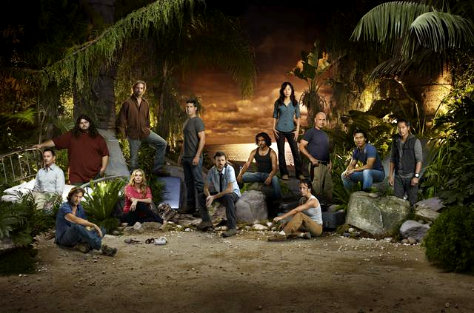
The show Lost starts up again tonight. I’m psyched.

For a while, that wasn’t necessarily the case. This will be the final season of the show — a longform mystery rooted in dime-store philosophy and science fiction — and after the end of the last season, I feared the show’s myriad still-unanswered questions could be answered in some manner I wouldn’t find satisfying.

Nothing that’s happened in the interim has quieted that concern. I’m still a little put off by the fact that the mysterious Jacob — a powerful character we’d only been hearing about in vague terms until the Season 5 finale — turned out to be just some J. Crew-model-looking dude and not one of the characters we already knew locked up in some bizarre time-warp trap, as I had previously guessed.

It felt like a cop out, and made me skeptical about the promise made by the show’s writers since the first season that they knew exactly what was going on with the Island and had an endgame in mind.

I used to think about how mad I’d be if the ending sucked. I’d joke about a lifetime protest of ABC programming, or an angry letter-writing campaign, or worse. I thought that if the show didn’t come to a satisfying conclusion, it would mean all the time I’ve spent thinking about it would amount to time wasted.

But at some point, I realized that regardless of what happens this final season, the enjoyment I’ve derived from the show so far is real. For all I know, the writers have had no plan in mind whatsoever, but they were at least good enough to make me believe they did.

And the show has been, to this point, good enough to make me consider massive real-life questions of faith and science, free will and destiny, and the awesome implications of time travel.

And it’s got a whole lot of hot people running around on the beach without a lot of clothes on.

Hilariously, and perhaps ironically, Lost demands faith from its audience while depicting characters repeatedly rebuked for the same quality. So sometimes I wonder if the ending will be something intentionally dumb, just to show us what we get for all our faith, because sweeping, tragic irony is a big part of what Lost is all about.

And yeah, I realize that would then mean we should have had faith in the producers all along, but, well, messing with people’s heads is the main thing that Lost is all about.

I’m kidding, obviously, and I’m flying off the rails here. Whatever, I’m excited. Forgive me for being an annoying Lost fan. Here’s The Onion, featuring SNY.tv’s own Brittany Umar as Bree Lindsay, on the matter:


Final Season Of ‘Lost’ Promises To Make Fans More Annoying Than Ever

This Putz thing

I’m still trying to process this whole J.J. Putz thing.

The Mets’ much-heralded eighth-inning guy who wasn’t, the dude for whom they traded a slew of young players, came out yesterday and said that the Mets never gave him a physical immediately after the trade, despite the bone spur in his elbow that hampered his 2008 season. Putz called the exam he received during Spring Training “a formality,” and insisted that the Mets convinced him to pitch through pain rather than undergoing surgery recommended by Dr. David Altcheck.
The Mets, in turn, released this statement:

In our review of the player’s medical records in the acquisition of J.J. Putz, we were aware that he had a bone spur before the trade.  He had the same condition in 2008 and was able to pitch with it.  J.J. underwent an exam during Spring Training and an additional exam and MRI before he was cleared to play in last year’s World Baseball Classic.  Unfortunately the spur did flare up again in May, and he missed the rest of the season.

OK. For what it’s worth, Putz did spend time on the disabled list in 2008 with an injury in the elbow, probably the type of thing worth checking out when giving up so many players. But to the Mets’ credit, Putz did pitch pretty well after returning from the injury in late July, so most likely the Mets were guilty, once again, of looking only at the bright side.

It’s worth noting that Putz stands only to gain by throwing the Mets under the bus now. The Amazins have become league-wide whipping boys, so blaming the team for his struggles in 2009 is probably a pretty easy way for Putz to put his best foot forward for his new fanbase in Chicago.

After all, if Putz was in so much pain, why’d he agree to pitch in the World Baseball Classic?

Still, it’s hard to give the Mets the benefit of the doubt in the situation, since everything Putz says seems to jive with everything else we’ve heard about the way the Mets handled injuries last season.

More of the same. It’s Groundhog Day.

Anyway, while it’s certainly bad, it’s also certainly last year’s issue. It reflects poorly on Mets management, for sure, but just about everything from last season already reflects poorly on Mets management. As Matt Cerrone just pointed out to me, the real concern will be when this keeps happening, now that they’ve promised to make changes.

Still, that Putz was injured — and that the Mets knew he was injured — at the time of the deal only thrusts that trade upward in the ranks of epic Omar Minaya failures. Few criticized the deal at the time — I was ambivalent — but the most valuable cog the Mets ultimately got out of the trade was Sean Green.

And — and I’m not sure if the credit should go to Seattle’s scouting or Seattle’s good fortune here — one of the Minor Leaguers the Mets gave up in the deal, Ezequiel Carrera, emerged as a prospect. The outfielder posted a .441 on-base percentage at Double-A last year, and could be better than Gary Matthews Jr. right now.

Items of note

Criticism of Stephon Marbury’s debut in China: He was too unselfish.

“If bees did that, I’d fall off my chair.”

Jose Reyes is running healthy, to the sweet sounds of cheesy stock-music metal. He’s also striking a tractor tire with a sledgehammer, which is massively important.

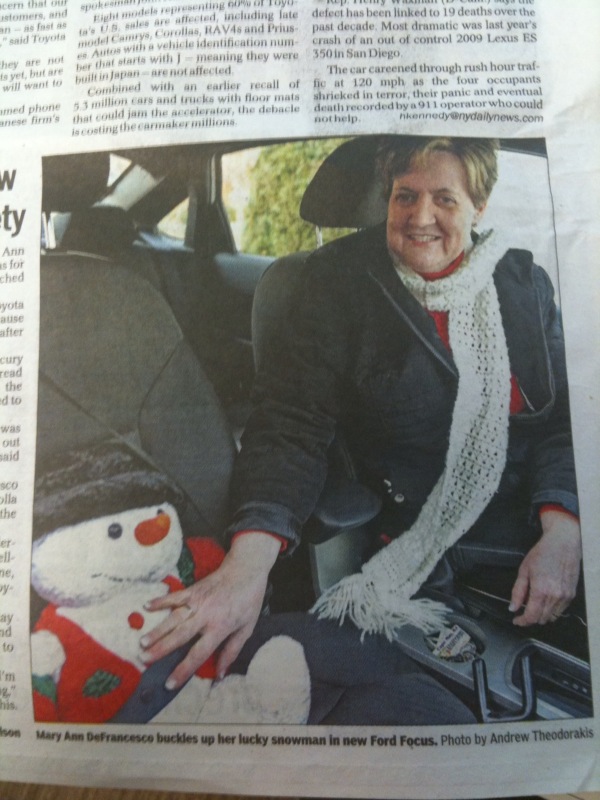
The snowman lady from the Daily News last week is back, but for some reason the online story doesn’t include the same picture as the print edition. Luckily, my phone has a camera. This one gives an explanation, though: It’s “her lucky snowman.” Note that this is not even the same car — she’s taken her snowman to the new car she got as a result of the original Daily News piece. Actually, now I kind of feel bad making fun of her. Well, whatever. Here it is:

Covering every angle of Rex Ryan’s finger

SNY.tv has you totally covered on The Great Rex Ryan Middle Finger Incident of 2010, and I’d be remiss if I covered a full day of middle-finger related items without linking to Mike Salfino’s excellent take on the matter:

You suffer with your fans and customers when you conduct yourself privately in a way that is opposite of your public persona. Think Tiger Woods. Rex’s public persona, though, is exactly that of a guy who will give it back to you if you get in his grill and hurl obscenities at him. He’s not selling himself as some moral disciplinarian. If Tom Coughlin did this, there would be hell to pay for him and the Giants. Plus, the Giants are selling class and pedigree — blue blood as much as Big Blue.

Mike determines — accurately, I think — that Rex is basically a Jets fan like the rest of us. A big, brash, New Jersey guy (a transplant, granted, but clearly with a New Jersey-guy attitude) that everyone expects and wants to flip the bird to Dolphins fans that taunt him.

Good.

So in conclusion, Rex Ryan is still awesome and flipping people off is still funny, and I’m not really sure why anybody would get broken up about it. Blah, blah, blah, he’s a public figure, he needs to concern himself with his appearance. Whatever. If he were concerned with his appearance, he probably wouldn’t eat 7000 calories a day. Rex Ryan’s got your public appearance right here, buddy.

From the Wikipedia: The finger

Hilariously, the finger — as in the middle finger, the bird, the flip-off — has its own Wikipedia page. And it’s your day, the finger.

From the Wikipedia: The finger.

You already knew that the finger is an obscene gesture created by showing the back of the hand while extending only the middle finger upwards, and that it often connotes the phrase, “up yours.”

What you probably didn’t know is that the tradition dates back to ancient Greece, and was known as — no joke — digitus impudicus, or “impudent finger” in Roman times.

The Wikipedia speculates that the use of the finger started as a threat, since the middle finger was an archer’s bow-plucking finger, and so extending the middle finger was really just the middle-ages version of the Gilbert Arenas trigger-thumb.

The entry also includes a rundown of similarly obscene hand gestures in other cultures, which is a handy thing to know if you’re traveling. For example, DO NOT flash the two-finger, back of the hand V-sign to people in most other English-speaking countries, because they do not think it means “peace.” This means you, Justin Bieber.

What the Wikipedia does not include, unfortunately, is a list of popular middle-finger delivery styles.

So I’ll provide a few on my own. If anyone wants to add these to the Wikipedia, you know, go to town.

1.) The “Right Here, Buddy”: This is the method Rex Ryan chose, and probably the most widely used variety of the middle finger. It is by nature dismissive, as if to suggest that the provider has something to lord over its recipient. In Ryan’s case, it almost certainly came in response to some heckling, as if to say, “I got your fat joke right here, buddy. I just coached a team to the AFC Championship, and I’m about to eat more bacon than you can possibly conceive.”

2.) The Maniacal Double: This is my favorite, especially while driving. I think in New York the finger gets bandied about so liberally that it almost loses its meaning, so I like to bring it back by adding a little flair. Next time someone cuts you off or does some bad-driving move that prompts your road rage, drive up next to them, widen your eyes as far as they’ll go, and wave both middle fingers around in the air at them. The driver will almost certainly be terrified enough to think twice next time he or she is about to do something stupid and/or dangerous on the road.

NOTE: It is crucial that your tires be properly aligned before you attempt the Maniacal Double. And yes, I know that it is hypocritical to respond to a dangerous or dumb instance of driving with something at least as dangerous and dumb. But wait ’til you see the look on that guy’s face.

3.) The Clever Guy: This category includes all middle-finger techniques popular in late elementary school, including holding up the index, middle and ring fingers and instructing recipients to “read between the lines” and pretending your hand has a little crank attached to it and using your off hand to ratchet up the middle finger. These methods were hilarious in elementary school, but have lost their luster with time. Avoid these methods.

4.) The Emphatic Thrust-Bird: OK, I just made that name up (which I guess makes sense, since I’m making all these up). But sometimes you really, really need to give someone the finger, and you’re concerned that the regular old finger just isn’t strong enough. That’s what this is for. It’s actually a combination of two-to-three obscene gestures, depending on your definition of obscenity, and it really drives home how emphatically you want to let the recipient know how you feel.

Here’s what you do: Keep both feet planted with your weight distributed evenly and knees slightly bent. With your left hand, slap your right bicep as you swing your right hand up, simultaneously extending your middle finger. This combines the classic French bras d’honneur — recognizable from Spaceballs, of course — with the time-honored middle finger. As you’re doing it, ever so slightly thrust your pelvis forward. That’ll show ’em.