
Reese’s piece

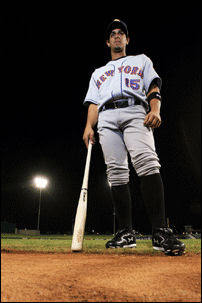
Toby Hyde, just returned from a trip to the Arizona Fall League, provides a great scouting report with video on Mets’ prospect Reese Havens. He writes:

The game film validates, to some degree, the power he showed in St. Lucie, and his approach was plenty patient.   Add a few more singles to his batting average in the FSL (where he struck out just 73 times in 97 games) and his .247/.361/.422 line would look a lot better.   I wouldn’t be the least bit surprised to see Havens hittin .280/.380/.450 by July of next year for AA Binghamton.

Havens will likely continue his transition from shortstop to second base with the B-Mets this year, under the watchful eye (or maybe the watchful shimmying hips) of Timmy Teufel.

If you recall, Havens was a guy expected to move quickly through the Mets’ system when they drafted him in 2008. On paper, his stats with Port St. Lucie in 2009 weren’t overwhelming, but it’s important to keep in mind that the Florida State League is generally considered a pitcher-friendly one.

According to MinorLeagueSplits.com, Havens’ line, when neutralized for park and luck, becomes a much more impressive .280/.387/.465, far more in keeping with the one Toby predicts for him at Double-A.

I’m far from sold on Havens, but his plate discipline and power — even at a low level — are promising signs. If he can continue progressing and successfully make the positional switch, he could be ready for regular play at Citi at some point in the 2011 season.

That’s a long way off, but it’s an important factor to consider while rumors abound about the Mets dealing Luis Castillo and signing Orlando Hudson to a multi-year deal.

Havens almost certainly won’t help the Mets in 2010 and it’s  silly to plan the team around a guy who’s still a couple of years away. The Mets will have a much more accurate sense of Havens’ longterm value to the team after he faces higher-level competition this season, though, so it might be imprudent to sign any second baseman on the backside of his prime for multiple years when they could have — in either Havens or Ruben Tejada — a good, inexpensive, young, homegrown solution ready midway through that player’s contract.

Again, if I was certain the Mets could compete in 2010, I’d be all about finding an upgrade over Castillo. But that’s not really the ticket to building a sustainable winner, and since the Mets frequently demonstrate no willingness to move on from sunk costs, it’d be a shame to see a guy occupy precious payroll and a starting spot just because the team made a misguided attempt to win immediately.

One quick note on Toby, for what it’s worth: He’s an excellent guy and does a tremendous job, plus he recognizes how I’m killing it, but he might be a vampire. We e-mail with some frequency, and I’m not certain I’ve ever received a message from him that didn’t arrive between 2 a.m. and 5 a.m.

The Ted Quarter

Reader, budding stop-motion animator and TedQuarters artist-in-residence AJ admittedly has a lot of time on his hands, but he’s making the best possible use of it.

His latest masterpiece, the Ted Quarter:

tq

That mustache picture, familiar from the header of my Flushing Fussing column, is a bit controversial around here. Some of my co-workers feel I shouldn’t use it anymore, because it makes me look like a 45-year-old weirdo instead of a 28-year-old weirdo.

The conversation usually goes like this:

“You shouldn’t use that mustache headshot anymore.”

“Why? It’s me with a hilarious mustache.”

“But it misrepresents you. It makes you look like a pervert.”

“Maybe, but a pervert with an awesome mustache.”

In truth, I can’t even grow a mustache. It’s massively ironic. My beard grows quickly, but under the nose I just get a few lame, stringy hairs.

I used the fake mustache in the picture above because when I started writing for SNY.tv, I looked about 16 years old (I was 25) and my editor didn’t think anyone would be interested in a teenager’s baseball analysis. I happen to disagree, but I recognized it as a fine opportunity to use one of my impressive collection of fake mustaches.

On Iverson

I mentioned yesterday that I would watch the Knicks way more if Allen Iverson was on the team. I suppose I should note that I would watch Allen Iverson do pretty much anything.

I feel that way about a couple other athletes, but usually they’re the ones who are epically great, guys like Albert Pujols and Michael Jordan who are tremendous in stature both physically and metaphorically.

Iverson is different. Iverson’s appeal is more akin to Carlos Beltran’s. Both great players, no doubt, but not legends like their contemporaries. They’re athletes whose appeal is bolstered by some kind of palpable aesthetic cohesiveness.

Beltran’s, I would say, is grace. Every part of his game is elegant and smooth, there are no hiccups or excess movements.

Iverson’s is something else entirely. Watching him, and actually considering the moves he’s making, you’d think he should look awkward, herky-jerky. I don’t know that I’ve ever seen another NBA player spend so much time stumbling.

But there’s a fluidity to Iverson’s game that creates some unified sense of style, and one that’s difficult to define.

It’s like he’s mastered the rhythm of basketball. When you think about it, I guess, that’s really the nature of his game: He knows exactly when everyone else on the court expects something to happen, and exploits it to his advantage. That’s how he pulls off the crossover dribble into the jumper, or the improvisational layup, or the takeaway at halfcourt.

It’s all about timing, I suppose, and that’s nothing new. Iverson just toys with it so perfectly. It’s like bebop, intentionally awkward and disarming, but inarguably poetic.

You can even see it in that thing he’s probably, and pathetically, most famous for — “We talkin’ about practice.” Was there anything so outlandish about what Iverson said there? Not really. It’s the way he said it — the rhythm of it, the repetition, the weird pauses and stutters — that made it so entertaining.

It’s the same stuff that makes him so awesome to watch, even now past his prime.

I have the utmost respect for what Donnie Walsh is trying to do with the Knicks. It takes a whole lot of chutzpah to maintain a patient approach to building a team in a city with such demanding fans and media.

But Iverson wouldn’t jeopardize that at all, not signed to a one-year deal. He’d simply be a diversion, a reason to watch the Knicks now while we all sit around and wait to find out what happens with LeBron.

Items of note

Ben Shpigel reports that Omar Minaya is planning a visit to Puerto Rico to scout Carlos Delgado. I understand the thought process — Delgado could be had on the cheap and serve as a nice one-year stopgap for Ike Davis — but I’d rather see Murphy get more at-bats to show what he can or can’t do. Would a healthy Delgado be better than Murphy? Almost certainly, but Murphy could be a much bigger part of the team’s future.

The Brooklyn Cyclones introduced Wally Backman as their manager yesterday, prompting John Harper to speculate about whether Backman could replace Jerry Manuel, and also write this maddening sentence:

He was never afraid to get in the face of a teammate, once even calling out Darryl Strawberry for missing games because of hangovers disguised as sick days, so if anybody is going to tell Carlos Beltran he’d better slide next time, it would likely be Backman.

IAHFSKLJH%^#&%#$&#$&$*!!!. I won’t even start.

ESPN aired 24 hours of college hoops yesterday, and friend of TedQuarters Howard Megdal stayed up for the whole thing. Georgetown beat Temple in one of the ugliest offensive games I’ve ever seen, 46-45.

Let he who has not gotten liquored up and fancied himself a ninja cast the first stone.

Anonymous sources say the darndest things

James Kannengeiser at Amazin’ Avenue, obviously as giddy as I am about the Georgetown hoops game that starts at 4 p.m. today, posted a pretty amazing rundown of things he heard from his anonymous sources.

My favorites:

– My anonymous sources are familiar with the thinking of people who have knowledge of a league official’s inside man.

– My anonymous sources are trying to find the words to describe Bengie Molina without being too disrespectful.

He included a few from my Twitter feed, which I appreciate, though I should note that I completely stole the idea to tweet about anonymous sources from James’ Twitter feed.

Anyway, here’s some more undeniable insight from the MLB Hot Stove, courtesy of my giant network of baseball insiders:

– According to a person familiar with the Cubs’ thinking, it doesn’t happen very often.

– An MLB insider close to Brian Sabean says he has terrible B.O.

– A well-placed source with connections to the Mets organization says, “I’m Keith Hernandez.”

– According to a Yankees insider, Brian Cashman has suggested to ownership that the team trade Derek Jeter, and even maintained a straight face for about 10 seconds before cracking up.

– According to a Japanese baseball expert, Hideki Matsui 大人のビデオの印象的なコレクションを持っている。

– An anonymous MLB source tells me he was just speculating, and that it was really irresponsible of me to spin that into an entire column.

Art Attack: The Berg Manifesto

Little-known fact: I did my master’s studies in Arts and Humanities, an interdisciplinary arts program I began immediately after giving up my dream of a career in sports journalism. I had no solid plan in mind for turning it into an actual job, but it seemed like — and was — a damn fine excuse to move out of my parents’ house, meet interesting people, and learn a whole lot about a bunch of different stuff I found interesting.

It was through my coursework there that I developed my still-unfinished plan for Dawn of the Awesome, the art manifesto aimed to foster appreciation for the spectacular and unsubtle, one I detailed in greater length in July.

Anyway, to better utilize my long-dormant arts background and to forward awareness of my art movement, Awesomeism, I’m starting a new non-sports feature on this blog in the vain of From the Wikipedia and Culture Jammin’: Art Attack.

The debut Art Attack installment: The Berg Manifesto

The Berg manifesto, amazingly, was not written by me. In fact, unbelievably, it’s not even about me. It’s about The Berg, a proposed 1,000-meter tall manmade mountain for Berlin, Germany by architect Jakob Tigges.

The Berg would stand about 1,000 feet taller than any other currently extant man-made structure, a literal mountain of unapologetic Awesomeness right in the heart of Berlin.

Oh, and it’d be great for skiing, apparently. And a safe haven for mountain goats, too.

Needless to say, this has to get done. Naysayers in the Popular Science comments section say things like, “oh, it’ll affect the weather.” Damn right it’ll affect the weather! It’s a f@#$ing mountain! You think people haven’t been living beside huge awesome mountains since the dawn of civilization? Think of the goats, guy!

A bunch of others bring up more practical applications for the money that would need to finance the Berg, and one even says, “Just because we can do something, does not mean that we should.”

What? No! That’s exactly why we should do something. Do you even understand the fundamental tenets of Awesomeism? Sometimes tremendous and awesome things don’t need a reason. That’s the whole point.

This absolutely needs to happen. It’d be, at the very least, the most certain way the city of Berlin could earn my tourist dollar, not to mention my utmost respect.

Still, because people somehow doubt that this would be a good idea, proponents of the mountain have penned The Berg Manifesto. And to make it even more awesome, it’s all loaded up with Schadenfreude:

Hamburg, as stiff as fat, turns green with envy, rich and once proud Munich starts to feel ashamed of its distant Alp-panorama and planners of the Middle-East, experienced in taking the spell off any kind of architectural utopia immediately design authentic copies of the iconic Berlin-Mountain.

Suck it down, Hamburg! You too, Munich! Yield to our ridiculous homemade mountain! Do you have a giant mountain in the middle of your city? No, I didn’t think so. And yeah, Dubai, we et that you’ve got some pretty awesome buildings, but do you have any giant mountains? Bow down to our architectural utopia.

Joel Pineiro particularly intriguing

According to Adam Rubin, the Mets are “particularly intrigued” by Joel Pineiro.

It makes sense, because Joel Pineiro is particularly intriguing. Not necessarily as an answer in the Mets’ rotation, but just in general.
Looking at Pineiro’s counting stats, I’d immediately dismiss him as a potential free-agent fit. After all, he’s 31 and coming off his only decent year since 2003. Plus he doesn’t really strike anybody out.

But Fangraphs paints a more interesting picture, as it often does. Turns out Pineiro pretty decidedly changed his approach in 2009, confirming various reports. He threw way more fastballs (sinking ones, no less) than he ever did before — which probably contributed to his miniscule walk totals — and so, predictably, induced more contact.

His groundball rate went from hovering in the mid-to-high 40s to an outstanding 60.5 percent, dropping his line-drive and flyball rates accordingly. He cut his home runs per flyball rate in half.

There’s probably some luck and randomness in there, but Pineiro pretty clearly figured out a way to pitch to bad contact more effectively than he ever had before. Simply put, batters just didn’t hit him hard.

Whether that’s sustainable is something else entirely. Pineiro succeeded under Cardinals pitching guru Dave Duncan, and, like I said before, doesn’t have much of a track record to fall back on.

Essentially I just wanted to throw out the idea that Pineiro could be more than a one-year wonder. I’d expect him to regress toward his mean, but, assuming he can maintain his adjusted approach, be a pretty decent pitcher in the next couple of seasons.

The Mets could do a whole lot worse, in other words.

Also, for what it’s worth, I had a video game once in which Pineiro always ended up a Hall of Famer when you played in franchise mode. So there’s that.

Items of note

Howard Megdal votes no on Chone Figgins. Sam Page is ambivalent, and points to Figgins’ “really cool name,” an excellent point. I refuse to pronounce it “Shawn,” for what it’s worth. I much prefer to say it phonetically with a terrible cockney accent, along the lines of “I’m Chone Figgins, I am, I am” and maybe throw in a “guv’nah” in there, too.

Also, someone clearly needs to put Chone Figgins, Lastings Milledge and Norris Hopper on the same team to field an All-Dickens-name outfield.

Rich Zuckerman, SNY.tv Knicks columnist and lauded ass-kicking machine, says Allen Iverson is not The Answer for the Knicks. I think it just depends on the question. If it’s “Would I be more likely to watch Knicks games if Allen Iverson was playing?” then, well, yes.

Scientists say people who believe the world will end in 2012 are crazy. Darren Daulton replies, “STEAK! STEAK! RADIO!”

The problem with “winning now”

Anyone who has read this space with any consistency knows how I feel about the Mets trading away prospects this offseason, but I’ll reiterate for newcomers. (And because I just don’t have much else to say today.)

There is a time and place to trade prospects.

Fans of almost every Major League club overvalue their team’s prospects, because — mostly thanks to the Internet, I imagine — we now follow them from the moment of their signing to the time they arrive in the big leagues or leave the organization. But prospects are never sure things, and many, many of the players that appear most bound for success, either mechanically or statistically, never turn into Major Leaguers.

So yeah, sometimes a team is best served by moving one or a couple of its best young players for an established star. If a team feels it is one piece away and a star player could be had at a reasonable cost, then yeah, pull the trigger.

For the Mets, this is not one of those times.

Obviously it’s best to evaluate such deals on a case-by-case basis, as no deal could be properly assessed without knowledge of the specific players involved. But the problem with established Major Leaguers is that they usually cost big money, and the Mets are already close to their reported budget.

A trade for Roy Halladay would be exciting, for sure. It’d give the Mets an unbelievable 1-2 punch at the top of their rotation.

But a trade for Roy Halladay would also be a trade for about $20 million a year for the next several years. And that gives the team a whole lot less flexibility to fill its countless other holes moving forward, including a couple in that same starting rotation.

Many will argue that the Mets are “built to win now” and so must go all-in to compete in 2010, since they will inevitably crumble after 2011 when Carlos Beltran and Jose Reyes will, barring extensions, become free agents.

Guess what? That’s nonsense.

The only thing that could make the Mets a “win-now” club is committing to that philosophy. To say that the Mets must win in 2010 would be to know for certain that not a single one of their current prospects will be contributing at the Major League level by 2011.

That’s a possibility, of course. There’s always the chance that none of Ike Davis, Jon Niese, Fernando Martinez, Jenrry Mejia, Reese Havens, Brad Holt and Ruben Tejada pan out. I’m optimistic that at least a couple of them will, but then again, I’m a Mets fan. I overvalue their young players.

And with young players, there are few guarantees.

There is this one, though: For the first few years of their Major League tenure, players are always inexpensive. And with the recent trend of teams locking up young players to long-term extensions, Major League contributors can often be secured for a reasonable price beyond their arbitration years and deep into their primes.

And that, for about the millionth time, is what the Mets need. That’s what allows a team to free up cash for when the right free agents are available, and to take on payroll when a big-name player is available via trade.

Mortgaging the future for the opportunity to win in the present might work, at times, for small-market teams on the verge of losing a slew of stars to free agency. But a team with the Mets’ payroll should never have to.

A team with the Mets’ payroll should be built to win every single year, because making the playoffs — no matter how strong the club — doesn’t come anywhere close to guaranteeing a World Series victory.

The best way to do that is to make the postseason as frequently as possible, and so no team with the Mets’ means should ever build to “win now.” It is the very definition of short-sighted thinking.