On the horn with Brian Bassett

If I remembered we were going to do this video Jets preview with Brian Bassett of The Jets Blog, I might have shaved or not worn the orange sweater my mom gave me.

But whatever, it’s not about me or my sweater, it’s about Bassett and all the interesting things he has to say about Gang Green.

The worst confluence of awful

In a column for the Philadelphia Daily News, Marcus Hayes rubs salt in the wounds of New Yorkers everywhere by comparing Chase Utley to Brett Favre.

OK, I’ll admit that Chase Utley is awesome. He’s a spectacular baseball player.

But a couple of things:

First, responsible members of the media must never, ever bring up Brett Favre when he is not directly involved in the story. Brett Favre is an overrated media jester who can cry on command. He gets too much attention as it is. Don’t fuel the stupid, nonsensical, fawning fire.

Utley’s ninth-inning heroics, celebrated here, were on account of dumb luck. Yes, he hustled, and for that we should all be very proud of him. But the ball was foul and the umpire botched it. That is not heroism. That’s good fortune.

Power in numbers

John Harper, in today’s Daily News, channels Murray Chass to show how relying on numbers ruined the Red Sox last night.

Harper’s point is that Terry Francona elected to have Jonathan Papelbon walk Torii Hunter to get to Vlad Guerrero because Hunter had more success against Papelbon this season, and obviously Guerrero made the Sox pay.

I can’t speak for Francona or why he made the decision. It baffled the crap out of me at the time. But I can point to the great Joe Posnanski, who uses numbers to show why the decision was a terrible one.

Harper concludes:

And while Francona was just managing by the numbers the Red Sox love so much, you wonder if his gut would have made the same call.

Ugh. I wanted to put together a well-reasoned response to Harper’s column but I don’t have the patience right now.

Look: Francona made a bad decision, and he paid for it. When he was asked to justify it afterwards, he cited a stat based on a terribly, pitifully small sample size, and John Harper went to town.

But what Harper entirely misses is that the Red Sox likely wouldn’t have even been in the playoffs without loving those numbers so much, and wouldn’t have won two World Series in the past five years.

I have no beef with people who choose not to view the game the same way I do. When they’re smart about it, I love nothing more than engaging them in respectful debate about how to put together a team or fill out a lineup card. It’s fun, and I’m certainly willing to recognize that the numbers I trust are not the be-all and end-all of baseball analysis.

But nothing bothers me more than how anytime someone with some ties to the so-called “Moneyball” school of thought does something dumb, stodgy columnists come out of the woodwork to bash the entire concept. It’s cherry-picking at its worst, and it’s the same type of polarizing discourse that makes me hate politics.

Tito Francona makes a bad decision and John Harper wants to know, essentially, “where are your precious numbers now?”

But the numbers I hold precious show me that baseball is a hilariously random spectacle, and that a single at-bat is never, ever, ever reasonable grounds upon which to make blanket statements.

Items of note

I missed this the first time around, but here’s a funny feature on the dude who presses the home-run apple button at Citi Field. I’ve always wondered about that.

Former Met Ed Hearn has a kidney disease and takes 20 medications a day. Yikes. Rough story, but a good read.

Sam at Amazin’ Avenue points out how silly it’d be for the Mets to sign Hideki Matsui. Of course, he could have shortened the piece by just relying on the age-old argument, “Duh.”

This is also a few days old, but Paul at Section Five Twenty-Eight writes his first 25 John Olerud facts. Some of the highlights: “John Olerud collects bird houses,” “John Olerud has a pleasant singing voice,” and “Back in 1992, John Olerud had a white wine spritzer.”

Kerry Rhodes says the Jets are “more swaggerlicious.” That’s one of the best marketing lines I’ve ever heard. The 2009 Jets: Now more swaggerlicious! I’m sold.

Breaking (hilarious) news: Lo Duca fails on “stud fee”

According to a report in the Thoroughbred Times, Paul Lo Duca is being sued for failing to pay the stud fee owed to the owners of a horse that knocked up his horse.

There are many funny things about this story:

  • 1) It involves Paul Lo Duca
  • 2) “Stud fees” are always funny
  • 3) Apparently Paul Lo Duca is now working as an analyst for something called the Television Games Network
  • 4) Paul Lo Duca is (allegedly) a welcher, not really a surprise since in 2007, he gave the Mets a .689 OPS in return for their $6.25 million

According to Lo Duca, he tried to call the breeder to arrange payment, but his phone was TOAST!

OK, that was a lazy punchline, but it’s Sunday and I’m exhausted from eating wings all day. Have at it in the comments section if you’ve got something funnier.

Football is not like baseball

I love football. One of the main reasons I started this blog was to be able to write about football. Technically, I think I might actually know more about football than I do about baseball, as I played football for 10 years and coached in on the JV level (one of the most fun things I’ve ever done, for what it’s worth).

But I find writing about football much more difficult than baseball. With baseball, as you may have recognized by now, I like to write confidently about that which can be quantified and skeptically about that which cannot.

In football, I’m not certain anything can be quantified. We can easily determine whether a single hitter or pitcher is good because ultimately there are many, many times in a baseball season in which he has the opportunity to perform independent of his teammates.

No such situation ever exists in football, which is a big part about why I like football. It is the ultimate team sport, and the sport in which coaching — and coaching decisions — matter the most.

We can — and sometimes I do — examine game footage and watch tons of replays and try to determine the good players and the less-than-good players, but the process is so subjective that it’s impossible to tell whether our own biases are affecting our analysis.

I might look at a trap play and note that the guard made a good block on the opposite defensive tackle, but the runningback simply missed the seam. Someone else might look at the same play and see how the defensive tackle stood up that guard, plugging the hole the back was aiming for.

There have recently been leaps forward in the realm of advanced stats in the NFL, but as far as I know, there is still no way to assess any individual player in isolation. We can determine whether a runningback has been good or bad, but it will always have depended on, at least in part, the success of his line and his team’s ability to stretch the field, pulling defenders out of the box.

And of course a lot of that falls on the coaches, who are charged with making sure everyone on the field knows his assignment and executes it.

So it’s difficult to definitively know anything in football. I think Eli Manning used to suck and is now more or less awesome. I’d guess Laveranues Coles was underrated in his time with the Jets.

I’m certain that Mark Sanchez is handsome, and I suspect he’s actually pretty damn good at football. But he really, really needs to tuck the ball in while he’s running.

In short, football requires a whole lot more guesswork and faith than baseball, and while I’m prepared to attempt that here, you have the right to be skeptical. But know that any football analysis or opinion I provide is rooted in that same skepticism, and is only my honest attempt to in some way quantify a completely unquantifiable game.

I’m a Jets fan, for what it’s worth, but I like the Giants, too. I strongly, strongly dislike Brett Favre, and I have since way before it was popular. I think ball control is immensely important, and I think the term “ball control” is funny.

And I’m certain that this is one of the funniest pictures ever taken:

System requirements

Or: How I spent my Saturday morning.

Last week I tweeted about the success of the Rockies’ farm system in developing actual Rockies. Anyway, I wanted to see if any other team had drafted and developed players as well as Colorado, so, using the 25-man Division Series rosters from MLB.com, I compiled the lists of players who have spent their entire professional careers with their postseason teams.

This includes international free agents, which I realize in the case of guys like Hideki Matsui and Daisuke Matsuzaka is not really about development. Plus, guys like Derek Jeter and Jorge Posada likely only stayed with the Yanks because of the Yanks’ unique ability to pay them. But whatever, it’s just an exercise.

Obviously it’s not a perfect way to assess a team’s farm system, as in many cases, prospects are dealt for players who will help immediately. These are just lists. Don’t read too much into them.

Please excuse the terrible formatting, I’m not great with spreadsheets or WordPress and I have someplace to be in an hour. Anyway, here we go:

Continue reading

From the Wikipedia: Terror Birds!

Most of what’s published on TedQuarters will be about sports. But no more than once a day, you’ll have to indulge me and put up with a post that has nothing to do with sports. This is one of those posts.

I believe the Wikipedia is one of our greatest cultural achievements. And so in it’s honor, here’s the first of what I hope to become a quasi-regular series. It celebrates awesome things I find while surfing the Wikipedia.

From the Wikipedia: Terror Birds!

It’s a good thing evolution is based on survival of the fittest and not survival of the awesome. Otherwise, we wouldn’t be able to step outside without being menaced by these 10-foot-tall South American birds of prey from the Cenozoic Era.

Imagine looking out the window in the morning and seeing one of these hellbeasts thrashing your bird feeder. Then, for good measure, it could swallow your neighbor’s dog whole with its 18-inch beak.

Also, should you be so unfortunate as to piss a terror bird off, don’t expect to escape by foot, bike or Segway Human Transporter. These predators could run up to 30 miles per hour.

Look at that thing. You’re telling me this was somehow less fit for survival than the sparrow? Makes me dubious about this whole Darwinism concept.

A different reason to avoid Dan Uggla

Matt Cerrone from MetsBlog.com says he doesn’t think the Mets should sign Dan Uggla because of Uggla’s free-swinging ways.

While Matt’s right that Uggla is an unrepentant whiffer, he does manage to get on base adequately enough to be a valuable hitter. Uggla posted a .360 on-base percentage in 2008 and a .354 mark in 2009, so he is by no means Jeff Francoeur.

The problem is, he’s a bad defender by just about every standard. The Mets already have one of those at second base in Luis Castillo, so one could argue that Uggla’s offensive upgrade over Castillo — assuming it’s a wash defensively — makes him a nice fit for the Mets.

But with the team’s defense being as bad as it was, it’d be good to upgrade defensively if they were able to somehow move Castillo, especially if they hope to see some improvement out of ground-ball guy Mike Pelfrey.

The Mets seem more likely to acquire Uggla and move him to left field, but that would essentially sap him of his value by moving him away from a premium position. Because Uggla’s actually probably about 5’9″, tops (he’s listed at 5’11”), I’d be surprised if any team put him at first base.

Regardless, moving Uggla to any corner that’s not third base (which, in the Mets’ case, is occupied) makes him little more than a league-average hitter for the spot. Plus there are no guarantees he could field it adequately.

Granted, the 2009 Mets could have benefited from a few more league-average hitters, but not at the cost of the prospects it’ll take to acquire Uggla.

More of the same

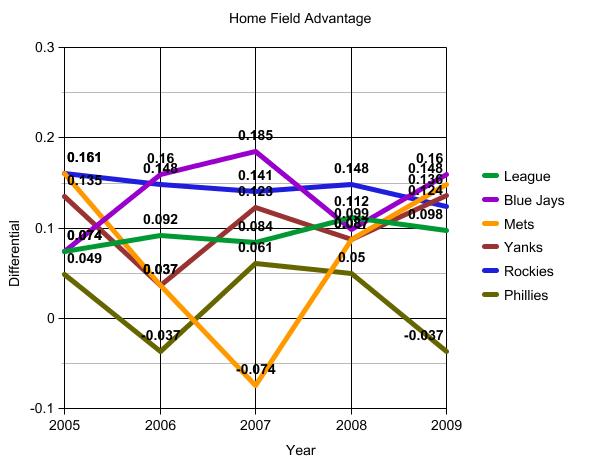
Here’s the third in this series. I picked the Blue Jays for Astroturf purposes, the Mets and Yanks because they’re the Mets and Yanks, and the Rockies and Phillies because of their noted hitter’s parks.

Looks like it’s just more noise.

Interestingly, the Rockies stayed above the league every single year. I wonder if the effects of altitude on the body, more than on the ball, could have something to do with that.

Hilariously, the Phillies were steadily below the league. That makes perfect sense, because everyone knows Phillies fans are miserable and don’t deserve to see a winning team.

The 2007 Mets were terrible at home, but the Mets otherwise fluctuated right around the mean. Same deal for the Yanks.

Graph!

There’s got to be a better way to quantify this, and a way to determine if it really exists. If anyone has any suggestions, I’m all ears. Just don’t make it too difficult on Jon T. Intern; he’s in college and should be having more fun.