More graphic fun

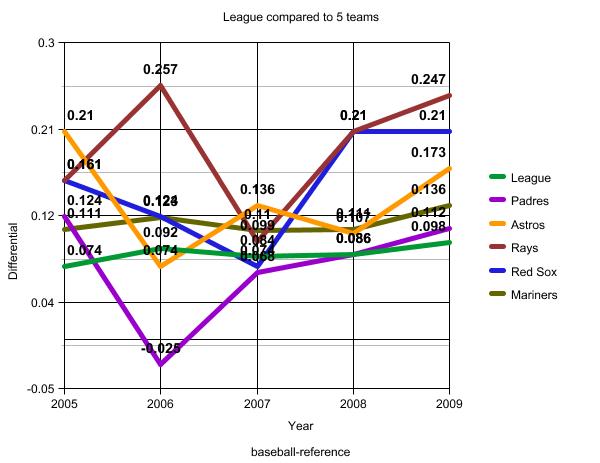
Here’s the second graph from Jon T. Intern, plotting the Padres, Astros, Rays, Red Sox and Mariners. Why those teams? Mostly more randomness.

I picked the Padres and Mariners because of their reputations for having pitcher’s parks, the Astros because they have a stupid, ridiculous hill in center field, the Rays because they play on turf, and the Red Sox because of its peculiar dimensions.

Looks like more noise to me. The Padres are the first team here to have played to a negative home-field advantage, back in 2006:

Home field advantage, random teams

Root, root, root for the home team

Harold Reynolds, on the MLB Network earlier this week, suggested that the Twins have the best home-field advantage in all of sports.

Just in terms of baseball, that seems to make a lot of sense. After all, the Metrodome features two unusual characteristics — artificial turf and a white roof — that could give fits two an unfamiliar team. (Granted, all Major Leaguers have played on turf at some point, but not with the frequency of the Twins, Blue Jays and Rays.)

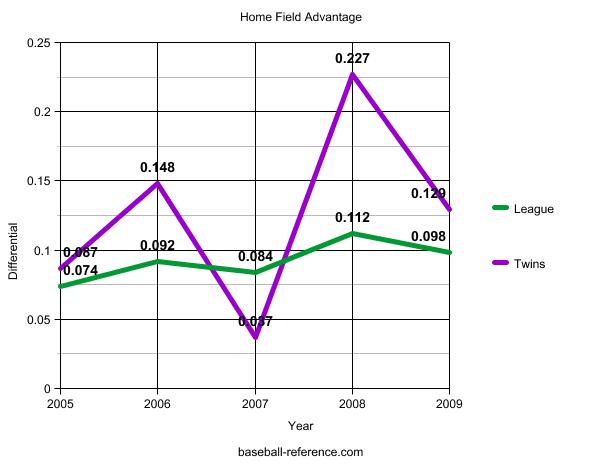
Anyway, the comment intrigued me, and I had an intern available to me with nothing else to do, and I love graphs. So, thanks to Jon T. Intern, here’s the differential between home winning percentage and road winning percentage for the Twins and the entire league over the last five seasons:

Twins vs. league average, home field advantage

So, by this relatively unscientific and totally imprecise method, the Twins have played to a better-than-average home-field advantage in four of the last five seasons. Is that significant?

Maybe, but I’m skeptical. It looks, to my untrained eye, like the whims of randomness and sample size.

Jon is working on another graph charting a bunch of other teams, ones that — off the top of my head — I thought might demonstrate a home-field advantage. Plus the Mets and Yankees, just because.

I won’t eat crow (unless it’s breaded and fried)

People keep asking me to eat crow for bashing the Jeff Francoeur deal when it happened, and I’m still not willing to.

I’ll admit this: Francoeur outperformed Ryan Church for the remainder of the 2009 season, so in that sense, it worked out for the Mets. But I maintain that Church — though not worth a ton — should have had more value than Francoeur when he was dealt, and if the Braves were as eager as they should have been to part ways with Francoeur, the Mets should have been able to get him for less.

Don’t try to tell me they couldn’t have used Church, injury-prone and unspectacular though he was, over the course of the last few months of the season.

As for Francoeur, yes, he did a fine job for the Mets, hitting .311 with a .338 OBP and a .498 SLG in his 308 plate appearances. And even though he barely ever walked, it’s true that — as many have pointed out — if he could sustain that type of performance over a full season he’d be worth keeping around in 2010.

The problem is, it’s not at all likely he can. Players cannot reasonably hope to maintain an OPS of .836 — Francoeur’s final Mets line — without taking pitches way more frequently than Francoeur does. That’s the issue.

I Twittered about this a couple of weeks ago, and someone responded that both Carlos Lee and Pablo Sandoval have. It’s true that neither is exactly a paragon of patience, but Lee has walked in 7.3% of his career plate appearances and Sandoval has walked in 7.1%.

Francoeur walked in 3.6% of his plate appearances with the Mets, or about half as frequently as Lee and Sandoval.

For a quick and dirty reference point, I searched baseball-reference.com’s play index for seasons in which players got at least 500 at-bats while walking 30 or fewer times and maintaining an OPS+ above 110, the Major League average for right fielders.

Only 17 guys have done it in the past 20 years, and only Andre Dawson and Dante Bichette have done it twice.

The idea is that pitchers and scouts are smart people, and will learn better than to throw you anything good to hit once you’ve proven you’ll swing at most pitches.

Of course, Francoeur wasn’t exactly facing anyone new when he switched teams in the same division, so it’s a bit puzzling that the change of scenery did seem to affect him so positively.

So maybe Francoeur really just needed to get out of Atlanta, and will somehow maintain his .300+ batting average and decent production moving forward. As a Mets fan, I really hope that happens, and I’ll gladly sit down to a nice big plate of crow if it does.

The odds are strongly against him, though, so banking on it to the tune of the rumored three-year, $15 million contract extension would be shortsighted at best.

Items of note

Sam Page of Amazin’ Avenue drives home a point I try to make all the time: labeling starting pitchers by rotation slot is pointless and unnecessary. Teams should just get the five best starters they can.

One of the biggest developments of the playoffs, I think, has been the exposure of Chip Carey as bad. I don’t get it: He’s so clearly unqualified for the job, how ever did he get it? Also, I feel like he’s dragging poor Ron Darling down.

Keyshawn Johnson has unmitigated gall to suggest that Braylon Edwards needs to focus on what’s on the field.

Carlos Gomez feels bad for the Mets. He’s not alone.

Ladies, gentlemen and Hoyas: We have a Michael Sweetney sighting.

If an unauthorized sequel to Catcher in the Rye was enough to make J.D. Salinger poke his head out and say, “stop that,” the Daily News’ back page today would probably really bother him, if only he subscribed to newspapers:

Mmm... pie.

Mmm... pie.

Dan O’Dowd: Cool

I’m rooting for the Rockies in the National League, and not just because I desperately want them to take down the Phillies. I just like the way they’re run.

I rarely hear Dan O’Dowd’s name thrown around in discussions of the better GMs in baseball, probably because his Rockies spent the beginning of his tenure mostly buried near the basement of the NL West.

But what O’Dowd has done with the franchise in the last few years is pretty remarkable. The Rockies — as I’ve recently tweeted — drafted and developed all 10 of their 2009 top 10 plate appearance leaders, all but Todd Helton drafted under O’Dowd. And in Troy Tulowitzki, Chris Ianetta, Seth Smith, Ian Stewart, Dexter Fowler and Carlos Gonzalez, they’ve got a nice core of players entering their primes. Plus Ubaldo Jimenez is beginning to look like something of a stud.

Moreover, as the Rockies’ GM, O’Dowd faces certain challenges few others do. Even in the post-humidor era, Coors Field is a peculiar park. Nearly all of the Rockies’ hitters feature pretty extreme home-road splits, and the team posted an .849 OPS at home against a .719 OPS on the road in 2009.

O’Dowd has managed to compile a pitching staff, however, that minimizes the disparity. Rockies pitchers yielded a .752 OPS at home, compared to a .713 tally on the road this season.

That’s done with ground balls. The starting rotation features three pitchers — Aaron Cook, Jason Marquis and Jimenez — with ground-ball rates above 50% and a fourth — Jason Hammel — at 46.2%, good for 16th among Major League qualifiers.

I have no idea if O’Dowd reads Fangraphs or just relies on scouting to determine the best ground-ball guys, but either way, it’s clever. Clearly that is the antidote to altitude.

In 2009, the Rockies combined those guys with good defenders (Stewart, Tulowitzki and Clint Barmes) in their infield, and wound up with a staff in which all five starters finished with ERA+s over 100. That’s a pretty solid way to end up playing postseason baseball.

The First Black Jack Taco in Elmsford, NY

I caught wind of the new Black Jack Taco today thanks to the Internet’s own Jake Rake.
bs8
I had to try it, but the problem is the Taco Bell nearest my home is the Worst Taco Bell on the Face of the Earth. Bar none. It’s terrible. One time I waited 17 minutes for my tacos. It was still worth it, obviously, but that’s really just inexcusable for Taco Bell.

The other thing they do is serve Volcano Tacos in regular, non-red taco shells. Are you kidding me? That’s just a regular taco with lava sauce on it, my friends. Don’t sell me it as a Volcano Taco, please.

Anyway, the woman at the register looked completely baffled when I ordered a Black Jack Taco. She asked if I meant Double Decker Taco, and I said no, that while the Double Decker Taco is indeed delicious, I was there to sample the new Black Jack Taco. She told me they didn’t have it, so I turned to leave, further disappointed in the World’s Worst Taco Bell.

But the confusion made enough commotion that some manager guy overheard and said, “hold on! It’s downloading now!”

Huh? Downloading?

I take this to mean that some Taco Bell supercomputer contains all of the Taco Bell recipes, and when Taco Bell gets a new menu item, all the local Taco Bell franchises must download them to properly prepare the delicious new menu items.

Because, you know, they can’t just look at the pictures.

Anyway, the main innovation — and only new Taco Bell ingredient — in the Black Jack taco is the black taco shell, which was predictably awesome. I don’t know that it tasted appreciably different than a regular taco shell, of course, but I don’t see what’s so wrong with that.

There was a decent amount of spice in there, and it might have been coming from the shell. Then again, it could have been the Pepper Jack sauce, which you may remember from such Taco Bell menu items as the Baja Gordita or the Cheesy Gordita Crunch. It’s amazing, and it’s probably one of the most underrated Taco Bell things.

Anyway, the Black Jack Taco comes with my heartiest of recommendations, mostly because it’s served at Taco Bell. But what I really took out of this day is that there is, somewhere on in the Internet, a database filled with forthcoming Taco Bell recipes. Please, hackers, help me out.

I also appreciate the new direction in Taco Bell products toward a greater variety of shell colors. Now, with the new black, traditional yellow, and volcano red varieties, I can finally create my all-taco tribute to the Belgian flag.

Items of note

Jon Heyman writes in SI.com that, according to a source, Omar Minaya would be gone if he hadn’t signed an extension last year. If that’s true, it’s another example of the Mets failing to grasp sunk-cost economics. And also, why did they sign him to that extension last year?

At SNY.tv, Mike Salfino examines what Braylon Edwards could bring to the Jets. I love the acquisition because it’s the definition of a potential buy-low steal. When could a guy’s value be lower in Cleveland than a couple days after he punches LeBron James’ friend in the face?

It will be really, really funny if the replacement NBA refs actually enforce the proper traveling rules. Sorry, Kobe — you only get two steps!

Jonah Keri provides some much-deserved love for Ben Zobrist. Two things: 1) Why was everyone so surprised that Zobrist turned out to be good? He had a .429 career Minor League OBP; 2) Keri points out, accurately, that Zobrist’s UZR (and thus, WAR) is skewed by small sample sizes at defensive positions, but if WAR is a measure of a player’s total value, shouldn’t Zobrist get bonus points for being willing and capable of playing nearly every position?

Tommy Dee puts a really silly picture of Al Harrington in an otherwise well-crafted teardown of people who obviously don’t follow the team like he does.

No.

In today’s Daily News, Bill Madden suggests that Major League Baseball add a second Wild Card, and then have the two Wild Card teams square off in a sudden-death playoff before the real playoffs begin.

What? No. No, no, no, no, no.

Madden says it would be “great theater.” That’s true. But you know what else would be great theater? Having every second-place team’s manager fight to the death in a steel-cage royal rumble to determine which squad makes the playoffs.

It just wouldn’t be fair, and it wouldn’t be baseball. (My money’s on Jim Leyland and his hickory-tough old-man strength, though.)

The current Wild Card system isn’t fair. That’s true. By having both a Wild Card and unbalanced schedules, the system occasionally rewards second-place teams in weaker divisions just for playing more games against crappy teams.

But part of what’s inherently awesome about baseball is that it provides teams an adequately long season in which to prove their dominance, and doesn’t permit too many teams to make the playoffs. In the NBA and NHL, lots of teams make the playoffs, so theoretically, any old gang of scrubs could get hot and take the title. In the NFL, with only a 16-game schedule, it’s entirely likely that some team could luck out and go 10-6 and make the playoffs while a significantly better team with a tougher schedule and some bad breaks could go 9-7 and miss out.

Madden argues that his system would make it more difficult for Wild Card teams to make the World Series, because, you know, the 95-67 Red Sox don’t deserve to make the World Series while the 87-76 Twins obviously do.

All Madden’s system would really do is throw one more team into the mix, and there’s no way it would make it any less likely that a Wild Card team — whichever one won the silly one-game playoff — would win the whole thing. Neither a one-game nor a seven-game series is long enough to determine which baseball team is really better, so once the playoffs start, there’s no way to be certain that the best team wins. That shouldn’t take away from the accomplishment, of course; luck is a big part of the game.

Basically, Madden’s major complaint is that the Wild Card “destroys” pennant races in each league every year, but that’s not really true at all. It happened to make the Yankee-Red Sox rivalry less interesting in 2009, which, I suppose, is terrible for New York- and Boston-based newspapers.

But the Wild Card race was really the only race that remained interesting in the National League in 2009, plus the existence of the Wild Card made the playoff races more interesting in 2008 and especially in 2007, when the NL had five teams in two divisions finish within two games of each other.

Adding a second Wild Card team to the playoff mix makes the entire regular season less important for the sake of one exciting game per league.

Madden finishes with his proposed slogan: “Sudden-death baseball. It doesn’t get any better than this.”

But it does. It’s called a 162-game season, after which the best teams are rewarded with postseason berths.

All the pieces matter

“We’re building something here, detective. We’re building it from scratch. All the pieces matter.” – Lester Freamon.

So the Mets announced yesterday that they received Chris Carter and Eddie Lora from the Red Sox, completing the Billy Wagner trade and surprising absolutely no one.
Many will denigrate the trade as yet another mark against Minaya, as Wagner, assuming he is tendered arbitration and rejects it, will provide the Sox draft picks.

But don’t forget that Wagner was still a question mark when the Mets dealt him, so the team risked hanging onto him, having him fall victim to injury or ineffectiveness, and getting nothing for him.

Carter is nothing spectacular, but he can easily be something the Mets pretty desperately need: an inexpensive role player.

I’ve made no secret of my disdain for Minaya’s habit of filling out the roster with overpaid players below replacement-level. With Carter, he has the opportunity to add a solid left-handed bat for the bench and allocate precious resources elsewhere.

So Carter hasn’t done much in his handful of Major League at-bats? So what? He has a career Minor League OPS of .890 and a history of mashing right-handed pitching. He could easily spell Jeff Francoeur against right-handers and serve as the team’s primary pinch-hitter.

Provided he doesn’t completely embarrass himself in camp, Carter should be on the Major League roster come April.

And just for fun, a list of the Mets’ primary pinch-hitters, by pinch-hit at-bats, in each season of Minaya’s tenure (with their season BA/OBP/SLG line).

  • 2005: Marlon Anderson (.264/.316/.391)
  • 2006: Julio Franco (.273/.330/.370)
  • 2007: Ruben Gotay (.295/.351/.421) (!)
  • 2008: Marlon Anderson (.210/.255/.275) (!!!!)
  • 2009: Jeremy Reed (.242/.301/.304)