In France, they call it ‘deauxping’

Floyd Landis, the American cyclist whose 2006 Tour De France victory was nullified after a positive doping test, has sent a series of emails to cycling officials and sponsors admitting to, and detailing, his systematic use of performance enhancing drugs during his career. The emails also claim that other riders and cycling officials allegedly participated in doping, including seven-time Tour de France winner Lance Armstrong.

Reed Albergotti and Vanessa O’Connell, Wall Street Journal.

And so concludes a run of public denial and bald-faced lies hilarious enough to make Roger Clemens look like Honest Abe. No word on why Landis fessed up now, though he claims he wanted to “clear his conscience.”

If you weren’t forced by your work to follow cycling in 2006, you might not know that Landis tried to explain unnaturally high testosterone levels by claiming he was out drinking the night before his test (during the Tour De France, because lots of successful cyclists break from the grueling, 2,200-mile race to get all liquored up), and then suggesting that he’s just some special superman who produces twice as much testosterone as everyone else. Because, you know, Floyd Landis is obviously the face of immense virility.

And because, of course, having the type of testicles capable of producing twice the normal amount of testosterone wouldn’t in any way make cycling unbearably uncomfortable.

Also, if you’ve never followed international cycling, you might not realize that every single person who has ever been on a bike has endeavored some sort of illegal doping activity. No term was bandied about on the now-defunct WCSN.com more than “disgraced cyclist,” because international cycling, for those who get broken up about cheating athletes, is a complete disgrace.

Oh, and I almost forgot the most ridiculous part: At some point, cycling legend Greg LeMond told Landis about the sexual abuse he endured as a child, and Landis detailed his doping regimen to LeMond.

And so when LeMond was preparing to testify against Landis in court, Landis’ business manager — from a listed number — placed a threatening call to LeMond during which he said, no joke, “Hi Greg, this is your uncle. I’m going to be there tomorrow… and we can talk about how we used to hide your weenie.”

Floyd Landis: One weenie apparently unwilling to go into hiding.

Retiring to the nerdery with my spreadsheets

Jerry Manuel said after last night’s game that Fernando Nieve has not “hit a wall,” citing the fact that the frequently used pitcher’s velocity has been about the same all season long.

Before we filmed the Baseball Show yesterday, Bob Ojeda and I talked about Nieve, and Bob suggested that though Nieve’s velocity is the same, it looks as if his fastball has flattened out. Bob said that could be because it requires more effort from Nieve to throw the fastball so hard, and so he gives up movement on the pitch.

Sorting through PitchF/X data is certainly not my area of expertise, but I figured I’d take a crack at it to see if there was data to back up what Jerry and Bob were saying. And since Nieve seemed so effective early in the season and has struggled so mightily of late, I hoped to note something that would explain what happened.

For all the graphs below, I only used games in which Nieve threw at least 15 pitches. That’s reasonably arbitrary, I realize, and 15 pitches is still a very small sample. But I figured that would be a decent enough way to sort out what noise might result from a five-pitch outing.

Plus, you know, I don’t have all day, and Nieve pitches a whole lot. That’s sort of the whole thing.

All the data came from BrooksBaseball.net and Baseball-Reference.com, two sites with tons and tons of data.

OK, first Nieve’s average fastball velocity:

There’s some fluctuation there, as would be expected, but it appears both Bob and Jerry are right: Nieve’s fastball has not slowed down this season. If anything, he’s been throwing it a bit harder of late.

Now the movement on that fastball:

The most interesting thing here? Those two data points in mid-April that appear to be outliers in both horizontal and vertical break are the two games Nieve pitched in Colorado. I’m sure someone has done way more research into it, but it’s a pretty funny statistical anecdote to see the way (I presume) the air there affects the break on pitches.

As for Bob’s point about Nieve’s fastball? I’m not sure, but it certainly looks plausible from the chart. The vertical movement has remained reasonably steady through the season, but the horizontal movement — the cutting action — on the pitch has lessened somewhat steadily. On April 9 the average v-break was at -7.79, and it held around there on April 17 and April 27. In his outings on May 13, 16 and 19, Nieve’s average horizontal break was at -4.62, -5.55 and -5.27.

Is that significant? I really have no idea, but it certainly looks so. Maybe someone with more pitchF/X knowledge than I have can help us out here.

And really, I have no way of knowing if the decreased movement is due to overuse or just Nieve not throwing his fastball effectively. Since he’s been used so frequently (and warmed up and not used pretty frequently, too), I’d bet on the former.

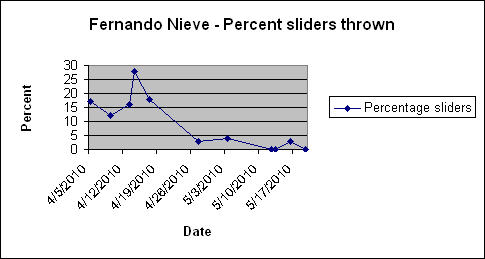
But one thing I noticed that seems both clear and reasonably significant is that Nieve has almost entirely stopped throwing his slider. PitchF/X isn’t perfect at identifying pitches, but check this out:

That’s particularly telling because, according to Fangraphs, the slider has been Nieve’s most effective pitch this season. I’m not sure if he’s not throwing it because he’s sore or if his coaches or catchers have talked him out of it — and again, we’re dealing with a lot of small numbers here. In either case, it seems a reasonable enough indicator that something actually has changed for Nieve since his effective start to the season.

Cashman and Minaya on developing pitchers

Hat tip to the Book Blog: Read this excellent piece by David Lennon at Newsday examining the way the Yankees and Mets handle their pitching prospects. The money quotes:

“I don’t care what an old-school person wants to say, the old school is what we’re learning from. Too much, too soon and it’s bye-bye to the asset. Just like back in the day, when they said it was OK to smoke, that smoking wasn’t bad for your health, and then it turns out everybody is dying of cancer. Now they don’t say that anymore. They learned from what happened in the past and so you evolve, and you improve, and you tweak, and continue to grow.” – Brian Cashman.

“I just don’t think there’s one formula that you can say is the perfect formula… The other day, against the Phillies, having [Jenrry Mejia] go out there and having to face Placido Polanco, Shane Victorino, Chase Utley and Ryan Howard — that’s a great experience. In the minor leagues, there’s no way you’re going to learn the adrenaline of facing those kind of guys. So that’s development right there.” – Omar Minaya.

As it turns out, everything sounds pretty badass when said with a Russian accent

Seriously, someone needs to hip Jeff Wilpon to this. New Nets owner Mikhail Prokhorov doesn’t say anything overwhelmingly interesting in his video message to fans, but it all sounds confident and vaguely ominous.

I guess that has more to do with Hollywood than Prokhorov, but it helps that I know he kickboxes in his spare time and has confessed to paying bribes. It’s no small feat to buy into a team part-owned by Jay-Z and instantly become the shareholder with the most street cred.

Also, when asked today how he would be able to woo big-name free-agents, he said, “I have my own secrets.” I have no idea what that means, but it sounds awesome.

Boston fans apparently want to deny successful GM his right to see Pearl Jam

The only question I have is who was actually criticizing Epstein over this? I value my brain cells so I don’t listen to Boston talk radio, but were people actually considering this to be some sort of issue? I’d wager $10,000 that Theo Epstein works more hours and is better at his job than every single person who considered this to be a legitimate problem.

Craig Calcaterra, HardballTalk.

This. For those of you who don’t know the backstory: Theo Epstein went to a Pearl Jam concert instead of watching a Red Sox game (which he very well might have TiVo’d), and apparently Boston fans were so broken up about it that Nick Cafardo wrote a column defending Epstein.

The Red Sox endured an 86-year championship drought. Then the Curse of the Bambino magically ended the year after Epstein took the reins. It’s amazing how a series of smart moves can undo an age-old hex. And then the Sox won again in 2007, just to quiet any talk that the first could be a fluke.

Even with their team underperforming this season, Boston fans should wake up every morning and give thanks for whatever series of circumstances brought them Theo Epstein. His record is certainly not perfect, but he’s as good a GM as any in baseball. His teams have won two World Series in the seven seasons he has been at the helm.

And the funny thing is, that’s sort of implicit in any anger toward Epstein for taking a night off. As mad as they are over their team this season, Sox fans still want their GM working to try to better the club. I have to imagine there’d be plenty of Mets fans excited to hear that Omar Minaya was at a Pearl Jam concert if it meant he had his hands off the controls for a night.

R. Kelly outdoes himself, and surprisingly, that isn’t meant to imply anything sexual

I have to confess that I’m kind of fascinated by R. Kelly. I can never tell if he’s some great genius whose accomplishments I don’t quite understand and and whose greatness won’t be recognized until long after he’s passed, or if he’s just one of the least self-aware human beings on the planet.

And for some bizarre reason, I can’t pull myself away. One time I watched all 22 chapters of Trapped in the Closet in one sitting. Today, I transcribed the lyrics to his “Sign of a Victory,” one of the anthems for the 2010 FIFA World Cup, and quite possibly the worst song ever recorded. I couldn’t find them online, and I wanted to have them all written down for posterity.

The only part I couldn’t decipher was the female backup vocals that follow the most predictable key change since “Man in the Mirror.” If anyone can, please let me know in the comments section. Here’s the song:

And here are the lyrics:

I can see the colors of the rainbow
And I can feel the sun on my face
I see the light at the end of the tunnel
And I can feel heaven in this place.

And that’s the sign of a victory
That’s the sign of a victory

I can feel the spirit of the nations
And I can feel my wings riding the wind, yeah
I see the finish line just up ahead now
And I can feel the rising deep within.

That’s the sign of a victory

Now I can see the distance of your journey
And how you fought with all your might
You open your eyes to global warming (Ed. Note: Huh?)
And through it all you sacrificed your life.

That’s the sign of a victory

If we believe, we can achieve anything
Including the impossible, this I know
So let’s lift up our heads, yeah
And raise the flag, yeah
Scream like you’re born to win
Now let the dance begin!

That’s the sign of a victory

When you keep on fighting
After you’ve lost your strength
That’s the sign of a victory
When darkness is all around you
And you still find your way
That’s the sign of a victory
You’ve got the victory, sing
C’mon and sing!
Lift up your voice and sing
That’s the sign of a victory
Ohhh, that’s the sign of a victory.

Time to shelve the bunting

Seriously, though: Last night, in the top of the ninth inning, Jerry Manuel decided to pinch-hit Gary Matthews Jr. and his .457 OPS for Chris Carter, the team’s No. 3 hitter in the game. Manuel did this because he hoped Matthews could bunt Luis Castillo into scoring position.

Castillo got into scoring position all by himself thanks to Billy Wagner’s wild pitch. But even with Castillo on second and even after Matthews, against all odds, worked the count to 3-1, Manuel still wanted him bunting. Why? Well, duh: Because Matthews hasn’t been swinging the bat well.

Which is exactly why he shouldn’t be pinch-hitting for the No. 3 hitter in the top of the ninth in a tie game.

Nevermind that Carter probably shouldn’t have been the No. 3 hitter. This space is not for ripping Chris Carter, one of the few Mets ripping the ball recently. And nevermind that Wagner is a southpaw and Carter hits lefthanded; Wagner has demonstrated almost no platoon advantage in his career and Carter’s, in the minors, was small. Small enough that he’s still almost certainly a better hitter against lefties than Gary Matthews Jr. Heck, if Manuel was so dead set on having a righty up against Wagner, he probably would have been better off sending Carter up to bat on the wrong side of the plate than Matthews and his .457 OPS.

Nevermind that. Mind why a manager would want to sacrifice bunt a decent runner to third base when there are no outs in the inning. (And the top of an inning, no less, with a bullpen far from guaranteed to shut the Braves out in the bottom half.)

To set up the sac fly, I guess. But why give up one of your most valuable commodities — outs — to put a runner on third for David Wright, with all his well-documented recent struggles to make contact?

Of course, Manuel didn’t trust Matthews to swing away, and he initially had Matthews in the game for his ability to bunt Castillo into scoring position. That’s a much more defensible strategy, if still a frustrating one. And probably the manager didn’t want to “show up” his player by pinch-hitting for him in the middle of an at-bat. Instead he just showed him up by not letting him swing on a 3-1 count with a runner on second.

Whatever. Whatever, whatever.

Manuel is managing with his back to the wall or his head on the chopping block or whatever other convenient metaphor you want to use to say, “in serious jeopardy of losing his damn job.” And apparently, when desperate to win games, Manuel will tell his players to bunt in every remotely feasible situation.

Manuel seems like a genuinely good guy. The players appear to enjoy playing for him. The media likes him too — after all, after Willie Randolph, it’s refreshing to cover a manager who will explain his thinking in clearer terms than just, “going with my guys” and “grindin’.”

But if the Mets are going to can Manuel eventually, they should just, you know, do it. Not for any nebulous issues of leadership, not because David Wright now seems to strike out constantly, not because Manuel’s big “throw strikes” philosophy from Spring Training has the team leading the Majors in walks. No manager in the world should be expected to convince Oliver Perez to reliably throw the ball over the plate.

Manuel is too often failing his team in the real, measurable, tactical aspects of managing. Ironically, in his urgency to win games, he is helping the team lose them: Overtaxing his relievers, relying way too heavily on platoon splits, and of course, bunting incessantly.

Martino: Mets did not “respond” to pregame drama

It was an interesting and memorable scene this afternoon in the visiting clubhouse at Turner Field. After Jeff Wilpon, Omar Minaya and John Ricco closed the door to Jerry Manuel’s office, a crowd of reporters retreated to the other end of the room, and settled in to stare at the white brick wall that separated us from team brass….

Several hours after that, the Mets won a baseball game. A good game, actually, with clutch pitching from Mike Pelfrey, who just has that ace look to him most of the time this year, the way he stands on the mound and establishes a rhythm and pace for the entire game.

Afterwards, the Mets made clear that they were oblivious to most of the drama. They weren’t lying or feeding us clichés. This stuff matters way more to media and fan-types than it does to the guys on the roster.

Andy Martino, Surfing the Mets.

Martino nails it here. The Mets’ decision-makers met, and then the Mets beat the Braves. The Mets did not beat the Braves because their decision-makers met. The Mets beat the Braves because even the worst baseball teams still win 1/3 of their games, and because Mike Pelfrey had a good game and Pedro Feliciano managed to wiggle his way out of a jam.

On Twitter last night, it was pretty baffling to see how eager people were to make post hoc ergo propter hoc arguments off a single game. It’s one game! And, for like the millionth time, to suggest that the Mets were somehow trying harder because they knew their manager was under the gun is to imply that professional baseball players aren’t trying really, really hard all the damn time.