Season in preview: Catchers

The Mets caught a lot of Internet snark — from me and others — for stockpiling old backup catchers this offseason in lieu of doing just about anything else to improve their team (insert Jason Bay caveat here).

Now we all owe the Mets an apology, or something, because they lost Chris Coste via waivers to the Nationals yesterday. And Josh Thole will have to endure the start of the Triple-A season without a built-in tutor on the Bisons roster.

Anyway, here we go:

The Major League catchers in April: Rod Barajas and Henry Blanco.

Overview: Given the various ways the Mets’ backstop situation could have played out this offseason, a Barajas/Blanco tandem to open the year isn’t all that awful. It isn’t all that great, mind you, but it’s not all that awful.

The Mets’ much-ballyhooed and widely decried pursuit of Bengie Molina fell apart when the team — smartly — would not offer the aging, impatient catcher more than a one-year contract.

By some fortunate series of circumstances, they wound up with Barajas, a marginally worse hitter than Molina but arguably a much better defender in 2009, plus inarguably a better baserunner and perhaps the person in the organization best-suited for a front-office job.  And for all that, he’ll earn about a quarter of what Molina’s getting.

Behind Barajas, the Mets have Blanco, one of the game’s better backup backstops. Blanco has put up a couple of decent seasons with the bat the last couple of years — respectable-for-a-backup-catcher wRC+s of 87 and 96 in 2008 and 2009, respectively. That’s not entirely likely to last, considering he’s 38 and has a less-than-stellar 67 lifetime figure, but he’ll make up for it with steady defense and badass looks.

Of course, both catchers qualify as stand-ins or contingency plans for prospect Josh Thole, recently ranked fifth in the Mets’ system by Toby Hyde at MetsMinorLeagueBlog.com. Thole, familiar to any Mets fan who braved the final months of the 2009 season, should start 2010 in Buffalo but could crack the big-league roster for good sometime in the middle of the season if he keeps hitting like he did in 2009 and his defense continues to improve.

Hilariously, the loss of Coste means Omir Santos will likely stick with the Mets in Triple-A, meaning Buffalo’s catching situation to start 2010 should look a whole lot like the Major League Mets did to end 2009. That’s novel, I suppose.

The Major League catchers in September: Thole, Barajas and Blanco.

Thole’s on the 40-man roster, so he’ll certainly be called up in September. I imagine he’ll join the club before then, though.

The Mets have some concerns about Blanco’s throwing shoulder, plus he’s 38. Barajas is 34. And since neither seems primed to tear the cover off the ball (with the bat. Blanco looks like he might actually tear covers off baseballs for fun), I would hope that, provided Thole is hitting and his defense has improved, the Mets will be ready to hand him the reins once a convenient opportunity presents itself late in the season.

Should Blanco or Barajas fall victim to injury sooner than that, we’ll enjoy more Extra-Base Omir.

How they stack up: I don’t think Carlos Ruiz will repeat the offensive totals he posted in 2009, but even expecting some regression for the Phillies’ backstop, it’s hard to expect the Mets’ crop of catchers to be anything better than fourth best in the division — better only than the Nats’ group of Ivan Rodriguez and Wilbert Nieves. And should Jesus Flores recover faster than expected from shoulder surgery and Thole not progress, the Mets’ group could be the N.L. East’s worst. But hey, at least they’re not going to be paying Bengie Molina multiple millions of dollars in 2011.

Next up: First basemen, obviously.
Items of note

You know who I feel like I overlook too frequently when I’m compiling my Lastings Milledge All-Dickens-Name team? Chauncey Billups.

If a religious sect identified me as its chosen one, even if I was sure it wasn’t the case, I’d probably just go with it. Just saying. Also hinting. I’m totally down to be your chosen one, religious sects.

Will Leitch compares the 2010 Mets to Freddy Got Fingered. I kinda liked Freddy Got Fingered. I only see one LeBaron, Freddy.

Big Pelf pulls a Bernazard

Fun fact: I once received a “lifetime” ban from a mini golf course on Long Island for breaking a putter over my knee in quasi-mock frustration.

I put lifetime in quotes because I went back a couple weeks later and no one said anything. I think a lot of times places doll out lifetime bans and don’t really mean it. Maybe I should have tried playing intramural football again after that incident my freshman year.

Anyway, apparently Mike Pelfrey had a bit of a meltdown on the golf course, broke some clubs and challenged his teammates to fight him.

That’s not going to do much for the whole “Mike Pelfrey is a head case” stigma, but I say awesome.

I really like picturing Pelfrey challenging a crew of entertained Mets in ridiculous golf pants to line up for their beatdowns. I wonder if in fights, Pelfrey only throws the same punch over and over again. Like I bet Pelf has a solid right cross, but he never throws a jab or a hook or an uppercut.

He kept his shirt on, which is probably for the best.

Penultimate Pedro?

So Pedro Feliciano wants to be the Mets’ eighth-inning guy. Everybody wants to be the Mets’ eighth-inning guy. We all want to anoint the new eighth-inning guy.

OK, let me start right off by reiterating that I think the whole need for a specific, dedicated eighth-inning guy is silly. Again, there’s little evidence that even having a one-inning closer helps teams finish out games more successfully than they did in the time before the trend started up in the late 80s:  “In the 20 seasons since LaRussa’s brainstorm, teams holding late leads have won at about the same rate they did in the 20 seasons before.

Regardless, looking at Feliciano specifically, there may be some merit to the concern voiced by SNY’s Gary Cohen, among others, that Feliciano is too valuable to the Mets in his current role — as a middle-inning lefty specialist — to consider moving to a setup position.

Fangraphs charts Leverage Index, “a measure of how important a particular situation is in a baseball game depending on the inning, score, outs, and number of players on base, created by Tom Tango.” A pitcher’s average Leverage Index when he enters a game is called his gmLI.

According to that stat, Feliciano entered games in, on average, the fourth highest-leverage situations of any Met reliever. Ahead of him were Casey Fossum, whose gmLI was certainly driven up by a tiny sample, J.J. Putz and Francisco Rodriguez. Feliciano finished third on the team behind Luis Ayala and Billy Wagner in 2008.

Turning to the list of 2009 Major League leaders in gmLI, the highest-ranked non-closer is Seattle’s Mark Lowe, decidedly an eighth-inning guy — 50 of the 71 1/3 frames he tossed last season were that game’s penultimate one. The next, Jeremy Affeldt, had the eighth inning account for 36 2/3 of his 62 1/3 innings.

The next two pitchers on the list, though, were Matt Thornton and Phil Coke, a pair of lefties, neither of whom threw more than half his innings in the eighth (although both pitched plenty in that frame).

So what does that mean? Not a ton. Relief pitchers traffic in small sample sizes, and I guess the moral of the story is that though eighth-inning guys tend to enter the game in pretty high-leverage situations, lefty specialists often do too.

Putz, in his short stint of full health, may have entered games in more important situations than Feliciano on average, but no setup man that lasted the year entered games in tougher spots than Perpetual Pedro. And by situational wins, Feliciano was the top pitcher on the team.

There’s no doubt, then, of Feliciano’s value to the team in his familiar role. He might be slightly more valuable as the elusive eighth-inning guy, for sure, but only if he could handle it.

And therein lies the rub. There’s been some talk of Feliciano’s developing cutter, and Feliciano seems earnest in his desire to use it get righties out. Good. He should want to be the best pitcher he can be, always. He’s a professional athlete.

But Feliciano was working on new strategies to get righties out last offseason, too. And righties responded with a .264/.365/.486 line, pretty similar to the .272/.364/.425 mark they’ve tallied off him across his career.

Feliciano’s long been one of my favorite Mets, so I’m rooting for him to succeed in any role. Maybe that cutter will work for him, and then, yeah, he’ll be ever so slightly more valuable to the Mets as a setup man than he was as a lefty specialist.

I’m just not sure it’ll work out that way, though.

Maybe the most curmudgeonly column ever written in the New York Post

Hat tip to Can’t Stop the Bleeding for pointing out this Phil Mushnick column lamenting the trend toward body art on NCAA basketball players. Must be a slow day:

According to the Elias Sports Bureau, Division of Self-Mutilation, this NCAA tournament destroyed last year’s record for in-view tattoos as seen permanently burned into the flesh of young student-athletes.

I don’t care what your position is on this pop-cultural “advancement” — whether you recognize that it’s another mainstreamed gift from our prison systems and street gangs — but you’ll admit that it seemed half the starters in this year’s tournament were covered with tattoos. Covered.

From there, Mushnick goes on to spend the next several hundred words just cracking jokes about how difficult it must be for these NCAA basketball players to see the tattoos that cover their own bodies, including several about how the text must appear backwards when they see it in the mirror and so they should consider having it written backwards. Poignant stuff.

I don’t have any tattoos and I’m not planning on ever getting any. Obviously I don’t begrudge anyone the right to ink themselves blue, it’s just way too permanent of a commitment for me.

I did watch a friend endure some pretty serious tattoo regret one time, though. It was heavy stuff, too. I was with him after he got his sixth or seventh tattoo, and I guess he didn’t like it, and he became really regretful and freaked out a bit about the permanence of what he had done to his body.

He got over it, though, and now has two full sleeves. That’s the happy ending.

Finally

I’m busy today, so in lieu of more content, enjoy this series of parody commercials from Mr. Show.

I’m pretty sure these came out in reaction to Hellman’s Dijonnaise, a product that combined mustard and mayonnaise in precisely the way demonstrated above, save the stripes. For a while, I’m pretty sure Dijonnaise was the only mustard you could get a Shea Stadium, which really sucked if you didn’t like mayonnaise.

Incidentally, Boar’s Head Pepperhouse Gourmaise is delicious, and should be excepted from any conversations making fun of mayonnaise/mustard hybrid products.

Season in preview: Starting pitchers

With Opening Day now a week away and with little else to write about, I’m going to attempt to preview the 2010 Mets, position by position, over the next seven days. Or maybe do a few posts like this one and then run out of steam. We’ll see.

I’ll start with starting pitchers, because starting pitchers have “starting” right there in their description, and because pitchers are “1” in the lineup card. I’ll end with relief pitchers, even though they’re also technically No. 1 in the lineup card, because we’ll have a better sense of who they are by then.
The format will be whatever the format is on this post. I’m going to figure it out as I go. That’s jazz, baby.

The starting pitchers in April: Johan Santana, Mike Pelfrey, Oliver Perez, John Maine, Jon Niese.

Overview: Yesterday, during WFAN’s coverage of the Mets’ Grapefruit League game, Wayne Hagin lamented the team’s need for a pitcher like Chris Carpenter, who could do to the N.L. East what Carpenter did to the Central last season.

“HELLO!?” – Herm Edwards.

Now, look: Carpenter went 10-0 against the Central last year, and that’s pretty nuts. But few pitchers in the Major Leagues are as qualified to dominate opposing hitters as the one fronting the Mets’ rotation. Johan Santana, assuming health, is not the problem.

Behind him lay question marks that have dotted just about every Mets season preview before this one: Pelfrey, Perez and Maine.

Color me slightly more bullish than most about the prospects of those three. Pelfrey, as noted earlier this offseason, was more a victim of the defense behind him than the demons inside him in 2009. He has been hit hard this Spring, but he has been throwing more breaking balls — something that should help him stop relying on Luis Castillo’s (complete lack of) range for groundball outs.

I’m mildly concerned that a more varied arsenal could make Big Pelf more vulnerable to injury, but assuming Jose Reyes regains most of the range he had before his hamstring injury, Pelfrey should bounce back from his rough 2009 as more of those groundballs bounce into the gloves of able defenders.

Perez enters the season to about the lowest expectations of anyone ever making seven figures not named Gary Matthews Jr. (or Andruw Jones, or maybe Barry Zito. OK, there are a few, but you get the point). It’s becoming increasingly clear that he’s not Sandy Koufax, no matter what Scott Boras says, but thanks to either a return to health or his conditioning program or new-found focus upon his first wedding anniversary, his velocity appears to be back to its 2008 levels.

If the results follow, the Mets will have a wild and frustrating but ultimately league-average middle-of-the-rotation starter in Perez. It’s annoying, but the Good Ollies and the Bad Ollies balance out and make for Just OK Ollie.

As for Maine? Well, I’m a little concerned about Maine. Not about his couple of shaky Spring Training outings or his talent — he’s got that, I think — so much as his ability to stay healthy. Maine has pitched progressively fewer innings in each season since throwing 191 in 2007, and the vagaries of his “shoulder weakness” last year are at least a bit concerning. I’ve speculated before that Maine might have flourished under Rick Peterson, noted for his expertise in biomechanics, but what do I know?

I know this: Maine’s strikeout rates have plummeted nearly as quickly as his innings totals, which is concerning. That could be a whim of the reasonably small sample of innings he pitched last season, but it could mean whatever Maine was using to fool hitters so effectively in 2007 isn’t doing the trick anymore. The velocity on his fastball has remained static and he has thrown a very similar mix of pitches, only less effectively. It could be the injuries, but it’s troublesome regardless. I’m rooting for the guy, but there are red flags all over the place.

The fifth guy, Jon Niese, I like. This I’ve covered.

The starting pitchers in September: Santana, Pelfrey, Perez, Niese and Nelson Figueroa.

Why’d I put Figueroa there? Just a guess. Trying to pick what will happen in September in March is a fool’s errand, and there’s a reasonable chance Figueroa is not even on the team next week, no less six months from now. Consider his name on that list as a stand-in for whatever fifth starter/long-man/fill-in guy they settle on when one of their starters gets injured or proves ineffective, assuming Jenrry Mejia has either hit his innings limit or been made a reliever.

I’m guessing Maine will be the starter that doesn’t last the year based on the red flags listed above. Pelfrey has been a horse for the last two seasons, Perez will have to suck really hard for the Mets to give up on his contract, and Niese’s only major injury has been the freak one he suffered last year.

There’s also a solid chance the Mets go out and trade for a starter if they’re in contention near the trade deadline and one or more members of their rotation is hurt or performing poorly. But we’ll cross that bridge when we get there.

How they stack up: I always think it’s a bit silly when, before every postseason series, newspapers run down the teams position-by-position to determine which team has the advantage where, because it doesn’t work like that. Derek Jeter isn’t facing Jimmy Rollins in the World Series, he’s facing the Phillies.

But I’m doing that here because it’s easy and I’m already 900 words deep into this post and I need to find a quick way to wrap it up. Jazz, like I said.

The way I see it, the Mets’ starting rotation is probably the third best in the division, behind the Braves and Phillies and ahead of the Marlins and Nationals. (Ooh, bold stance Ted!) I came to this conclusion via an incredibly complex scientific process which is far too complicated to detail here.

Next up: Catchers, which won’t take nearly so many words.

Items of note

Adam Rubin expects both Sean Green and Bobby Parnell to open the season in Triple-A. Cool. I suggested that plan a week ago but assumed it’d never happen. Now the Mets just need to pick Kiko Calero over Jenrry Mejia and all will be well.

Patrick Flood has an excellent and lengthy writeup from the parking lot at what used to be Tradition Field.

Somewhere in the middle of the Venn diagram circles for weird, pathetic and hilarious falls this article. I’ve seen Battlefield Earth, incidentally.

I hope Joe Mauer got a .444 necklace.

Now I am become death, the destroyer of worlds

I made bacon yesterday.

Not in any sort of figurative sense, either. I quite literally made bacon.

I don’t want to get too bogged down in the details because I basically followed this guy’s recipe, with a little help from this guy’s recipe, and so there’s already plenty of details online about how to cure and smoke bacon. It goes like this:

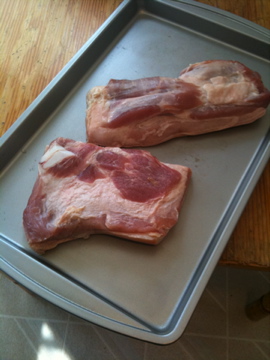
1) Acquire pork belly. This was by far the hardest part. I could only find one place in Westchester that had any — a Latin market in White Plains. I was hoping for a five-pound slab, but he only had a couple two-pound pieces left, but whatever, bacon is bacon, so I took ’em.

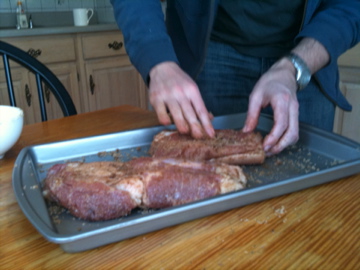
Then you rub salt and brown sugar on the pork belly:

Then you stick it in plastic bags in the fridge for a week to let it cure. The salt draws moisture out of the pork. Osmosis. This is exciting because it’s like a delicious science project.

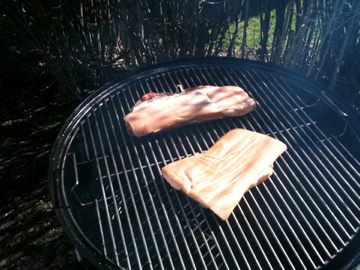
After a week, you rinse the pork belly and smoke the pork belly for a few hours. I used hickory, because that’s the standard in bacon-smoking. A lot of people say, “oh, use applewood” because you hear “applewood-smoked bacon” a lot. But I’m pretty sure you only note “applewood-smoked bacon” because it sounds fancy when it comes from Wendy’s, and because noting that it’s applewood-smoked is distinguishing it from most bacon, which is hickory smoked. And since this is my first foray into smoking bacon, I figured I’d use old reliable hickory.

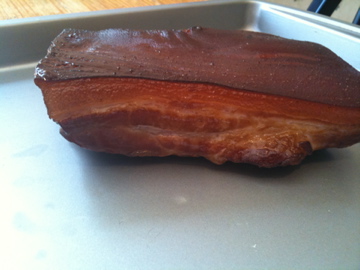
Three hours of low-heat smoking later, we have bacon. Sort of.

You know how bacon comes with the disclaimer that it’s only partially cooked? That’s the case here, as well. So it’s a little disappointing, because you can’t just rip into it right off the smoker and start eating delicious bacon. Also, that’s actual pigskin on the top there, so you’ve got to slice that off before you slice up the bacon for cooking.

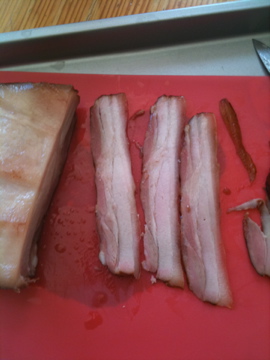
And then, fear. Since I didn’t use saltpeter, the bacon doesn’t have its familiar pink color once I start slicing into it, and I grow concerned that I’ve just made straight-up hickory-smoked pork somehow. Which would still be cool, you know, but not bacon:

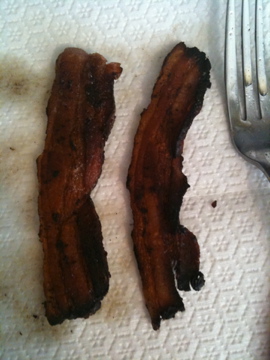
But I had no reason to worry. It’s bacon, alright. Shorter than most bacon, due to the size of the slab. And I burned it a little the first time cooking it — probably because, since I have no meat slicer, I had to slice it a bit thicker than regular store-bought bacon and it screwed with my bacon-cooking mojo — but it was still pretty obviously bacon:

As for the taste? Delicious, of course. It’s bacon. The best bacon I’ve ever had? No, probably not. But really good bacon regardless. Better than run-of-the-mill bacon, even (as if such a thing exists!).

It’s a bit salty even for bacon, and I think next time I’ll use a little more brown sugar to cut the salt more, or experiment with maple syrup. But no matter. What’s important is that I’ve moved from purely a consumer of bacon to a consumer and producer of bacon. I have lessened, by some tiny degree, the size of my bacon footprint.

According to this article, the average American, as of 2007, ate 17.9 pounds of bacon a year. That’s nuts. I initially figured I eat more bacon than the average American, but playing with rough estimates in my head, I really don’t think there’s any way I eat more than 1.5 pounds of bacon a month. And I really f@#$ing love bacon.

That means, especially when you factor in vegetarians and health-nuts and all the people who bring the average way down, there must be people who just eat bacon all the time. Like I mean really all the time. Like people who spend every waking hour eating bacon, driving up our national bacon-consumption rates. And bully for you, bacon eaters. I have nothing but respect for the choices you’ve made.

I will eat more than 1.5 pounds of bacon this month, I am certain, and so my efforts to cut into my bacon deficit will be mitigated by all this bacon I just made available to me.

But I will give some of this bacon away, too. For the first time in my life, I will give back to the world some tiny fraction of all the bacon I have taken from it.

Finally, I have joined the ranks of the baconmakers.

Not like the kind he had with Robin Ventura

A huge hat tip to the Scoreboard Gourmet for tipping me off to this:

Nolan Ryan Beef.

I guess I knew Ryan had a ranch, but I never stopped to think his beef might be available to me.

It is, and he guarantees it’s good:

After years of trying to find a consistent, high quality steak, I finally decided that the only way I could guarantee beef that was tender and good every time was to start my own brand. I gathered up several of my ranching friends and enlisted some of the top meat scientists and beef marketing people in the world. Together, we developed a program to provide you with guaranteed tender, all natural beef that would always be tender and tasty and a great value for families.

Meat science!

Nolan Ryan also has a blog through the site. It is not frequently updated, but it is incredibly well copy-edited, so that’s a plus. Also, almost all Ryan’s entries are about steak.

You might say, “oh, well that’s because it’s a blog on his beef company’s website trying to sell more steak, and he’s probably not writing these blog entries,” but I’m holding out hope that Nolan Ryan is a very careful typist who really likes talking about steak.