Anyone who has read this space with any consistency knows how I feel about the Mets trading away prospects this offseason, but I’ll reiterate for newcomers. (And because I just don’t have much else to say today.)
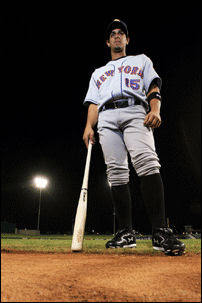 There is a time and place to trade prospects.
Fans of almost every Major League club overvalue their team’s prospects, because — mostly thanks to the Internet, I imagine — we now follow them from the moment of their signing to the time they arrive in the big leagues or leave the organization. But prospects are never sure things, and many, many of the players that appear most bound for success, either mechanically or statistically, never turn into Major Leaguers.
So yeah, sometimes a team is best served by moving one or a couple of its best young players for an established star. If a team feels it is one piece away and a star player could be had at a reasonable cost, then yeah, pull the trigger.
For the Mets, this is not one of those times.
Obviously it’s best to evaluate such deals on a case-by-case basis, as no deal could be properly assessed without knowledge of the specific players involved. But the problem with established Major Leaguers is that they usually cost big money, and the Mets are already close to their reported budget.
A trade for Roy Halladay would be exciting, for sure. It’d give the Mets an unbelievable 1-2 punch at the top of their rotation.
But a trade for Roy Halladay would also be a trade for about $20 million a year for the next several years. And that gives the team a whole lot less flexibility to fill its countless other holes moving forward, including a couple in that same starting rotation.
Many will argue that the Mets are “built to win now” and so must go all-in to compete in 2010, since they will inevitably crumble after 2011 when Carlos Beltran and Jose Reyes will, barring extensions, become free agents.
Guess what? That’s nonsense.
The only thing that could make the Mets a “win-now” club is committing to that philosophy. To say that the Mets must win in 2010 would be to know for certain that not a single one of their current prospects will be contributing at the Major League level by 2011.
That’s a possibility, of course. There’s always the chance that none of Ike Davis, Jon Niese, Fernando Martinez, Jenrry Mejia, Reese Havens, Brad Holt and Ruben Tejada pan out. I’m optimistic that at least a couple of them will, but then again, I’m a Mets fan. I overvalue their young players.
And with young players, there are few guarantees.
There is this one, though: For the first few years of their Major League tenure, players are always inexpensive. And with the recent trend of teams locking up young players to long-term extensions, Major League contributors can often be secured for a reasonable price beyond their arbitration years and deep into their primes.
And that, for about the millionth time, is what the Mets need. That’s what allows a team to free up cash for when the right free agents are available, and to take on payroll when a big-name player is available via trade.
Mortgaging the future for the opportunity to win in the present might work, at times, for small-market teams on the verge of losing a slew of stars to free agency. But a team with the Mets’ payroll should never have to.
A team with the Mets’ payroll should be built to win every single year, because making the playoffs — no matter how strong the club — doesn’t come anywhere close to guaranteeing a World Series victory.
The best way to do that is to make the postseason as frequently as possible, and so no team with the Mets’ means should ever build to “win now.” It is the very definition of short-sighted thinking.

 It makes sense, because Joel Pineiro is particularly intriguing. Not necessarily as an answer in the Mets’ rotation, but just in general.
 It’s a particularly hilarious thing to say, and as a Maurice Jones-Drew owner who lost by exactly the difference the touchdown would have made, I appreciate the sentiment.
 Tatis became something of a lightning rod for angry Mets fans in 2009 for a number of reasons. For one, he endured a ridiculous stretch from May 31 to June 24 during which he somehow hit into nine double plays in 45 at-bats, or one double play every five at-bats. That’s nuts.
 Plus, the way a large portion of Mets fans took to the guy, benching him or parting with him before 2010 would be akin to doing the same with Daniel Murphy before 2009. The team is backed into the corner by fan perception. We could argue that there are reasons not to bring Francoeur back, but it’d be pointless. There was really no way the Mets weren’t going to open 2010 with Francoeur in right field.
 Thor, as you may know, is the god of thunder in Germanic and Norse mythology. Traditionally, he is depicted as a bearded redhead. Tales of his exploits dominated Germanic documents from the dawn of written language in the area until the late Viking age, because Vikings obviously recognized how awesome Thor was.
 I also enjoyed that book very much so I’m certainly not advocating denying it to our nation’s ninth graders. Don’t mistake anything here as any sort of political stance on anything. I’m just sayin’s all.
 Moneyball geniuses have flopped like DePodesta, Ricciardi, and even the infamous Billy Beane whose exploits have all lacked a World Series trophy. It is all a tool to be used by the uninitiated. I’ll take a good scout and player development people anytime; the statistics are very secondary. How do you account a .220 hitter for being the hero of the World Series or a guy who hits three home runs a year wins the pennant clincher with a home run?
  Tedquarters