OMG you guys!
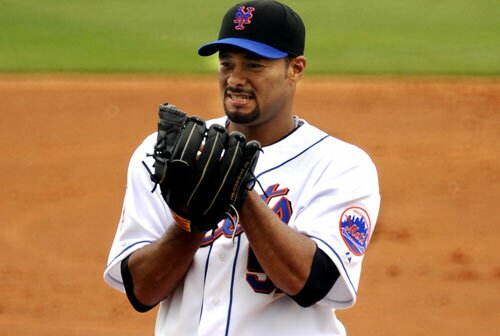
Carlos Beltran playing baseball
2

OMG you guys!
I joined the guys at Seven Train to Shea last night to discuss the Mets’ approach to the trade deadline, among other things. They asked if I would trade Angel Pagan for Cliff Lee and I reiterated my opinion that Pagan is too good to be given up for a rental player, since the outfielder will be under team control through 2012.
 Then they asked if I would trade Jenrry Mejia for Cliff Lee and I provided a rambling and incoherent response. Here’s what I wanted to get out:
Yes, if the Mets stay in this thing — and it appears that the Mets are staying in this thing — I would trade Jenrry Mejia for Lee. Pitching prospects are nearly impossible to rely on, even if they’re as talented as Mejia. No matter how good he looks now, Mejia is still only 20 years old and probably several years away from reaching his potential as a Major League starter. Many, many things can happen between now and then, things that could damn his prized, electric arm.
But I would trade Mejia with great reluctance, and not just the reluctance I express when the Mets trade any promising young player. Mejia appears to be the pitcher in the Mets’ system most likely to emerge as a frontline starter. An ace. And aces do not grow on trees.
Nor can aces reliably be found on the open market in free agency. By the time pitchers reach free agency they are generally in their early 30s, ready to begin declining. Yet due to the production they provided their prior club, they are given massive, lengthy contracts — often backloaded.
Thanks to a negotiating window, the Mets signed Johan Santana to a six-year extension at the market rate before he was even eligible for free agency, while he was still only 28. Now they’re on the hook for $77.5 million over the next three seasons, and Santana is beginning to show his age.
So when I hear reports that the Mets will only trade Mejia for Cliff Lee if Lee provides a negotiating window, I cringe. Lee will certainly not sign for less than what his agents believe to be fair market value. So instead of giving up their top pitching prospect to rent a great starter for a half season, the Mets would be giving up their top pitching prospect for the right to sign a guy to the same contract they could have given him as a free agent come the offseason, and a contract that will likely be an albatross in a few years.
Don’t get me wrong: Cliff Lee is amazing. But he will also be 32 by season’s end, and there’s no way he’ll be this good five years from now. And some team will be paying him as if he were.
That team should not be the Mets. Trade Mejia to rent the guy, sure, because world championships are invaluable and Lee significantly increases the chances of winning one. But don’t strive for the negotiating window. Let him walk and use the draft picks aggressively to try to find a guy who will develop into an ace in the future.
I asked Dickey about the Daily News article that mentioned how he was looking up stats on the Internet before his last start, hoping to find out precisely which stats he was looking up and how he used them. But he told me it wasn’t true. He said there may have been stats up on the computer when he sat down, but he wasn’t looking at them.
Josh Thole appeared amused by the entire conversation, either because of Dickey’s elocution or because I had the gall/stupidity to ask a baseball player about his stats. Ike Davis, on his way to the shower, chimed in that they only look at their record.
Dickey said the team goes over hitters’ tendencies and baserunning habits in their pitcher meetings at the beginning of each series, but that most players he knows intentionally avoid looking at their stats or anyone else’s during the season.
And, you know, duh. There’ll certainly be columns and blog posts written suggesting that Johan Santana pitched poorly today because of the news that came out about his since-dismissed sexual assault charges from October. But the truth is, Santana hasn’t been sharp all year.
 In fact, Saturday’s start was Santana’s fourth straight with at least four earned runs allowed. He’s only done that once before, back in 2004. And, of course, even when he was succeeding this season he wasn’t striking guys out.
Manuel suggested that opposing teams have become too familiar with Santana’s fastball-changeup pattern, and Santana didn’t disagree. Rod Barajas said, essentially, that maybe the league has finally caught up to Santana.
Both Manuel and Santana said the pitcher plans to mix in his slider more often, and said that doing so in the later innings today helped make his changeup more effective.
Santana said his struggles are “not the end of the world,” and stressed, “at some point, everything will turn around.”
Also, vaguely related fun fact: No one has ever described Johan Santana without using the word “competitor.”
Gary and Keith mentioned this story on air the other day and I couldn’t help but think how out-of-character it seemed for Jim Leyland — a guy who has always struck me as the most grizzled old baseball-manager type — to have a beautiful singing voice. I would have figured he just yelled “oh, horses***!” whenever anyone asks him to sing, because that seems like something grizzled old baseball men say a lot.
Anyway, it gets better. Turns out the article includes Jim Leyland’s Top 10 favorite songs. Most of them are doo-wop songs from the late 50s and early 60s, which I guess is predictable once you know Jim Leyland is a singer, because what the hell else would Jim Leyland sing?
But there are a couple of gems in there. For one, Mariah Carey’s “Hero” is ninth on the list. And fifth is this epically cheesy Survivor song I had somehow never heard before. Just imagine Jim Leyland singing along:
So while I was setting up Bob Ojeda’s SNY.tv chat last night, SNY’s Mets broadcast cut to Bob and I sitting in the studio getting prepared. We knew they might cut to us to promote the event so I wasn’t totally surprised, but no one told me they were about to cut to us right then. So you’ll note my initial shock when I notice myself on the monitor:
Keith was spot-on, incidentally. I was working as Bob’s caddy, so to speak. And while I’d prefer it if Keith mentioned me on-air to praise me as the greatest genius that ever walked the face of the earth and not to note a less glamorous aspect of my job, Keith Hernandez talked about me on TV, and that’s kind of awesome. Not trying to gloat or anything, but, you know, I’m a Mets fan and he’s Keith Hernandez.
If I knew that was going to happen when it did, I probably would have come up with something funnier than staring at the computer screen and masking my terror. Metal horns, maybe, or the sign of the Wu. Good lord, man, think of something.
I’m going to put aside Dan Haren for the purpose of this post. I figure he will — and should — cost a ton in prospects if the D-backs decide to deal him, and his contract is reasonable enough that teams with more premium prospects than the Mets can make a pitch for him if he becomes available. Plus I’m not certain why the D-backs would be eager to trade a great pitcher signed to a reasonable contract through 2012 with an option for 2013. Rebuilding processes don’t take that long; Haren should be part of Arizona’s long-term plans, not part of a firesale.
 Instead I’d like to look at Cliff Lee and Roy Oswalt, the two top-flight pitchers most frequently rumored to be available this season. Initially, I figured there was no way the Mississippi-born Oswalt would waive his no-trade clause to join the Mets, but he has since suggested he would. So dehumanizing this as much as possible, I want to compare Lee and Oswalt as commodities.
Lee is a better pitcher than Oswalt. By WAR, he has been worth 1.5 wins more than Oswalt in 2010. And Oswalt is enjoying his best season in three, so he’s more likely to regress in the second half of the season (though it’s hard to imagine Lee maintaining his historically good peripherals).
Frankly, I have no idea what either will cost. The Mariners traded three prospects for Lee in the offseason, only one of whom cracked Baseball America‘s Top 100 prospects list — Phillippe Aumont, who was No. 93.
But then teams don’t necessarily measure prospects the same way Baseball America does, plus that deal now looks like a complete fleecing. The Mariners were paying for a full year of Lee (plus the draft picks he’ll bring when he flees for free agency) and a team acquiring him now would be trading for a half season (plus the picks). But again, players seem to be worth more at the trade deadline than in the offseason, and it appears unlikely the Mariners will receive less value in young players than what they traded for Lee.
So in short, no clue. If I had to guess, I’d say it takes at least one high-end young player or prospect and 1-2 promising midrange guys for Lee, but that’s pure speculation.
But because Lee is signed to a reasonable deal that ends after this season and Oswalt is signed to an expensive deal that runs through 2011, there may be a disproportionate difference in their costs. Every competitive team could reasonably make a play for Lee, since none will be hamstrung by his contract. Only the teams that can afford to take on the $18 million guaranteed to Oswalt after 2010 can bid for his services.
That means there should be significantly more teams in the mix for Lee than for Oswalt. More competition means the Mariners can ask for more in return, driving Lee’s price higher.
So though Lee is inarguably better and would do more to help the Mets contend in 2010, it strikes me that the Mets might actually be better-served pursuing Oswalt. Granted, that assumes the Mets have — and will continue to have — some payroll flexibility, and I don’t know anything about their budget. But theoretically, the high salary should mean less to the Mets than most MLB clubs and the prospects — since they don’t have a whole lot of them — should mean more.
Of course, there’s that whole human element to consider. Oswalt has been the Astros’ ace for a long time now and certainly means a lot to that franchise. They may not be motivated to deal him — even with his big contract — without receiving top-flight talent in return. So again, who the hell knows? Consider this post useless.
OK, here starts the first of a two-part regarding the incessant talk-radio, message-board and comments-section trade chatter.
 So many things are overlooked when speculating on potential trades, but none more so than the economic factors involved. I’ll get deeper into that in the following post (about the supposedly available pitchers), but this one’s about Angel Pagan, a name frequently bandied about as trade bait for an ace pitcher.
There are plenty of obvious reasons the Mets shouldn’t trade Angel Pagan. He’s really good, for one, and a big part of the reason they’re even in contention this late in the season. And dealing Pagan because you’re relying on Carlos Beltran’s return to full health is just, well, you know. C’mon.
Inextricably linked to Pagan’s production, but perhaps less obvious, is his value to the team moving forward. Pagan will be paid $1.45 million this year, according to Cots. Per Fangraphs, he has already been worth about $9.9 million. And Pagan is under Mets control for the next two seasons. He’ll likely get a big raise in arbitration, but the total probably won’t come close to what he would cost to replace on the open market.
That means, if he stays healthy — no sure thing, of course — Pagan will provide the Mets with premium production at a bargain rate through 2012. He is precisely the type of player the Mets need more of: A low-cost contributor that allows them the payroll flexibility to pursue big-name free agents.
Obviously every angle in all trades should be explored, and if the D-backs come and ask the Mets for Pagan in a straight-up swap for Dan Haren, then, well, peace. But Pagan is worth more than a rental.
Using WAR as a quick-and-dirty reference point to evaluate players, Cliff Lee has been worth about 1.2 wins over Pagan this season. If they were to deal Pagan for Lee at midseason and both Lee and Pagan continue their torrid paces, the Mets will gain about 1.2 wins for the remainder of 2010, and that’s worth something. But the Mariners will receive Pagan’s cost-controlled production through 2012, which is worth a hell of a lot more.
Reader “dave crockett” brought up an interesting point in response to my post about the way Jerry Manuel and Dan Warthen handled John Maine’s recent injury. He wrote:
I’m no Jerry apologist, but he’s become a caricature on the interwebs. No hyperbole is completely out of hand. No need for context when it comes to Jerry’s monkeyshines. When he subscribes to the same worn out, cliched, debunked “book” that supposedly good managers also still use it’s evidence of “Jerryball”.
This to me is a prime example…
Jerry and Dan *clearly* could have and should have been the bigger men in this situation — no question. But Ted, you don’t think this incident has anything to do with Maine blasting Jerry in the press on multiple days after being removed from his last start? Maine didn’t burn *any* bridges with the act he put on, even after it was clear he was hurt?
I replied:
I’d probably just let it go if it didn’t reflect a pattern. Remember that Warthen suggested the Mets’ catchers were responsible for the team-wide inability to throw strikes last season, and Manuel had his whole thing with Ryan Church.I don’t know the nature of Manuel’s relationship with any of his players, and the players do seem to enjoy playing for him. But talk to just about any player or ex-player about what makes for a good manager, and he’ll stress the importance of the manager having his back publicly. Bobby Valentine got a lot of heat for having a big ego — rightfully so, maybe — but he generally did a great job of putting players’ mistakes on his own shoulders.
Manuel has a way of subtly divorcing himself from many of the things that go wrong in a game — instead of “we were sending him,” it was, “he has a green light,” etc. He’s very likely being honest, but he rarely seems to step out of his way to take heat for a player’s error.
dave crockett responded:
My larger point is that I think we — I’m lumping myself in this category — have a classic perceptual bias. We’ve become so hypersensitive to JerOmar’s (many legitimate) faults we can’t acknowledge positive steps. The Maine situation was handled about as differently from Church or even Beltran as possible, but rhetorically people are connecting those three instances rather than separating them.
For the record, I wish we had a better manager. It’s just that manager is really hard to significantly upgrade. The woods are full of guys like Jerry. They may not come with a bunting fetish, but it’ll be something else. Almost the most you can expect is for them to be thoughtful about and responsive to their mistakes. Slowly and uncertainly maybe that’s beginning to happen.
I’m not ready to excuse Manuel or Warthen for the things they said about Maine’s injury after the fact. But I do think dave crockett makes a good point: It does seem like Manuel and Minaya are frequently crucified on the Internet for typical behavior of men in their positions.
And it seems like, in certain situations, Manuel would be torched no matter what he did. I was surprised he brought Jon Niese back out on Wednesday night after the rain delay and lengthy inning, but also surprised by the amount of negative reaction it prompted.
Disagreeing with managerial decisions is a big part of being a baseball fan, and I’m certain that fans of every Major League team quibble with the choices their manager makes. But are we too hard on Jerry Manuel for what we perceive to be mistakes? Do we ignore the correct decisions he makes? Should we point instead to this season’s positive results?
I don’t know. I’ll still contend that he bunts too often and overworks his relievers, no matter what anyone tells me. But at the same time, I think dave crockett is right that I’d be saying something similar about any manager leading the Mets.
 Tedquarters