‘Duk posted this classic Reds video today at Big League Stew, and it made me realize that there could be a few TedQuarters readers who haven’t seen the following bit of absurdity:
Chris Sabo impressed with new cup technology
1

‘Duk posted this classic Reds video today at Big League Stew, and it made me realize that there could be a few TedQuarters readers who haven’t seen the following bit of absurdity:
So Steve Phillips has been replaced as ESPN’s resident GM-turned-analyst by former Blue Jays honcho J.P. Ricciardi.
 I don’t know exactly how it’ll shake out — from the news stories I’ve read, it sounds as though Ricciardi’s destined for Baseball Tonight and not necessarily replacing Phillips in his star turn as the third member of the Joe Morgan/Jon Miller Sunday Night Baseball booth.
I read speculation earlier this offseason that Bobby Valentine could be ticketed for that role, but I can’t find anything concrete online. Either way, the good news is that this pretty much confirms Steve Phillips will be nowhere near our TV screens anytime soon, unless he’s on the Today show apologizing again or breaking into our homes to steal our TVs.
I don’t know how Ricciardi will fare on-screen. By most accounts, he had a reputation as an accessible and charismatic GM, but he did have a strange proclivity for saying really weird things. And at least one time, just straight-up lies.
So that should be interesting. Plus Ricciardi, as a former Billy Beane protege, is lumped in with Moneyball and sabermetrics even if many of the moves he made with the Blue Jays don’t exactly speak to those philosophies. So if Ricciardi goes off on some misguided tangent like Phillips used to, it will be amusing — or perhaps maddening — to watch the Murray Chasses of the world point to his words as why stats-based analysis has led baseball astray or whatever.
But while I don’t watch a whole lot of Baseball Tonight anyway now that the MLB Network has launched, here’s hoping Ricciardi turns out better as his new job than he was at his old one, and he can use the platform to bring a better understanding of advanced metrics to a wider audience.
Chico Harlan at the Washington Post wrote that the “Nationals’ roster seems unusually well-defined” this morning, but apparently it’s getting a lot, well, less defined this afternoon.
 According to Bill Ladson of MLB.com, the Nats agreed to terms with Livan Hernandez on a Minor League deal today.
This is doubly good news for the Mets: First, it means the Mets will not acquire Livan Hernandez at any time in the foreseeable future. Not that the move had been rumored, but, well, it’s always good to have to certainty.
Second, it means there’s a good chance the Mets will face Livan Hernandez several times in 2010.
I don’t mean to discredit the 135 innings Livan scarfed down for the Mets in 2009, especially given how pitiful the Mets’ starting staff was at times last season, but Hernandez’s unique ability to stay healthy enough to make 30+ starts a year has now been entirely mitigated by his inability to retire Major League hitters in any consistent fashion.
Hernandez finished dead last among qualifying pitchers in the Majors with a 76 ERA+ in 2009 after finishing second to last with a 71 ERA+ in 2008. I defy you to find someone who has been permitted to throw so many innings so poorly since Jose Lima.
No one will convince me that Hernandez can offer more to a team than Nelson Figueroa at this point, which is good, because I don’t think anyone’s trying. Even his once-lauded batting abilities have withered with time.
Some mischievous editor slipped one past the goalie at MLB.com:

I know it’s not pronounced that way. But there are a lot of more tactful ways to word this headline. Kudos to whoever didn’t opt for any of them.
Hat tip to D.J. Short for pointing out this article in the Times today, about how Topps is giving baseball-card collectors an opportunity to win, among others, original Mickey Mantle rookie cards.
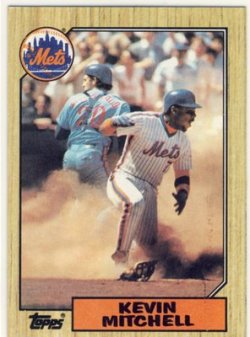 I have thousands of baseball cards, sitting in binders and boxes and bags in my parents’ basement. There’s nearly a whole storage room dedicated to them, the fruits of years of labor by my brother and me in the late 80s.
But what’s funny to me is how much time is spent valuing baseball cards, because I wonder how many baseball-card collectors, when push came to shove, could actually bring themselves to sell their once-prized possessions?
And I wonder if the actual, price-guide value given to the cards has anything to do with how much we, the owners, actually value them?
I have no idea what a Kevin Mitchell 1987 Topps rookie card is supposedly worth. I do know that it’s one of the most awesome cards in history — featuring Mitchell crossing home plate in a cloud of dust — and that when Mitchell’s career took off in 1989, my brother and I spent hours plumbing the depths of our collection to pick out every single one had — and we must have had 30, no joke — and put them in our binder of valuable cards, right next to the Pete Incaviglia and Mike Greenwell rookies from the same year.
But what did we honestly expect to get from that? College tuition? A car? A house? Did we ever really plan on selling the things? I have no idea.
I know that if now, someone came up to me and offered me twice the Beckett price-guide dollar value for all those Mitchell rookies, I’d say, “hell no.” I don’t even think I’d sell him one. And I have no idea why. I haven’t even looked at the things in years.
Collections, and the instinct to collect, are strange to me now. Sure seemed to make a lot of sense to me when I was a kid, though.
I know marketing departments dominate Major League color-scheme decisions, but it always bothers me how dull the variety is in baseball. It’s like every team is some variety of royal or navy blue with white, sometimes highlighted by red or orange.
I’ve been campaigning for several years to no one in particular that some team should adopt the UCLA color scheme — sky blue and yellow. The Rays added both colors when they ditched the “Devil” from their nickname, but they’re tethered to the navy-and-white hat for whatever reason.
Anyway, they introduced new sky blue jerseys today, another step in the right direction. And it appears their batting-practice caps are sky blue with white. It’s not hard, Rays’ marketing department: You change your hat to sky blue with yellow letters, and I’ll buy one. That’s one sale, done. It helps that your hat has my initials (and Taco Bell’s) on it.
H/T to Craig Calcaterra for the link.

Bobby Kielty’s in the news this week, apparently trying to make a comeback as a pitcher after being cut by the Mets in the great, mysterious Lake Erie Eradication of 2009.
(If you’ve forgotten — and you probably have — the Mets cut Kielty, Javier Valentin and Wily Mo Pena from their Buffalo club on the same day in late June last year. I’m still not certain why it happened — for all I know, there were contractual reasons for the moves — but it did seem funny that a team desperate for depth should cut the only three hitters on its Triple-A club with any history of Major League success in one fell swoop.)
Anyway, Kielty’s return gives me enough reason to reprint this split image, an underrated athlete/celebrity lookalike, I feel. It’s Kielty with his hat off, and South Park’s Kyle Broflovski in the same condition. Daywalkers both:

The Times had a great article today about Brian Cashman’s trip to China to show off the Yanks’ World Championship trophy:
M.L.B.’s goal is to build a base in China like the N.B.A.’s. It broadcasts games to more than 50 Chinese television stations and reaps tens of millions of dollars in revenue from Chinese fans. But baseball has a long way to go: four million people play baseball in China, according to Xinhua, the state news agency, and the country has a relatively meager professional league. By comparison, China has a nationwide basketball league, and 300 million Chinese are said to play the sport regularly.
That sounds about right — basketball is absolutely everywhere in China. I spent a month there in the summer of 2007, and spotted hoops in the Forbidden City and at the foot of the Great Wall. A student I spoke to asked me to “detail the extent of Yao Ming’s genius.”
It makes sense for Major League Baseball to be doing outreach to China. Even one marketable Chinese star could mean a huge boost in revenue and a massive expansion of the international-recruiting base, assuming the country takes to the sport anything like it has to basketball, which it probably would, since baseball’s awesome.
Anyway, here’s what I wrote from a Chinese Internet cafe in 2007. (Incidentally, the Chinese word for Internet cafe is pronounced “wangba.” But “wangba dan” means “turtle egg,” which, in Chinese slang, means “son of a bastard.”) I was oversimplifying things a ton, but I was all gussied up on grad school at the time. I really just wanted to reprint it here because I liked the Colonel Sanders line.
And there’s little or no sign of [baseball] in China.
Still, there’s hope on the horizon. Though the intricacies of baseball can appeal to high-minded audiences and the spectacle can appeal to more lowbrow fans, baseball is undeniably a middle-class fascination. In a nation that exerted so much effort squashing out class distinctions and so-called bourgeois behavior for so long, it makes perfect sense that baseball — like many sports — hasn’t entered the hearts and minds of the Chinese population. It’s one of those ‘opiate of the masses’ things that Karl Marx railed against.
(Little known fact: Marx’s quote on religion is about as frequently taken out of context as any maxim there is. Marx himself was a recreational opium smoker, so his stance on religion wasn’t nearly as harsh as it sounds today. I find baseball, in reasonable quantities, to be a pleasant, healthy alternative to opium for taking the minds of the people off their fettered working conditions.)
But though president Hu Jintao and most of the Chinese government are still technically part of the Chinese Communist Party, capitalism now dominates Shanghai and most of the urban parts of China I’ve seen. Retail shopping permeates every inch of storefront and sidewalk space, and the ominous Big Brother stare of Chairman Mao has been replaced by the perhaps equally ominous stare of Colonel Sanders — there’s a KFC on every corner, it seems.
And stadiums are under construction everywhere I turn. None of them look to be dedicated to baseball, but it seems like only a matter of time before the growing fascination with sports in China — spearheaded by the excitement surrounding the 2008 Beijing Olympics — leads the giant nation to baseball.
Big thanks to Takashi to pointing me to this massive developing story out of Japan. Tsuyoshi Shinjo has apparently shaved his head. Check it out:
I can’t say I’m 100 percent in favor of the decision. I realize I should know better than to doubt Shinjo’s fashion choices, but man, he had some good hair, and I can’t help but think its absence is society’s loss. Still, maybe Shinjo’s just so far ahead of the fashion curve that I can’t even comprehend how stylish his newly shaved head is, and soon I’ll come to realize how good he looks.
That said, even he looks like he’s still getting used to it.

Market inefficiency is the new black.
 Moneyball, despite what Murray Chass thinks, was not about VORP. It was about one general manager identifying a widespread anomaly in baseball’s marketplace and exploiting it. At the time, players with high on-base percentages were not paid in accordance with the way they helped their teams win, so Billy Beane stockpiled them for his Oakland A’s.
Today, now that the value of OBP is more widely recognized, everyone’s searching for the new market inefficiency. This offseason alone, I’ve read how older players are a market inefficiency and how versatile players are a market inefficiency. And though players who rated well on defense were recently considered another market inefficiency, Ken Davidoff reported earlier this offseason that some baseball people now felt they were being overvalued.
I’m confused. And I’m beginning to wonder if, in a post-Moneyball world with so many analysts and bloggers and GMs out to find the new market inefficiency, it isn’t increasingly difficult for that single marketwide inefficiency to actually develop.
Now I can’t purport to know exactly how baseball teams operated before Moneyball, or, heck, even now. But the book sure made it seem like nearly all the Major League teams were zigging and Beane was zagging, and that’s what allowed him to take advantage.
Clearly that is no longer the case. Beane’s proteges and advocates of advanced metrics have spread throughout the league, and many are working, just like we are, to identify the best way to help their club win at the most reasonable cost. In other words, it’s a lot harder to practice moneyball now that everyone’s read Moneyball.
That’s my guess, at least.
Which is not to say it’s impossible to find a particular team that overvalues or undervalues a particular asset and exploit it. The Mets — at least according to Omar Minaya — seem to think Gary Matthews Jr. still has something to offer defensively, whereas any team with access to Fangraphs would likely disagree. So bully for the Angels for taking advantage of that, and getting what appears to be an anomalous return for their sunk cost.
Nor is it to say a team can’t find a great value on a free agent past his prime. They can, of course. But it has to be a good free agent past his prime, and one likely to return more value to his club than he’s compensated for. And there aren’t exactly a ton of those players flopping around. If simply stocking up on old guys made you a shrewd baseball economist, Michael Lewis would have written a book about Brian Sabean by now.
Same goes for versatile players that can allow a team to make better use of their available roster spots. If they’re good and available at reasonable rates, they can be immensely valuable to a team. If they’re Joe McEwing, they aren’t.
So it strikes me as too easy to say one type of player or another represents a new market inefficiency, or at the very least overstated. For an inefficiency to truly develop, the bulk of teams would have to be undervaluing a particular, measurable skill, and neither old age nor versatility is necessarily that, nor is it clear that most Major League clubs are ignoring those types of players.
It’s entirely possible, even in this day and age, that some aspect of winning baseball is being undervalued and that someone will be able to take advantage of it, but it appears from this angle like the best way to operate is trying to identify the bargains on a case-by-case basis rather than pursuing some elusive, overarching secret key to success.
 Tedquarters