
From the mailbag: Wright, Beltran

Ceetar writes:

You looked up streaks The Captain has had before that were this good, but has this year now surpassed those in length?

He means David Wright, for what it’s worth. And yes, it has. In a couple of earlier posts, I looked up whether Wright had any hot stretches in any of his disappointing seasons from 2009-2011 that, if isolated by arbitrary endpoints, match the production he has put up to open the 2012 season. There were 33- and 38-game stretches that matched this hot start, but by my best digging on the baseball-reference gamelogs, I can’t isolate a 41-game stretch from any of those years in which Wright was this good for this long — at least if you consider Wright’s lack of strikeouts along with his hilarious production.
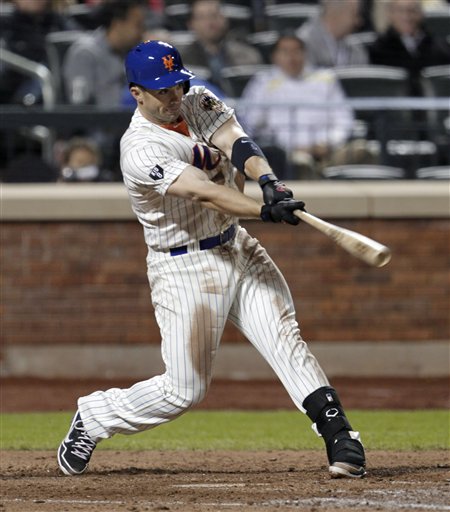
In fact, the last time I can find that Wright was this hot was back in his MVP-caliber 2007 campaign, when he posted a .379/.500/.662 mark from the second game of a July 28 doubleheader through Sept. 12. And though Wright hit 10 home runs over that stretch and it was less fueled by batting average in balls in play, given the distinctions in hitting environments and league-wide offensive standards it seems reasonable to contend that an 1.128 OPS today is at least impressive as a 1.162 OPS in 2007 (to boot: Carlos Beltran’s .904 OPS with the Mets in 2011 produced a 152 park- and league-adjusted OPS+ whereas his me-first .982 OPS in 2006 yielded a 150 in the same stat).

Which is to say something you may have noticed: Wright’s first 41 games in 2012 represent about the best we’ve seen of the man. And it is, you may also have noticed, pretty spectacular.

As for calling Wright “The Captain,” this is confusing for a bunch of reasons. For one, to me “The Captain” will always refer to The Captain Dog (more frequently known simply as “Captain” or “T. Captain Dog”) my late, lovably dumb, giant-headed Scottish Terrier. Alternately, it might also refer to Captain Morgan or Kirk Nieuwenhuis.

Should the Mets name Wright their captain? I guess? If someone could tell me anything specific that a baseball-team captain does that David Wright doesn’t already do, I might be more adamant about it. He gets to wear a little “C” on his jersey? Symbolic gestures are nice, but I suspect the best way to indicate to Wright and Mets fans that the team is committed to him as a leader and player is to pony up for a long-term extension, which seems pretty likely anyway.

Tyrion writes:

Carlos Beltran leading the league in homers while not an upcoming free agent, how does this selfishly benefit him?

Beltran has figured it out, Tyrion. He knows that we know he’s only playing for his next contract, so he’s playing really well in a non-contract year as misdirection so it doesn’t seem suspicious when he plays really well in a contract year. He pulled the same act with the Mets in 2006, 2007, 2008, the first half of 2009, and the last month of 2010. It’s utterly depraved.

From the mailbag: Baxter, Hamels, Nieuwenhuis

The Mets-heavy edition. Here we go.

Scott writes:

What’s your opinion on how the Mets should utilize Mike Baxter at least for the immediate future?

It has been good to see Baxter get some starts over the past week, and he’s earned some more. Plus, though Baxter has seen very few opportunities against left-handed pitchers in 2012, he didn’t really demonstrate much of a platoon split in the Minors. So if Baxter is on the bench for a game, I might rather see him left in to face a lefty specialist in a pinch-hitting spot than see him pulled for one of the Mets’ lesser-hitting righty bench bats (i.e. anyone but Scott Hairston).

We talked about this some on the podcast that just rolled out: Jason Bay’s probably going to play every day when he returns, at least to start. There are a bunch of reasons for this, some better than others. His contract and veteran status don’t seem like good reasons to play him every day, but they do seem like likely factors. One last effort to get him straightened out so the Mets can part ways with that contract without eating the whole thing does seem like a decent reason.
But if and when Bay struggles against righties — as he did in 2011 and the first couple of weeks of 2012 — the Mets will have to face platooning Bay if they want to win as many games as possible. They’ve got three lefty-hitting outfielders (with varying amounts of upside) who are under team control way longer than Bay and who could feasibly play some role on future Mets contenders. Baxter, older and less-heralded than Kirk Nieuwenhuis and Lucas Duda, is probably the lowest priority for regular at-bats. But he has also performed the best in his tiny sample in 2012.

Unless Baxter is somehow one of the top five hitters in the Majors he’s not going to keep hitting at this clip, obviously. But 27-year-olds with histories of good Minor League hitting do sometimes come out of the woodwork to become productive Major League regulars, so it doesn’t seem imprudent to give Baxter as many opportunities as possible to prove himself. It’ll just be tough to do that, given how many lefties the Mets have in their lineup and how many seem to also merit regular at-bats. The task becomes easier if the Mets do decide to demote Ike Davis.

Paul writes:

Hey Matt,

Big fan of the blog. I was wondering do you think the mets should trade David Wright? and what sort of prospecs could they get in a deal for wright? chipper jonas is retiring, would the Braves be willing to give3 up some of their arms in a package for Wright?

Hey Paul: You misspelled “traid.”

Speaking of which, C. Hamels writes:

If you could traid Val Pascucci straight up for me, would you pull the trigger?

Well, yeah. C’mon now. I hope it’s clear by now that I realize Cole Hamels is about as awesome at pitching as he is at posing for embarrassing photos. Plus, as much as I dislike the Phillies, I’m rooting for Pascucci to get more Major League chances anywhere, and the Phillies could use a bat right about now. Ty Wigginton, of the .639 OPS and the not-very-good defense, is the righty half of their first-base platoon. You’re telling me Pascucci can’t outproduce that?

The Mets could use a starting pitcher, the Phillies could use a power bat and Pascucci could use another crack at big-league pitching. It just makes sense. GET IT DONE SANDY.

Steve asks:

Kirk Nieuwenhuis (spelled it without looking it up, how’d I do?) has been striking out in 30% of his at bats. You think he’ll still turn out to be a solid regular?

Nieuwenhuis’ 30.3 percent strikeout rate is nothing extraordinary by his standards; he struck out in 27.4 percent of his plate appearances in Triple-A. He will likely have to improve that if he aims to become a solid regular.

The outstanding baseball-reference play index for whatever reason doesn’t seem to search by strikeout percentage, but to date there have been only 17 full seasons in Major League history in which a hitter suffered an at-bat to strikeout rate as low as Nieuwenhuis’ current 2.9 with an OPS+ above 100 (i.e. league average). Most of them are by three-true-outcomes type mashers: Three by Jack Cust, two by Jim Thome, two by Mark Reynolds, two by Rob Deer, two by Adam Dunn, etc.

Of course, there’s probably some selection bias in play. Ten of those 17 seasons have come since 2006, so maybe, as the Major Leagues warm to the idea that strikeouts aren’t so awful, we’ll see more guys succeed despite extremely high strikeout totals. And maybe, somehow, Nieuwenhuis is one of those guys.

But since Nieuwenhuis is currently the benefactor of the Majors’ second-highest batting average on balls in play, it seems like he’ll have to put more balls in play to keep his batting average and on-base percentage up when that normalizes a bit. But he’s 24 and these are only his first 144 Major League at-bats, so there’s hope yet.

Sources hear Yankees could be put up for sale

Multiple baseball and finance sources told the Daily News they are hearing that the team the Steinbrenner family has led to seven World Series titles could be put on the block in the wake of the record sale price of $2.175 billion the Los Angeles Dodgers went for in April….

Yankee president Randy Levine adamantly denied the rumors: “I can say to you there is absolutely, positively nothing to this. The Steinbrenners are not selling the team.” And managing general partner Hal Steinbrenner, George’s younger son, weighed in with his own denial Thursday morning, saying in a statement: “I just read the Daily News story. It is complete fiction. Me and my family have no intention to sell the Yankees and expect it to be in the family for years to come.”

However, according to the sources, who requested anonymity because of the sensitive nature of the situation, the recent sale of the Dodgers to a group that includes NBA legend Magic Johnson is just one reason why the Steinbrenner family may be looking to sell the team, which experts estimate could be worth up to a stunning $3 billion.

Michael O’Keeffe and Bill Madden, N.Y. Daily News.

Are you a hedge-fund billionaire looking to get your name in the papers more often? Do you fantasize about paying Alex Rodriguez tons and tons of money through 2017? Good news! The Steinbrenners could possibly be considering selling the Yankees soon, even though they deny it.

Hopefully I have an extra $3 billion laying around by the time it actually goes down because it’d be fun to buy the Yankees then troll everyone hardcore. Put names on the back of the jerseys, or change their name back to the Highlanders and go with an entirely Highlander-themed new logo and color scheme — tartans and lightning bolts and stuff.

Over-unders revisited

At long last, I have added the rest of the preseason over-unders to the sidebar on the right side of this blog for reference. Five of them have been settled already.

Kirk Nieuwenhuis made his Major League debut on April 7. 63 percent of readers believed he would appear in a big-league game before July 13.

Dillon Gee shaved his goatee last week. 66 percent of readers predicted he would shave it before July 1.

On May 18 in Toronto, Scott Hairston hit an opposite-field home run — his first since 2009. Only 41 percent of readers thought Hairston would serve up the proverbial oppo taco this season.

Finally, when Mike Pelfrey fell victim to a torn ligament that ended his season prematurely, he locked in a line full of weird, small-samply rates. He allowed 11.0 hits per nine innings this season after only 35 percent of readers thought he’d allow more than 10 hits per nine, and, more alarmingly, he finished with a 3.25 K:BB ratio, which absolutely no one predicted.

Differential equations

A couple of friends of the program weighed in on the Mets’ extreme (and rather ominous) run differential today. Check out Mike Salfino and Patrick Flood on the subject.

What they say is true: The Mets won’t keep winning like they have been if they keep getting outscored like they have been, so they can either start playing better or start losing more games. But that said, the 22 games they won in their first 42 are banked now regardless of how they got them.

With Leather

Completist readers of this site know that: A) I’m generally down on prospects, or at least banking on prospects from the low Minors to someday contribute to Major League teams and B) I still sort of randomly pick favorite prospects and track their progress even if I know how unlikely it is they’ll ever be as good as I hope. One such prospect is lefty Jack Leathersich, who earned my attention based on his awesome name and even more awesome strikeout rates. Toby Hyde has an interview with the young man, who was recently promoted to High-A St. Lucie.

Leathersich’s first 36 2/3 professional innings have gone about as well as any pitcher could ever hope, for what it’s worth. He has struck out 63 batters in that span while walking only 11, yielding 16 hits and no home runs. He has a 0.74 ERA. Yeah, he’s probably ready for High-A ball.

Card stock

Baseball fans argue endlessly about the best ever to play the game, tossing around names like peanuts at a ballpark. But no one disputes that the greatest card collector was Jefferson R. Burdick….

The father of card collectors, as Burdick was known among his admirers, amassed more than 30,000 baseball cards that are presumed to be worth millions of dollars.

But they will never reach the marketplace because Burdick gave his trove to the Metropolitan Museum of Art, the storehouse of civilization known for its Egyptian mummies, medieval armor and Renoirs. It also houses one of the largest baseball card collections in a public institution.

Ken Belson, N.Y. Times.

Awesome read from the Times about Jefferson Burdick, a lifelong baseball-card collector (and oddly, not a big baseball fan) whose collection is housed but not fully on display at the Metropolitan Museum of Art. The article says that “the museum is trying to fulfill his wish that the cards be available to everyone,” which would be sweet. I happen to enjoy the Met plenty without a huge old-timey baseball-card exhibit, but I imagine I’d go there a lot more if there was one.

In the earliest days of my baseball fandom, I collected cards voraciously. I don’t know why exactly it petered out in the early-to-mid-90s — probably some combination of things. I remember growing slowly frustrated with the splattering of card brands, when it was no longer just Topps, Donruss and Fleer but suddenly Upper Deck and Score and Bowman and O-Pee-Chee Premier, and the valuable cards weren’t just the rookies of the good players but the Platinum Special Collection Rookies of the good players and other such nonsense. Also, I suspect my burgeoning interest in girls probably got in the way of considered baseball-card investments.

I still have every single card, though. They’re not worth nearly as much as I thought they’d be by now, in part because my brother and I scaled them and flipped them and traded them with our neighbors all the time, and never paid much attention to keeping them in good shape. Plus I’d never sell them anyway, because selling the baseball-card collection that I shared with my late brother for something less than the fortune we thought we’d someday reap from our binder pages upon binder pages of Pete Incaviglia rookies would be about the saddest thing imaginable.

Sometimes when I’m home, I look through them. The binders are a fun reminder of the dudes we hoped would one day be good and how infrequently prospects actually pan out, not to mention an entertaining peek at several of the late-90s’ beefiest sluggers in their much slimmer days.

But now I’m more taken by our huge duffel bag full of scrubs, all the heroically mustached and tragically sideburned lunchpail guys we tossed aside while weaning out the Wally Joyners and Kevin Seitzers. Some of the names and faces I recognize from later stints with the Mets or one of their divisional opponents, or from certain odd moments in the national spotlight forever inked in my memory; some are guys I’ve seen coaching or scouting, even spoken to in this line of work.

Most of them are just guys, though — smiling portraits or dirty uniforms with a baseball-reference page and a permanent home stuck face-to-face with Kelly Gruber in a duffel bag in my parents’ basement. And somewhere, certainly, those guys and their wives and their kids have those same cards framed and those baseball-reference pages bookmarked, and a lifetime of triumphant and tragic baseball memories to go with them.

And I don’t think that’s sad, really. I think that’s pretty awesome. I mean, Spike Owen doesn’t have any photos of me in his parents’ basement.