Melting down

I understand the whole debate about chemistry in a clubhouse, and if it truly impacts the bottom line of a team’s performance. I understand that any major league player should perform well under any circumstance, regardless of emotional stimuli. However, I don’t think you can deny the positive impact that having a good clubhouse can provide. I’d like to think that this team’s situational hitting is directly correlated to the fact that they have a good group of guys that put team first. So with that said, how worried are you that this team, because of its seemingly emotional reliance, can keep its confidence up when the bullpen collapses in such fashion? How much effect do you think it actually has on guys like Justin Turner (who’s had limited opportunities but has put together a few key AB’s this season, including providing tonight’s go ahead runs in the 9th) and his psyche to see the bullpen collapse multiple times in one series? Basically, can bullpen collapses actually create a feeling of “this is all for naught?”

– Brian, via email.

OK, where to start.
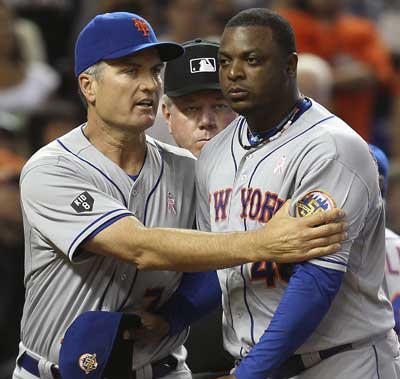
Having a decent group of dudes in the clubhouse certainly can’t hurt a team, but why do we know that these current Mets are a better group of guys than previous incarnations? I suspect it has to do, mostly, with one thing: They’re winning more than they’re losing, and the opposite has been true the past few years. Every team at every level has more fun when it’s winning ballgames, and so naturally we look at them and say, “man, they really like each other; they’re pulling for each other; they’re winning games for each other.”

And we probably feel like we know Turner in particular more than most recent Mets because he’s generally available to fans, via Twitter and the press, and does seem like a good guy. But Marlon Anderson also seemed like a really good guy. Jeff Francoeur, by most accounts, is pretty much the best guy.

Which is to say that fundamentally I disagree: I do not think the team’s strong situational hitting to date is directly correlated with its positive clubhouse atmosphere. I think it’s more likely a combination of some good luck, a bench that’s probably better constructed than most initially thought, and some poor hitting in other situations earlier in games that amplifies the team’s success in certain clutch spots. Remember that earlier in this same season, many decried the team’s inability to hit with runners in scoring position. But it was the same group of good guys. What changed?

But all that said, I don’t think a couple of bullpen meltdowns — even those as miserable as yesterday’s debacle — could break a Major Leaguer’s spirit like that because I don’t think that type of capricious, defeatist attitude breeds Major League baseball players. Look at Turner, for example: The guy spent five seasons in the Minors before he finally got a full-time shot last year. In 2010, he torched the ball at Triple-A while the Mets started Luis Castillo, Alex Cora, Joaquin Arias and Luis Hernandez at second base. If he’s so subject to external factors as to allow a bad bullpen to break him, I suspect he’d have long since packed it up by now.

And the same goes, to some extent, for pretty much everyone on the team. No one makes it to the Majors without failing a lot and having the guys around him fail a lot. And if you can’t handle that, I imagine you don’t last very long.

As for that bullpen: It’s not good. It seems like the club’s relief arms are being victimized by a mix of bad control, bad luck and overuse. Last night’s culprits — Ramon Ramirez, Frank Francisco and Manny Acosta — have been the worst of them, and though all three have been hit hard at times and are doing themselves no favors with unintentional passes, they’ve all suffered batting averages on balls in play way higher than their career norms. There’s a pretty good deal of evidence suggesting that Ramirez and Francisco are capable Major League relievers, and it’s still only May 13. If they’re healthy, I’d bet on them turning it around.

The Mets lead the Majors in relief appearances, partly due to the ineffectiveness of their relievers. I propose this phenomenon be called the Jerry Manuel Quandary: Bad relief pitching causes overuse and overuse causes bad relief pitching. That doesn’t really explain the bad outings yesterday, though, and the two most-used pitchers in the Mets’ bullpen — Jon Rauch and Tim Byrdak — have been among the best.

Regardless, it doesn’t seem like it could hurt the team at this point to shake things up with a fresher arm from the Minors. Since there’s no easy fix on the Mets’ 40-man roster, there doesn’t appear to be an obvious move, but there are some viable candidates at Buffalo: Lefty Garrett Olson (who has been starting in Triple-A) and young righty Elvin Ramirez among them.

One reliever to keep an eye on — though it’s certainly not time for him yet — is Double-A righty Armando Rodriguez. Rodriguez was in big-league camp this spring on the Mets’ 40-man roster for Rule 5 Draft protection, but was passed through waivers at the start of the season. In his first 23 innings as a full-time reliever in the Minors, the massive Rodriguez has a 0.78 ERA with a 5:1 strikeout-to-walk ratio.
Gee’s up?

Over at Amazin’ Avenue, Chris McShane examines Dillon Gee’s start to the season and wonders if the 26-year-old’s improved peripheral numbers indicate some real improvement.

It’s actually something I’ve been planning to ask Gee about next homestand: He’s striking out more guys and walking fewer hitters, but his batting average on balls in play is up, as is his home run per fly ball rate. He’s yielding more ground balls, but also more line drives.

Those results seem to indicate he’s throwing more pitches in the zone and getting hit a bit harder in the process, but this data suggests he’s throwing strikes at a similar rate to last year and yielding less contact (with more swinging strikes). He’s also throwing fewer fastballs. Maybe he’s fooling more hitters more often with breaking stuff, but paying for it when they don’t get fooled?

Beats me. And this is all classic small-sample-size stuff.

To date, Gee has pitched differently in 2012 than he did in 2011, and in some way that’s more amenable to the peripheral-based ERA predictors but that hasn’t yet paid actual dividends — his WHIP, ERA and ERA+ are all worse than they were last year.

This type of return — striking out a decent number of guys while not walking many but getting hit pretty hard — seems more in keeping with Gee’s Triple-A numbers than his 2011 campaign did, so it’s not hard to imagine it continuing. Given that history, though, I’d be pretty shocked if his actual ERA dips down close to his strong FIP and xFIP.

One upside — and again, small sample size — seems to be that Gee has gone deeper into games. This could just be because Gee has to date avoided the type of clunker start that has befallen all his rotation-mates, but he’s averaging 6.3 innings per start, up about a half an inning per start from last season.

The Adjustment Bureau

Flash back to March of 2011, a Mets off day in Port St. Lucie. Davis decides to see “The Adjustment Bureau,” a movie about career vs. happiness. Matt Damon and Emily Blunt are in love, but a shadowy organization tries to keep them apart, because their important careers will be spoiled by a relationship.

On the way out of the theater, Davis and then-third base coach Chip Hale run into one another, and discuss whether they would rather find true love, or hit 800 home runs.

“Gotta go with the home runs,” Hale says.

“I would take the true love,” Davis argues.

Andy Martino, N.Y. Daily News.

Well that’s gonna make ’em swoon, Ike. Of course, there’s a minor, unfortunate chicken-egg scenario, since, as they say, chicks (and dudes) dig the longball. Still, you have to figure if he can rattle off a few more backbreaking 430-foot bombs like the one he hit Wednesday in Philadelphia, he’ll again earn True Love from Mets fans, if not true romantic love. And I’m still waiting on my first big-league homer but managed to win the love of a beautiful, awesome woman anyway. So there’s hope for us all, on both sides of the Mendoza Line.

All that aside, Davis could enjoy his day off yesterday seeking true love with whatever confidence comes from his most encouraging game in weeks. Andrew Keh at the Times has more on the mechanical adjustments the Mets’ coaching staff believe Davis made — and needs to make — to get out of his early season funk.

Taxi!

It happened to Dickey a few times earlier in his career, first when he played for the Texas Rangers and later when he was in the Milwaukee Brewers’ farm system.

He once spent three days at a hotel in St. Louis while the Brewers mulled calling him up. And because he was flown in to possibly replace a struggling player, not an injured one, the team didn’t want any major leaguers to see him. Dickey had to stay in his room until players left for the field in the early afternoon.

“It’s lonely,” Dickey said. “Nobody there would talk to you. You get a random call at random times. ‘Hey, we’re not going to activate you tonight. Just spend the night. We might activate you tomorrow. Beeeeeep.’ It’s really bizarre. You feel like an MI-6 agent.”

Brian Costa, Wall Street Journal.

Lots of good stuff from Costa on baseball’s new taxi-squad rule and the shady tradition it grew out of.

Via Amazin’ Avenue.

Deuces wild

The Mets’ strong offensive performance with two outs to date this season comes up a lot, but the numbers are often presented without context. So here’s some:

The Mets have scored 67 of their 118 runs with two outs. That’s not typical, though I don’t know that it’s meaningful either.

Generally, the league as a whole scores just under 38 percent of its runs with two outs, about 38.5 percent with one out, and by far the fewest of its runs with no outs (which makes sense). There’s some variation every year, and the numbers are close enough that it’s not at all uncommon for a team to score more runs with two outs than it did with one out (the Mets did last year, for example, and the National League as a whole did in 2008).

It does seem weird for a team to score 56.8 percent of its runs with two outs, as the Mets have to date in 2012, but since it doesn’t appear the Mets are doing anything appreciably different with two outs than they are with one out or no outs, I’d guess it’s just a heaping helping of early-season randomness. And part of it certainly has to do with how bad they’ve been with one out — hitting to a .618 OPS, well below their .707 team rate. That’ll even out, and when it does, the two-out stats won’t seem so extraordinary.

Want more weirdness? The Braves have scored 50.6 percent of their runs with one out. Why? Randomness. Sorry, but it’s going to take a hell of an explanation to convince me otherwise.

But if the randomness thing doesn’t satisfy you as an explanation for the Mets’ two-out heroics, try spreading this around and hope it catches on: The Mets never attempt sacrifice bunts with two outs, so they score lots of runs.


Twitter Q&A

Yes, and I don’t think they’ll be far off. Presumably by the time the apocalypse rolls around, a good portion of the human population will indeed worship Giancarlo Stanton.

Seriously though, I think about what future civilizations will assume about us a lot, even though it’s utterly pointless because whatever they think will be filtered through their all their future-people frameworks and we have no idea what those will be. This especially happens whenever I go to DC and tour the monuments at night, since our memorials to great leaders look a bit like those from earlier civilizations that we assume and/or know to be temples to religious figures — at least in their stateliness.

And of course, the way future civilizations perceive us all has to do with how much of our information survives, and we’re documenting everything much more thoroughly (and archiving it all better) than we ever have before. Basically, as long as there’s no dark-ages stuff, some massive worldwide event or series of event that prevents the advancement and preservation of technology, future people are going to know more about us than we know about anyone from the past. But will the people of 3012 have a way to play Blu-ray? Will they even have the right cables? Because if there’s no way to watch Crank 2: High Voltage in stunning HD quality, the future sucks.

There were a couple of questions about Mejia, who’s set to make a 75-pitch rehab start today in St. Lucie. It’ll be interesting to see how the Mets handle him. For all the hype around him dating back a few years now, he’s still only 22 and he’s still only made six starts in Triple-A — he is younger than Matt Harvey with less experience starting at the highest level of the Minors.

Mejia’s got the Jerry Manuel-fueled taste of big-league mop-up duty under his belt, so it’s unfair to call him less experienced than Harvey. But it’s worth noting that he’s yet to throw more than 100 innings in a season at any level. I have to imagine the Mets will want to proceed cautiously with him for that reason, and he’ll wind up starting games in Buffalo. This article from the Daily News suggests Mejia could see a spot start at Citi at some point before Chris Young is ready, though.

Everything out of the Mets seems to suggest they’re bullish on the prospects of Young returning, which is weird since he’s coming off shoulder surgery and has spent most of his last three seasons on the disabled list. But I have not seen Young throw and presumably the Mets have, so maybe they’ve got good reasons. And ideally, they just need Young to stay healthy until one of Harvey, Familia and Mejia proves ready for the Major League rotation later in the summer.

Well I definitely don’t think the division is bad: There’s only one team in it below .500 (and it’s the Phillies, everybody! The Phillies!) and it has the best collective winning percentage in the National League. I do think many people underestimated the Mets before the season, what with the silly 60-win predictions and such.

But I wouldn’t read much into the Mets’ record against their division. It’s nice and it’s a great way to start the season, but it’s also a small sample. They happened to play the Braves before the Braves got hot and the Marlins before the Marlins got hot. All credit to the Mets for beating those teams when they did, but at some point they’re going to run into some divisional opponents playing at their best and their record against the NL East will balance out a bit. The good news is they probably won’t put up an ofer against the NL Central all season.

Josh Hamilton hits four home runs (and a double)

Presumably you know about this already, but last night Josh Hamilton went 5-for-5 with four home runs and a double. I’m posting it here for posterity: Four home runs in a game is easily my favorite single-game accomplishment, because it requires four home runs in a game.

Now you join the ranks of Mark Whiten!

Other awesome things include the Mets’ come-from-behind win over the Phillies last night. Here’s how this goes: When the Mets lose a series to the Phillies, I say, meh, just another series, sure it’s a division rival but it’s only a couple of games. When the Mets take a series from the Phillies, it represents not just a notch in the standings but a triumph of good over evil, a victory for the human spirit in the face of adversity.

A sweep would be the best thing.