Twitter Q&A part 1

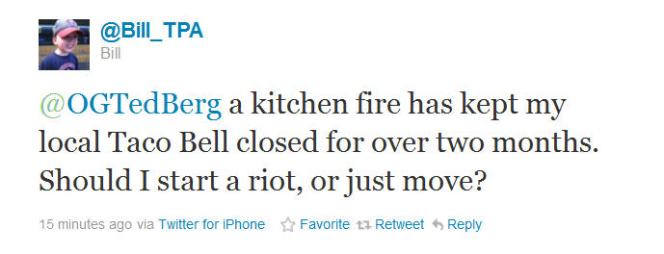
Hey, Jose Reyes: You really don’t want to move. Trust me on this one, bro. Moving sucks so hard.

Even if it makes financial sense to move, it’s still going to be a terrible experience. And I know we’re not exactly in the same income-tax bracket, and you’ve got the resources to hire an army of people to help you transport your stuff anywhere.

But the bottom line is it’s your stuff, so you’ve got the most invested in it. And it’s going to be on you and your family to determine where it goes in the new place, not to mention what to keep and what to throw out. Boxes to unpack and all that. Really, no matter how rich you are, there’s just going to be a ton of mental and physical stress involved with moving.

And moving in the winter? Forget about it, Jose. I purposefully moved in late October just to avoid dealing with winter weather, and you know what happened? Six inches of snow the morning I was set to go. I had to shovel when I should have been packing, then the U-Haul place lost power so I couldn’t get the truck I reserved.

I had to scramble to find another one last minute. In the process I very nearly got into a car accident when some guy in a Volvo spun out of control in the Home Depot parking lot. It was just a miserable, terrifying experience, Jose. And with the way the weather has been around here these last few years, man, I just don’t know of any time before the summer that it’d be safe to plan a move without the threat of a blizzard.

And so expensive! Holy hell do those costs add up. I didn’t calculate the total, but I bet it came to something like, I don’t know, 40 million dollars. Yeah, 40 million dollars. It’d be worth staying in my old place unless I stood to make more than 40 million dollars by moving.

Oh, and then you have to wait for the cable guy! Do you remember how much that sucked last time? They give you a four-hour window, then you just have to sit there like some sort of chump until the dude shows up to plug in the box. You can’t even watch TV while you’re sitting there, because you don’t have cable yet. Jose, it’s awful.

So that’s basically my advice to you, Jose Reyes: Do not move no matter what. Isn’t your current home great?

Yeah, moving’s probably the best way to play that one.

I don’t. I should note that my sense of reason is probably skewed a bit by my appreciation for Reyes, so maybe this is me rationalizing my desire to see him back in a Mets uniform.

But the way I see it, elite 28-year-old free agents don’t hit the market all that often, and especially not elite 28-year-old free agents who play one of the positions you most need to fill.

If Reyes stays healthy, he should still be very productive for the next several seasons. A five- or six-year deal may very well mean a couple of seasons on the back end where Reyes makes more than he’s worth. But if the Mets believe that Reyes can stay productive and that they’ll be in position to compete in 2013, 2014 and 2015, then, well, go for it.

Actually, it’s not a terribly different situation than when the Mets signed Carlos Beltran before the 2005 season. The team was not quite poised to compete that season, but reaped the benefits of Beltran’s awesome 2006-2008 campaigns and stayed in the thick of the pennant race each year.

Of course, Beltran was a year younger than Reyes when he signed and didn’t have anything like the injury history. And it’s easy to look back on Beltran’s contract favorably now, in hindsight.

Point is, though, I don’t think signing Reyes would be a win-now move so much as a win-in-the-next-few-years move, and teams with the Mets’ payroll should never be more than a few years from contention. And by the time Reyes’ contract becomes an albatross — as so many free-agent contracts do — the Mets should (hopefully) be well-enough constructed to shoulder the financial blow and still remain flexible.

Whoa, whoa, whoa

On his first day of freedom after a grueling five months in an Egyptian jail, Queens native Ilan Grapel got his cruelest punishment — being told the Mets won the 2011 World Series.

Grapel, expected to fly home to Queens today from Israel, was celebrating his release at a press conference in Tel Aviv, flanked by his mother Irene and Rep. Gary Ackerman (D-Queens), when he was pranked.

Andy Soltis, N.Y. Post.

Wait, that really happened? This dude just got out of Egyptian jail and people just immediately start messing with him?

That’s like waking up from a coma to have someone like, “Good news, Jim! Your dog’s coming to see you. Just kidding: He’s dead.”

It’s not even a good prank. A good prank would be convincing the guy that in the five months he was in jail, the entire borough of Queens suffered from an epidemic that turned half its population into flesh-starved zombies, then having his dad come surging toward him in zombie makeup when he lands at Laguardia.

Actually that might be going too far.

Over the line, Smokey

We’ve got four or five guys that I would call ‘above the line,’ that we could go into the season with, in the rotation.

Sandy Alderson.

This comment led to a lot of speculation about where exactly “the line” is. I doubt Alderson was letting us on to the team’s internal calculations or whatever. He probably just meant the Mets have four or five guys they consider Major League starters — Jon Niese, R.A. Dickey, Mike Pelfrey, Dillon Gee and Johan Santana.

And obviously that’s got people fired up, because people want to argue that Mike Pelfrey is less than a viable member of a Major League rotation. Pelfrey had a bad year, but for reasons discussed three months ago, he should be offered arbitration and brought back in 2012.

Is that rotation a great one? Hardly. But is it so bad it will single-handedly prevent the Mets from competing in 2012?

Not at all. If you’re looking for an example of a team that can win with a good offense and a bunch of innings-eater types, look no further than the reigning World Champions.

I know Chris Carpenter has the “True No. 1 Ace Bigtime Frontline Show-Pony” label everyone craves in a pitcher, but Carpenter posted an 105 ERA+ in 2011. The Cardinals’ best pitcher on the season was Kyle Lohse, who sported a 107 ERA+.

Mostly, the Cardinals got innings from their starters. Lohse, Jaime Garcia and Jake Westbrook each turned in over 180 frames, and the 36-year-old Carpenter was good for 237 1/3. By ERA, Cardinals starters were eighth in the National League. The Mets’ group finished 10th.

The Cardinals made the playoffs because they had by far the best offense in the National League and a pitching staff good enough to keep the team in games. Remember: The object is only to score more runs than your opponents. There’s no real set formula for the way you have to do that.

So yeah, while the Mets’ pitching staff could stand to improve, signing free-agent starters is almost always a terrible idea. And since any upgrade available via trade would likely cost the Mets a ton in terms of young players, their best approach for 2012 is to try to improve the team’s offense and defense and hope the pitching holds together.

Of course, it’s going to take a lot of work and a couple of big bounce-back years for the Mets’ offense in 2012 to hit anything like the way the Cardinals did in 2011. But that’s at least easier to imagine than Niese, Pelfrey and Gee pitching like Halladay, Hamels and Lee.

And they’re blue

Moving sucks and everything hurts. I’m back in the office today, trying not to think of all the boxes piled up in my new apartment waiting to be unpacked.

While I was without the Internet, the Mets apparently announced they’re reconfiguring the Citi Field walls. Presumably you knew that already. But maybe you haven’t yet checked out Gerard Schifman’s work at Roosevelt Avenue Rant, investigating Citi Field’s effects on line-drive hitters. His big finish:

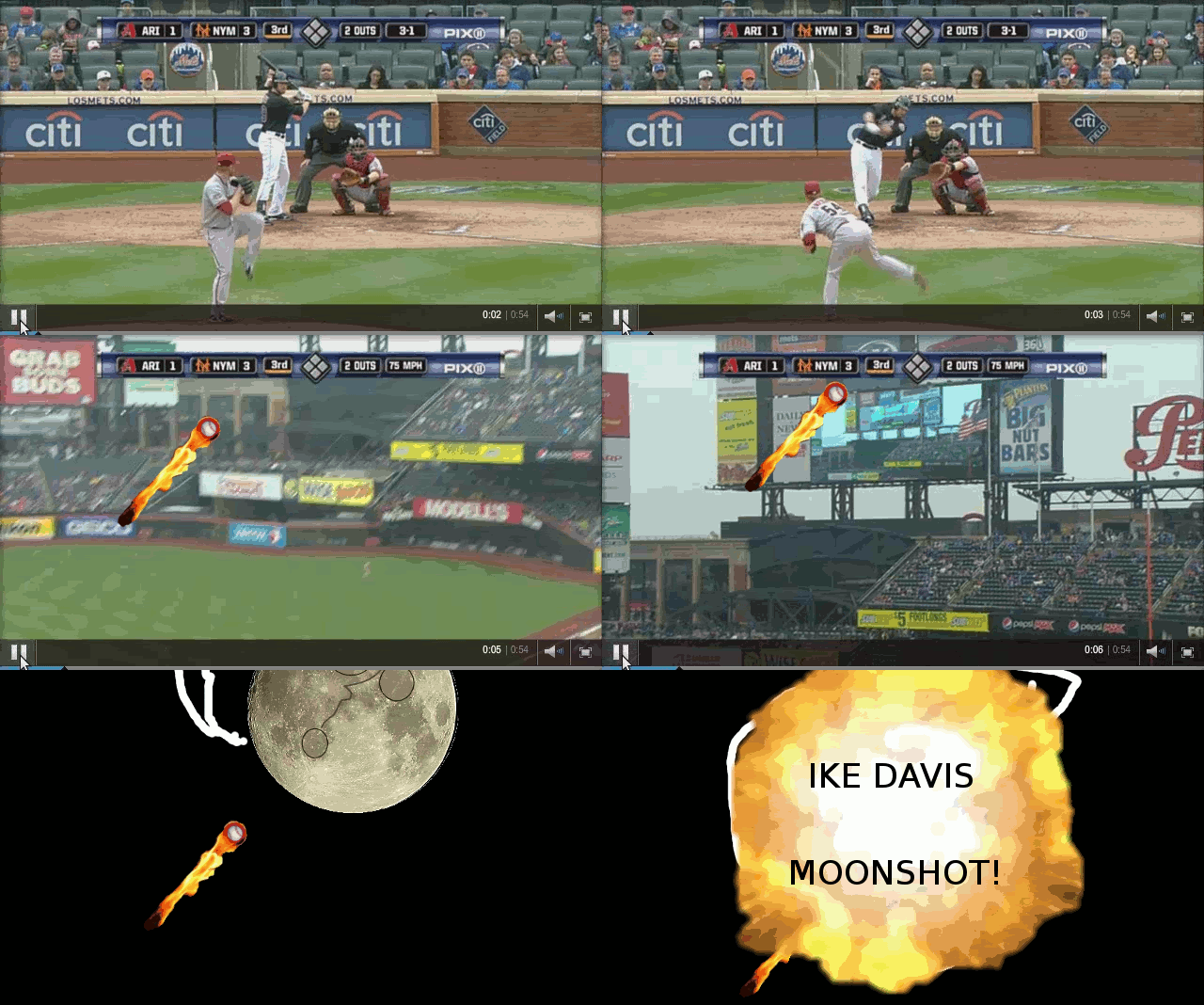
You’ll notice that as LD% goes up, less home runs are hit both on the road and at home.  On the road, Slugging remains fairly constant, slightly decreasing as LD% increases.  But at Citi Field, as LD% goes up, fewer home runs are hit and Slugging hugely decreases.  So no, it doesn’t appear that the Mets have regained any total bases as a result of the ballpark’s dimensions, further justifying the forthcoming changes.  The BABIP and Slugging differences show us that the ballpark is currently the punchless hitter’s dream.  Hopefully now, with reconfigured dimensions, the Mets can channel their inner Ike Davis a little more than their inner Luis Castillo in 2012.

Exit Carlos Beltran

Originally posted July 27, 2011:

I started and scrapped this post a couple times. To be honest, I tried to pre-write it the way newspapers do with celebrity obituaries, though by the time I got around to actually doing so the news of Carlos Beltran’s trade had already started to leak out. And I meant to hold off on publishing it until the deal was made official, but now Beltran is out of the Mets’ lineup tonight and it sounds by all accounts like the announcement is a mere formality.

The first draft included an introduction explaining how real sadness is universal and comes in near-infinite supply, and how in that context Beltran’s departure is not really sad at all. But that’s patronizing. Presumably you know that sadness is a relative thing, and you can distinguish sadness for actual tragedies from the sadness we feel when a favorite baseball player is traded across the country to play out the final few months of his contract with a new team.

There’s no good reason to dwell on it now regardless. Any Mets fan paying attention the last couple of months has heard about and likely reasoned through Beltran’s being moved, a deal that makes a whole lot of sense for a club with little chance of a postseason berth in 2011.

In the trade with the Giants, Sandy Alderson reportedly scored Zack Wheeler, a young player better than the ones many – especially me – expected the Mets would get in return for Beltran. Wheeler is a Single-A pitcher so he’s still a ways off from contributing in the big leagues, but he’s a former first-round draft pick twice ranked in Baseball America’s top 100 prospects and with over 10 strikeouts per nine innings in the Minors.

And Beltran’s exit provides one final excuse to celebrate the man’s career in Flushing. In his tenure with the Mets, Beltran played 831 games. He hit 148 home runs, drove in 552 runs, stole 100 bases, and posted an .867 OPS. Statistically, his 2006 campaign stands among the very best seasons any position player has ever provided the club. He ranks in the team’s all time Top 10 of too many categories to bother listing.

That feels like it’s somehow understating it though, no?

Not long ago, a Kansas City Star reporter wrote, “If you want to know how to approach the game, teammates or life, watch Jeff Francoeur.” Though the author was merely upholding the rich journalistic tradition of writing ridiculous things about Jeff Francoeur, the comment rightfully inspired a ton of hilarious Internet snark.

Swap in Beltran for Francoeur, though, and the guy has a much better point.

And I don’t mean in terms of off-field stuff. We only think we know baseball players from what little they reveal of themselves to the press and the fans: We heard Terry Collins rave about Beltran’s leadership this year, we read about his charitable efforts and saw the professional way in which he handled every single one of the incessant questions about his future, but for all any of us know Beltran punts puppies on his home from the ballpark.

Let’s accept that we don’t really know Beltran as a person and just think about the ballplayer. Could you imagine what the world would be like if we could all do everything the way Beltran plays baseball? If we demonstrated that same elegance and efficiency in our morning commutes, our jobs, our yardwork? What if we could all stay so calm and so patient under pressure, and remain so humble upon success? What a place that would be!

Or would that entire world be mistaken for joyless?

Oh, whatever. I made it this far without mentioning the infernal haters, and it’s probably best to just leave them stewing in their pathetic corners, pissed about whatever it is they’ve chosen to be pissed about next. Let’s applaud Beltran now, not waste time defending him from those that will never understand. Know this: People who don’t appreciate Carlos Beltran by now don’t deserve to.

I’m going to rehash the point I made in regards to Jose Reyes earlier this summer. I apologize for repeating myself: What we’ve seen from Beltran is ours to keep forever, no matter what team he’s playing for tomorrow. Carlos Beltran playing baseball at the peak of his ability is a beautiful sight to behold, and we got to watch it hundreds of times.

The sad thing about baseball is that greatness is fleeting. The awesome thing about baseball – or one of the many, at least – is that more great players and great moments are always on the way. Who knows? Maybe Zack Wheeler is one of them.

So Beltran is off to San Francisco to put the Giants’ putrid offense on his shoulders, and we’ll watch him in the playoffs then hear unsubstantiated and likely fruitless rumors that the Mets are pursuing him in the offseason.

I’m not sure how to wrap this up. Last time through I had some dumb story about the old-man version of me, 30 years in the future, describing Beltran to some punk kid. But it sucked and now I’ve got a train to catch. So we move forward.

What we carry

Originally posted June 15, 2011:

A white-haired couple got on the train yesterday and stepped toward the first pair of open seats while I fumbled with my headphones. The woman sat first, across from me, then grabbed her husband’s hand and steadied him down into the seat next to mine.

“It just hurts sometimes,” he said. Then he leaned toward me and smiled. “Never get old.”

“Hey, beats the alternative,” I said.

———————————————————————————————————

My brother would have loved Jose Reyes. Who could blame him, really?

Hold up. I’m going to get to the personal part of this post in a minute, but I want to focus on Reyes first.

Let’s pretend for one moment that we could all manage to successfully tune out the constant speculative noise surrounding Reyes, and that we have the capacity to put everything else aside to just appreciate the things Jose Reyes is doing on baseball fields around the country.

Holy hell. Have you ever seen anything like this?

There’s Jose Reyes lashing a liner in the gap, bounding out of the box. Jose Reyes stealing second, stealing third. Jose Reyes diving to his left to stop a hard grounder, Jose Reyes firing the ball across the diamond from deep in the hole.

Jose Reyes is dancing off the base, in the corner of the pitcher’s eye and the front of his consciousness. He’s chasing down a pop-up near the foul line in left field. Jose Reyes is celebrating in the dugout and he’s looming on deck. Jose Reyes just smashed a frozen rope past your office window and now he’s sprinting through your backyard. Look to your left: It’s Jose Reyes. Now to the right: Jose Reyes. Jose Reyes, Jose Reyes, Jose Reyes.

This is your summer blockbuster: The Jose Reyes Spectacular.

Only they don’t often make movies this grand and this good, the type you can watch over and over again and still find new details to appreciate: minor plot points, aesthetic intricacies. It is a production massive in scope and so richly rendered in every particular, like the work of a great auteur afforded an unlimited budget and – oh dammit, there’s that money thing we’re avoiding.

My brother Chris loved triples, even more than most. He had what you might call the triples mentality, if not the requisite speed. The way Reyes aims for third base so brazenly on hits that seem certain to be doubles, the irrepressible gusto of it – that was the approach Chris took to pretty much everything.

And I know he was my big brother and I probably aggrandize him a bit, especially now that he’s been gone almost nine years. But when I run into his old friends, they practically tell Bill Brasky stories about the guy: about his exploits in sports, in frat-house shenanigans, even in school.

Apparently, he once took a class at MIT in which teams of students were charged with creating the best design for a machine to lift panels of sheetrock. At the course’s outset, the professor joked that any student who could lift the sheetrock on his own would be excused from the assignment. So Chris – according to the story – marched down to the front of the lecture hall, lifted the sheetrock above his head and carried it out of the room. He returned for the next class and his team ultimately won the contest.

I have no way of verifying if the story is real or apocryphal, and a quick Google search tells me panels of sheetrock weigh about 80 pounds – unwieldy, perhaps, but certainly well within the range of normal human strength. But regardless of its accuracy, the story sums up my brother pretty nicely. He was competitive, cocky, funny, brilliant, ox-strong and doorway-wide.

He was the type of dude it would have been easy to envy if he weren’t always so damn awesome to me. Other than his abject refusal to let me win at anything, Chris provided me everything an older brother could, from guidance and big-picture life lessons to mixtapes, and beer when I was underage (sorry, mom).

More than anything, though, he gave me baseball. He taught me the rules, players and teams. He bought me cards and taught me how to scale them. When he was old enough to drive, he took me to games. Tons of them. Though eventually Chris and I differed on certain finer points, he is responsible for the very fundamentals of how I watch and appreciate the game. After all, he’s responsible for me watching and appreciating the game.

Late in the summer of 2002, Chris moved from his home in Boston to my parents’ house, to a hospital bed set up in our living room. What started as melanoma on his shoulder had spread through his body and into his brain. We knew – though we never said it out loud – he was dying, and it became clear it was easiest for everyone to let him do it there. Weird time.

The best I can figure it was Saturday, Aug. 31, when I watched my last game with my brother. Baseball-reference tells me the Mets lost a 1-0 tilt to the Phillies, an unlikely pitchers’ duel between Randy Wolf and Steve Trachsel.

I can’t recall any of it. All I remember is that I was charged with carrying my brother from a wheelchair to the easy chair in the den where he would watch the game. And I remember how light he was, how frail he felt – this guy who weighed 230 pounds just a year earlier, the football stud with the broad shoulders, my big brother. And I could feel the cancer just under his skin, invasive little bumps. It was everywhere, and terrifying.

The next day I packed up my car, told my brother I loved him, and headed off for my senior year of college. He died two days later.

I skipped the Mets’ home opener in 2003, the first I missed in 16 years of being a Mets fan. Soon after I graduated and moved back home, the Mets called up their top prospect – the 19-year-old shortstop, you know the guy.

It is only now, eight years later, that I realize Chris never saw Reyes play. Or David Wright, for that matter, but he would have hated Wright – that’s a different story. A whole generation of Mets players have come up and grown up before me without him there to share it. And now, maybe, they’re going away. It’s… well, it’s strange to think about.

But he would have loved Reyes. Of that much I am sure. Hell, we all love Reyes.

We love him. We watched him develop, and we have seen so many of his trials and triumphs. We know the way he gets when he’s happy, when he’s sulky, when he’s angry, when he’s jubilant. He feels, well, almost like family.

Note that I say almost like family, which is very different than actually being family. We are not actually related to Jose Reyes and the love we feel for him as fans is not the love we have for our real-life loved ones. Obviously. And the prospect of losing Reyes, weighing so heavily on the minds of Mets fans these days, is not the same as losing a family member. You don’t have to remind me.

But it is, on the orderly plane that baseball provides for us to try to sort some of these things out, some distant, more palatable version of that. Here is someone you love. And now, due to circumstances beyond your control, you might lose him too soon.

So understandably, Mets fans gather on blogs, in the airwaves and out on the Shea Bridge on Friday nights desperate to show the world their love for this great player, underscoring the pain we will feel if he leaves for some other green pasture elsewhere.

I can’t say if Reyes will be a Met at the end of this season or the beginning of the next one. Few can. And while I’m not as resigned to his departure as many in the media and fanbase, I know this for certain: He’ll be gone someday. Everything goes away eventually. If not next year for Reyes, then five or seven or ten years down the road.

We can lament the hand Reyes – and all of us, really – has been dealt, with so many of his best years wasted by a subpar front office, bad players around him, crappy bullpens, mishandled injuries, everything. Not to mention his contract coming up now, with the Mets in financial flux and hamstrung by a slew of bad deals. That all sucks, no doubt.

But we should celebrate, too, that we have this right now. No matter what happens with Reyes later this year or after the season, the special things Reyes has done and is doing every night this season are some we can carry forever. It is an awesome spectacle, a confluence of immense talent and pure joy on the baseball field, with the churning legs and flying dreadlocks and beaming smile. This is ours to keep.

And I can sit here now regretting that my brother never got to see this, knowing how much he would have loved it. But that’s useless. Besides, I carry with me my brother’s love of baseball. I carry him every day, and it’s not traumatic; it’s awesome. He exists now as an inextricable part of me, a part I can celebrate.

We are alive and we get to enjoy Jose Reyes playing baseball. It beats the alternative.

Moving out, moving on

This is the only greatest hit I’m including from the ol’ Flushing Fussing spot. Not sure why, except that I do still feel nostalgic for Shea. Super emo. Originally posted Feb. 2, 2009:

On Sept. 25, 2008, in the top of the 7th inning, I ducked out of the Shea Stadium press box, found a private spot on a less-trafficked ramp, sat down against a cement barrier, and cried.

I rarely cry, and I’m still not sure why I did that night. It might have been because I was working on this column, a difficult one to write. It might have been because there was some chance it was the last I’d ever see of one of my favorites, Pedro Martinez, and I knew he deserved better than to have Ricardo Rincon and the Mets’ miserable bullpen blow what could have been the swansong of a brilliant career. And the setting probably had something to do with it, too.
Most of the tears I’ve shed in the past 22 years have fallen on Shea Stadium’s concrete concourses. I have no idea why I meet the real, meaningful events in my life with a straight face and sarcastic comment and weep like a widow at baseball games. All I know is that Shea Stadium is to making me cry what Babe Ruth once was to hitting home runs.

(One notable outlier is the movie Finding Neverland starring Johnny Depp, which is very, very sad. Leave me alone.)

So knowing Shea’s unique ability to move me, and with no particular professional interest in mind, I headed out to pay my last respects to the stadium at the fan-organized gathering near what used to be Gate A on Saturday in Flushing.

I estimated that there were about 200 people there, though some said there were twice as many. It was hard to say. There was no formal agenda, no proper funeral service, no final tour of the grounds and no divvying up of the remaining scraps of salvageable keepsakes. It was just a swirling mass of bundled-up Mets fans, some reporters and cameramen covering the phenomenon, and cops on megaphones ushering traffic away from the construction site.

Somehow no one thought to capitalize on the event. Families gathered around breaks in the blue-sheathed chain-link fence and climbed up piles of dirt to take last looks and snap photos of the crumbling behemoth. A young man and an old man played catch with mitts and a tennis ball. Fans who knew each other from Internet message boards exchanged awkward comments about meeting each other in person and rued the blistering cold.

It was nice, but it was not particularly emotional. Only when prompted by camera crews did a group of fans sing a verse of “Meet the Mets.” The icy wind blowing off the Flushing Bay brought more tears than did any sense of mourning for the Mets’ old home.

“It’s bittersweet,” one woman said. “I’m sad to see it go, but Citi Field looks so much nicer.”

That seemed to be the order of the day — deflecting any attachment one might have felt for Shea toward the new, sterile ballpark that now appears ready for action out beyond what used to be center field. In fact, nearly everyone with whom I spoke echoed that sentiment.

That’s not how it went for me, although I wasn’t that sad. It was more like denial. I spent a while staring at the last remnants of Shea Stadium, and I could only think one thing:

This is so f@!#ing weird.

Make all the jokes you want: Shea is now inarguably a giant pile of trash. Only a section of upper deck still stands, with parts of the façade tagged by graffiti artists to add to the sense of urban decay. The rest is rubble, a mess of royal blue and grey being cleared by bulldozers that chugged along even as the fans huddled in memoriam.

In my 28 years, I’ve been lucky enough to see the Colosseum and Chichen Itza and the Great Wall of China, and after my visit to Flushing on Saturday, I couldn’t help but wonder why those relics got to stand the test of time and mine will be made into a parking lot.

I know that’s irrational. I know Shea Stadium is not a great architectural achievement or a lasting cultural landmark. Heck, it can only boast two world championships. But I’ve spent some 2,000 of the best hours of my life at Shea, watching, working, cheering, booing, praising, heckling, eating, drinking, dodging the old-man security detail, and of course, crying like a toddler. And I’m not sure I’m ready to let that all go.

I don’t know which memories I will amplify and exaggerate and which will fade, just like I don’t know if the tears I shed in September were for Pedro or my brother or the stadium or my youth, all of which felt very fleeting that evening. I don’t even know if I’ll ever cry again without Shea Stadium to bring it out of me.

I do know that it is fitting that city laws would not permit an implosion. That would have been too cathartic, too clean an ending for a stadium where too often, your heart was torn out one tiny piece at a time, where nearly every year you were left looking at a heaping pile of garbage and wondering what the hell happened.

So maybe it’s best that they’re getting a fresh start. Maybe a lot of Shea Stadium memories are better paved over. I don’t know.

Before I got back on the 7 Train to head home on Saturday, I noticed that a group of fans had climbed over a torn-down piece of fence and into the construction site for one closer, final look at the stadium. The men with the baseball gloves and tennis ball were among them.

As I considered joining their crew, a wind-whipped cop walked over, ordered them up against the fence along Roosevelt Avenue and reprimanded them.

“Now get out of here,” he said. “And don’t give me any more trouble.”

And so they did. And so did I. And so will Shea Stadium.

But as the train pulled out of the station and I stole one final glance at what used to be my favorite place in the world, I became overwhelmed with a feeling difficult to mask with sarcasm. It was a feeling that said the 22 years since my first baseball game, Opening Day at Shea in 1987, have passed way, way too quickly, and a feeling that knew that buried somewhere in that rubble, there is a whole lot of me.

Classic

Reader/commenter Non_banned_ryan passes along Gordon Edes’ list of potential managers for the Red Sox. Included:

JERRY MANUEL, 57
His nine years of managing experience with the White Sox and Mets include a division title in Chicago in 2000, when he was named AL Manager of the Year. But Manuel was never able to overcome the stigma of the Mets blowing a seven-game lead with 17 to play in 2007, and was fired in 2010 after two seasons in which the Mets were decimated by injuries. Cerebral and low-key, Manuel scores high in communication skills and would seem to fit the Sox profile of seeking a players’ manager.

As Ryan points out: “Cerebral” is code for “wears glasses.” “High in communication skills” means “impresses the media with his one-liners while he neglects to talk to players for weeks at a time.”

Also odd that he wouldn’t be able to shake the stigma of 2007, when Willie Randolph managed the Mets. But I suppose Manuel was the bench coach then.