Gag order will not prevent Daily News’ from sexy, druggy coverage of Clemens trial

Like a loose manhole cover above a steamy city sewer, there may be a weak spot in the gag order a federal judge applied in the government’s prosecution of Roger Clemens, who pleaded not guilty last week to charges he lied to Congress in 2008.

A gusher of sex and drugs stories about the famed pitcher could erupt from a civil lawsuit filed by his former trainer, Brian McNamee, in the Brooklyn courtroom of U.S. District Court Judge Sterling Johnson, starting Wednesday.

Teri Thompson and Nathaniel Vinton, N.Y. Daily News.

So no actual juicy news here, but let’s recap: “Loose,” “steamy,” “gag,” “gusher,” “sex,” “drugs,” “erupt,” and, of course, “manhole.”

Q&A with Grady Phelan, bat inventor

When I walked into the visitors’ clubhouse on Saturday, Ike Davis and Josh Thole were examining one of Thole’s new angled-knob bats. Thole told me it was designed to protect against hamate-bone injuries, and I pointed out that Thole choked up anyway and was an odd choice to be debuting the new bat design.

During warmups the next day, several Mets passed one of the bats around, fascinated both by the oddly shaped knob and the bat’s finish.

I snapped a picture of it a few hours before Mike Hessman used it on his pinch-hit double on Sunday, becoming the first Major League player to do so. The inventor of the angled knob, Grady Phelan, made his way here and was willing to answer a few questions about how the idea came about and how the bat works.

Ted Berg: First off, how’d you get into the bat-design business?

Grady Phelan: My youngest son, Brian, and I have a summer ritual of fungoing hickory nuts out of our backyard -– it’s great practice and makes for a fun afternoon. While we were hitting these green nuts into the woods the bat I was swinging slipped from my hands nearly hitting Brian. The knob had been digging into the palm of my hand, had left a nice bruise in my hand (similar to what you get from your first time in the cages every spring). That’s when I realized that the knob probably caused my grip to fail. I started to do research on thrown bats, hand injuries, anatomy and even started to experiment with bat designs to eliminate the problem.

TB: So did you just get on a lathe and start crafting? I think even if I came up with a good idea for a better bat knob I wouldn’t know where to go from there.

GP: I didn’t get a lathe at first. I had a local custom wood turner make a five or six bats that I could carve my designs into. It’s one thing to buy a lathe and try to turn a bat, it’s quite another to find quality ash and Maple that can actually be used to hit baseballs with.

TB: And how did you finally settle on a design? How did you test the bats out, get feedback? And what are you using to produce them now?

GP: I worked through an endless series of designs, testing in the cages with my son and refining each iteration. While I was doing that I also started researching patents on baseball bats to see what was out there. I did a lot of homework on rules that govern bat shapes for MLB and NCAA to ensure I didn’t create something that would be illegal. My thinking at the time was if I was going to do all this work I might as well try to protect my idea, so I submitted a patent application and then started testing the bats with players. The patent was issued this past June.

I’m fortunate to know some college baseball coaches in the St. Louis area and they let me bring my bats to practice for the players to try. After each session in the cages I had them fill out a survey on the bats.

I’m currently working with Rock Bats, an MLB-certified bat company, to produce bats with my angled-knob design. It’s owned by the wood scientist who developed the MLB specifications for maple bats, Roland Hernandez. So not only is the wood these bats are made of the best, the performance of the bat in the players hands is designed to give them their best swing.

TB: You mentioned in the comments that the bats give players “quicker hands, stronger swings, better plate coverage and reduced incidence of injury.” Is that the conclusion from those surveys, or is there more evidence pointing toward that? And do those benefits come just from the ergonomic design of the knob, or is there more to it?

GP: The test results from the batting cages indicated players felt a number of performance improvements. Players said they could extend the bat better with more ease and control, they said they felt like they had quicker hands and that their swing felt smoother. As the data came in showing consistent responses from players at all levels, I began to think I had come across something new –- something every other bat maker had overlooked.

The wife of a good friend is a professional hand therapist and university teacher –- I showed her the bats, told her my theories and explained my findings. Soon after that meeting I found myself in the physical therapy labs at Washington University School of Medicine, using digital pressure sensors to test the knob pressure on the hands of my bat and a standard MLB bat. The tests consistently showed a roughly 20% decrease in pressure to the base hand from the knob with my bat.

So in fact, the ergonomics of the knob reduces the pressure to the base hand allowing a more natural and powerful swing to occur. Standard knobs cause what I call “The Speed Bump Effect”, at the point of contact with the ball the batter rolls his hands over the knob –- it’s this pressure point that causes broken hamate bones, thrown bats and weak swings.

I believe batters have become accustomed the negative forces of the knob in their base hand and their natural swing suffers because of it.

TB: I know that in addition to the knob, one of the things that seems to fascinate a lot of the Mets about Thole’s new bat is the finish, which is a bit rougher and harder than you usually see on Major League bats. Do you know anything about that, or is that all Rock Bats? Were you at all involved in the process of getting them to Thole, and are any other Major Leaguers currently using them or testing them out?

GP: Rock Bats developed the proprietary Diamond Barrel finish on the bat that has the Mets talking –- it’s impressive technology and Rock Bats is the innovator on that one. It is all about developing technologies that players want to use.

I got the bats to Josh in a round-about way. It goes back a few years when new neighbors moved in across the street. Their son and ours play baseball so we’re always talking baseball. His cousin, Josh Thole got drafted by the Mets, began playing Single-A ball and the connection was made. I sent Josh some bats over the years and he used them in batting practice. Now, I can’t take credit for his batting skills, but it is interesting that players who have used my angled knob bats have had the highest batting average on their teams at one point or another.

You can’t just give someone bats to use in an MLB game, they need to be made by certified bat makers, which Rock Bats is. I met Roland early this past spring and we hit it off (pardon the pun). We made the bats, I let Josh know I would meet him in Chicago with the bats. So my son Brian and my wife drove to Chicago with the bats in the car and met Josh outside the clubhouse before the game.

Other players using these Rock Bats are Cory Hart and Prince Fielder. The response to the angled knob and the finish has been surprising. I actually didn’t think anyone would use the bats right away. I was guessing it would take a few days in the cages for someone to get comfortable with it. And as you know, Mike Hessman is the first MLB player to ever use an angled knob bat in a game and he got a double with it.

TB: Thanks so much, Grady.

You can check out Grady’s website here or follow him on Twitter here.

Second City sleuthing

When the team-dispatched fan photographers make their way around Citi Field, it seems like most Mets fans no-thanks them away or, at best, muster up a halfhearted smirk and shove the claim card in their pockets to be discarded later.

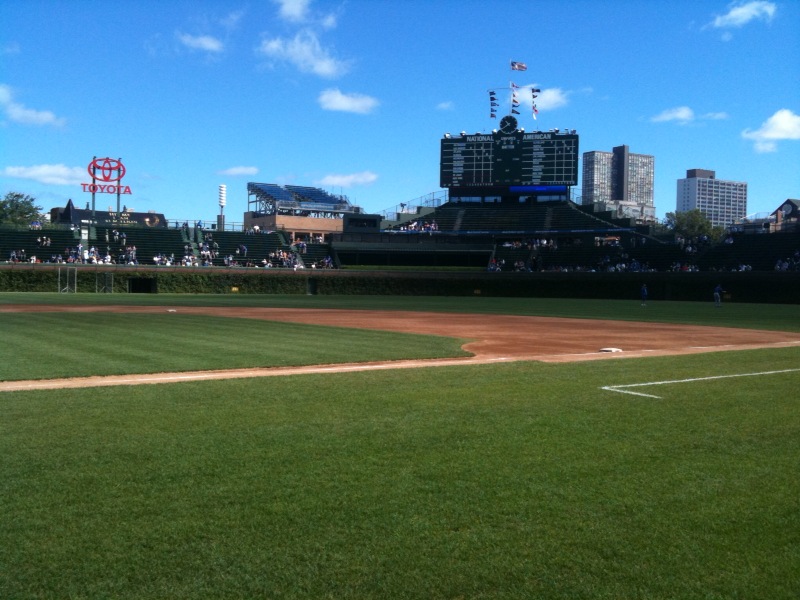
Not so at Wrigley Field. Not this weekend, anyway. Cubs fans stand and pose their best Facebook poses, arms around each others’ shoulders, faces locked in mile-wide smiles prepped to withstand digital shutter delays. When the photographer walks away, they examine the card and file it in a wallet or handbag, then cheerfully turn their attention back to crappy, meaningless September baseball.

Everyone told me about how Cubs games almost always sell out even when the team sucks, and how the fans almost never boo, though they haven’t seen a champion in over a century. So I went to Chicago hoping to learn something, trying to take from the Second City some lesson I could bring home about patience or eternal optimism, to find out what it is about those people that allowed them to tolerate a terrible team for such a long time. An ambitious goal obviously, but Chicago is built on the maxim, “Make no little plans.”

For a day, I considered that perhaps the Wrigley crowd was like an audience full of Tyler Durdens, nihilists enjoying baseball games for the sake of baseball games, in isolation, absent of hope. Remember that in Fight Club, Durden maintained that true freedom came only after you hit rock bottom. I thought maybe all these Cubs fans stopped dreaming years ago and could come out to Wrigley to drink and watch, unencumbered by the desperation that claws at fans of the 29 other teams. Maybe they don’t need any validation; maybe they just want to see baseball.

But I’m not sure that’s it.

Many of the people I asked maintained that Cubs games — or at least these particular Cubs games — are more a social event then a sporting one. The park is the attraction, and all the day games draw the carefree, playing hooky. The loudest cheers we heard all weekend came for the successful completion of a stadium wave on Sunday. After that, the most raucous applause came for a guy who made a nice play on a foul ball, and the only jeers were aimed at a fan slow to throw a Met’s home run ball back onto the field of play. Fans rooting for fans.

I came to Chicago under the impression that Cubs were the drunken, epithet-spewing cretins that so flummoxed Milton Bradley, the racists that buy the terrible t-shirts I saw selling on the street outside, the angry mob that looked ready to murder Steve Bartman. But the people I encountered were attractive, bubbly, happy to be there. Maybe some were buzzed, some even tipsy. But none appeared bitter, downtrodden, angry or even the slightest been concerned that the Cubs idled in fifth place in the N.L. East.

I suspected the bleachers held some answers so I tried to make my way there. I wasn’t allowed. Turns out the “all” in “All-Access Press Pass” does not include the bleacher section at Wrigley. I asked everyone I could to find out how I could get in, but I was denied at every stop. They said the bleachers were for fans only.

So I have no idea what goes on there. Maybe it’s more of the same, the smiling Facebook set with their cheery singalongs. Or maybe those are the real Cubs fans, and they’re all just too drunk or too sad, too terrorized by bad baseball to summon the strength to boo their team so late in a lost season.

And I realize that’s probably the big thing, that trying to measure Cubs fans when their team is out of the race in September is unfair or impossible, that it would be a whole different story if the team was actually playing for something.

But then again, it’s not like that happens that often.

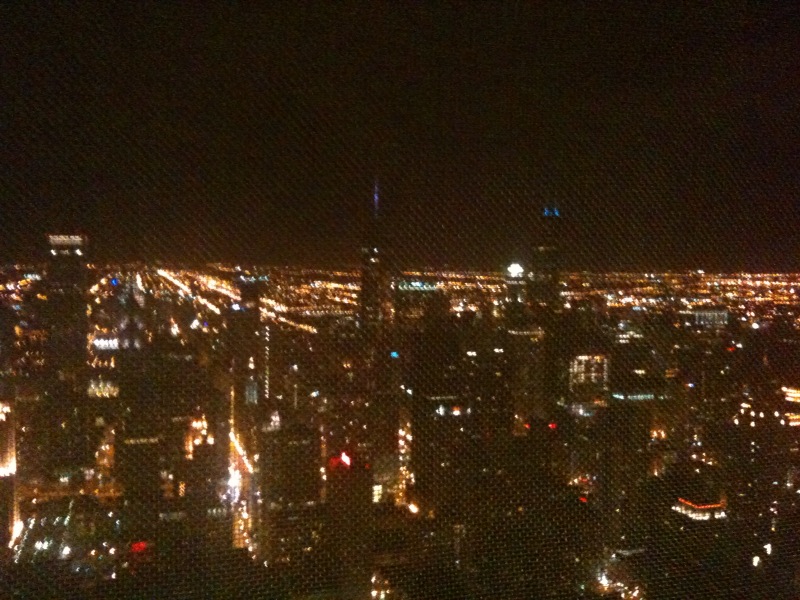
On Sunday night, before I left the city, I went up to the observation deck on the 94th floor of the John Hancock Center. I looked out from that skyscraper at all the others, behemoths tapering swiftly into the endless suburban twinkle. And I wondered how people could stand in the shadows of such accomplishments and still stand for this, how a place with the hubris to erect so many stories on so much land could stomach so much losing.

I have a feeling it’s something that would take a whole lot more than a weekend to understand.

Simon: Mets score 18 runs and win

Mark Simon does a nice job rounding up nuggets about the Mets’ outburst today. Not to pat myself on the back, but I want to point out that I totally tweeted about how the ball was flying out of Wrigley during BP. Also, Simon neglects to mention my favorite thing about that 19-8 game, which I’ll never forget — the only Cubs pitcher that went unscathed was diminutive outfielder Doug Dascenzo. 

Wrigley food

I got a hot dog here at Wrigley and I forgot to take a picture of it. So here’s some video that’s a bit out of context but that contains footage of the wiener in question:


Pretty excellent hot dog, actually. I was unimpressed with the ballpark food the last time I was here and have always heard it was nothing special — which is pretty much understood when you’re at an old park like this one.

But the hot dog itself was tasty and sweet, not sweet like “sweet, man,” but actually sweet to the taste. Which, I guess, is why the guy said I shouldn’t put ketchup on it. Plus I liked the customizable nature of the thing, with the relish and hot peppers and all.

I liked the poppy-seed bun, too, though it was a touch chewier than I would have liked. Obviously you can’t expect the Shack-ago Dog from every hot dog you try in actual Chicago, but this was a decent estimation, especially considering it came at a rusty old ballpark.

I imagine I’ll do better when I get to The Wiener’s Circle everyone keeps raving about.

Cool

Somehow I never knew about this; I didn’t see them yesterday or the last time I came to Wrigley a few years ago, but the Cubs have a live Dixieland band that walks around the stadium during the game.

Fittingly enough, they’re called the Cubs Band. They feature a cornet, a clarinet, a tuba, a trombone, and a banjo, and they’re pretty sweet.

I have long, long held that the Mets — and most baseball teams — should have some sort of live musical act inside the stadium during games. The Hammond organ is obviously a nice start, but I’m open to all sorts of ideas.

I think it would be particularly badass, for example, if a dominant reliever kept a string quartet on hand to play his entrance song. I’ve written about this before: The Hannibal Lecter approach to closer music. I’ve priced that out with my friend Ben, an orchestra conductor, and he says the cost to keep four top-flight musicians on hand for that type of work for 81 home games a season would be peanuts compared to player salaries. A good reliever could easily get it written into his contract.

But I’m open to most things. A top-flight college basketball pep band would be fine if it played funky arrangements of decent songs. Not like a lame, b-rate pep band, I mean like one of the awesome ones that outshines the basketball team itself. Just filling up a whole section of Citi Field with joyful noise and all that. And absolutely no “25 or 6 to 4” or “Carry on My Wayward Sun.” It’s time to retire those to the rafters.

A funk band up on the bridge to the Pepsi Porch. Delta Blues in the Delta club. Metal in the Acela restaurant. Anything would be better than trying to get me to sing Sweet Caroline or Rickrolling the entire stadium.

One of the dudes from the Cubs Band told me they’ve been playing together since 1982 and they’re at every game. Cool.

Also, fun fact: I could almost entirely outfit a band like the Cubs band with instruments I have in my house (or at my parents’ house). The only one I don’t have is a tuba, which is ironic because it’s one of the few I can play capably. I really need to practice that banjo.

Wrigley wakes up

Walking up Wrigley Field’s concrete ramps to the press box this morning, I caught the inimitable smell of hot cotton candy. I turned a corner and spotted the vendors, at the machine, forming the confection. Around and around, again and again. Sweet and colorful, but nutritionally devoid and questionably palatable.

The Cubs haven’t won a World Series in over 100 years. It seems like every offseason they go about building their team the entirely wrong way. Buy high, sell low. Reward veterans for one good campaign. The whole thing. Around and around, again and again.

And yet the fans keep showing up. Some reporter doing a radio interview on the phone behind me just said that a crowd of 35,000 is a bad day for Wrigley. Seems accurate. Seems like none of them ever boo, either.

It’s weird.

Seizing this opportunity

The Cardinals are fading fast, so I might as well seize the opportunity to point this out while I can: Major League Baseball’s Wild Card system is unfair. A lot of times it works out fine and good teams wind up in the playoffs, and certainly it makes for some exciting pennant races, plus there’s always a lot of randomness at play anyway.

But the idea of rewarding the non-division winner with the best record doesn’t really make sense so long as the clubs play unbalanced schedules. Those Cardinals get to play the bulk of their games against the Astros, Brewers, Cubs and Pirates, four teams toiling well below .500.

And yet St. Louis is only a half game better than the Rockies in the Wild Card race, even though Colorado regularly squares off with the Giants, Dodgers and Padres, all of whom are above .500.

The example isn’t perfect because the Cardinals are only 31-29 against the N.L. Central, so it’s not like they’ve coasted into playoff contention by dominating their weak opponents. But then, what would their record be if they faced the rigors of playing in any other division?

It strikes me that you can have an unbalanced schedule or a Wild Card, but you probably shouldn’t have both. I don’t imagine this system is going anywhere so maybe I’m just an old man yelling at clouds, but to me it doesn’t seem like it would be too hard to come up with a better one.

A while back I suggested (twice, actually) that the whole “Year of the Pitcher” thing might have something to do with the league-wide pitching talent finally catching up to the number of teams after expansions in 1993 and 1998, among other things.

So I imagine Major League Baseball could jumpstart offenses a bit by expanding to 32 clubs and giving each league four four-team divisions, eliminating the Wild Card.

Some would argue that shaking up the divisions would destroy certain rivalries, since in that model perhaps the Mets would no longer play the Braves, boohoo. But extant rivalries would intensify and new rivalries would develop.

Another potential downside would be the possibility that teams in each division run away with it and there’s not much meaningful baseball in September. But that’s basically happening in the American League this year anyway. Unless the White Sox manage to make a run in the Central, the only compelling race in the Junior Circuit is which A.L. East team wins the division and which takes the Wild Card.

A nice additional benefit to expansion could be the possibility that it would make the players’ union more amenable to some kind of salary cap or a more punitive luxury tax system to prevent the Yankees from doing what they do, which seems to piss people off so much. The Mets annually show us that there’s no strict correlation between payroll and winning, but I suppose it wouldn’t hurt the game to level the playing field a bit.

And I don’t know about that stuff and I haven’t thought it all the way through. I just know that if the Cardinals manage to scrap out the Wild Card this year, it’s kind of a travesty given how much harder the haul has been for the teams in the other N.L. divisions.

I realize, of course, that lots of things about baseball aren’t fair and that random events like that are a big part of the game, but I do feel the onus should be on the league to make everything as equitable as possible.