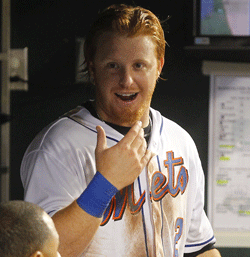
The three fallacies of Jose Reyes

Over at Amazin’ Avenue, Rob Castellano investigates a few of the fallacies perpetuating the nonstop talk that Jose Reyes will inevitably be traded at some point this summer.

I’ve said it before and I’ll probably say it a bunch more times: All the decisions — on all sides — regarding Jose Reyes’ future with the Mets are nuanced ones, and dismissing them by saying, “Oh well he’s X type of player and Sandy Alderson is Y type of general manager” is just silly. Alderson, Reyes, and Reyes’ agents are smart people. They’re going to spend a lot of time with this.

That doesn’t mean he’s certainly back in Queens next year, but it doesn’t mean he’s as good as gone either. It does mean no one should go about moving Reyes to second base to make way for Ruben Tejada just yet. Holy hell.

Wither the Fernanchise?

Martinez is only the first outfielder to get at least 100 plate appearances by his age 20 season and not be qualifying for a batting title by his age 22 season. No hitter regardless of position with at least 100 plate appearances by age 20 has failed to become a big league regular. Most became all-stars.

Mike Salfino, SNY Why Guys

Fernando Martinez is getting about a plate appearance a day, which doesn’t seem like the pace you want for a 22-year-old prospect.

I suspect he’s the guy to go when Angel Pagan returns. I know a lot of fans are eager to run Willie Harris out of town, but with Chin-Lung Hu gone, David Wright out and the infield stretched thin, Harris’ defensive versatility becomes more valuable to the club. Plus obviously Martinez should be seeing regular playing time somewhere.

We get to see two games’ worth of Martinez’s bat in the lineup this weekend, as he’ll be DHing in the Bronx. Pagan played the last two nights in St. Lucie and the Mets want him to play four nights in a row there, so if all goes according to plan he should rejoin the club Tuesday in Chicago.

Jason Giambi puts the people of Denver on his back and carries them to discounted-taco glory

In the event, Giambi exploded for three home runs and drove in all seven Colorado runs in the Rockies’ 7-1 blowout of the Phillies. He’s now got 419 round-trippers, but this was his first three-homer game.

Rob Neyer, SBNation.com

Look: It’s awesome that Jason Giambi, a really nice guy and a massively entertaining masher of baseballs, became the second oldest man in baseball history to hit three home runs in a game last night. And it’s even more awesome that he did it against the Phillies.

But the most important thing here — and the thing that will be overlooked in the history books, I fear — is that whenever the Rockies score seven or more runs, Denver-area Taco Bells serve discounted tacos between 4 and 6 p.m. the next day. And the Rockies didn’t really need Giambi’s last two home runs and four RBIs, what with Jhoulys Chacin cruising like he was. Giambi did that for the people. So the people could eat cheap tacos.

And if Jason Giambi heroically securing discounted tacos with a home run sounds vaguely familiar, it’s because it has happened before.

One last thought about prospects

One last thing, and I imagine this point has already been made. I strikes me that it must have been, at some point:

People often discuss which Minor League transition is the biggest jump. In this Scout.com roundtable from a few years ago, most of the experts argued that the biggest jump is from High A to Double-A, and I’ve heard as much elsewhere.

But the biggest jump of all almost has to be from Triple-A to the Majors, no? Is that just common sense? Here’s how I figure:

There’s no talent ceiling in the Majors. Dominant players at every level can advance to the next level, until they reach the big leagues, but dominant players at the big league level have no place else to go.

If in some weird scenario a guy as good as Josh Johnson is in Triple-A — and I mean Josh Johnson now, not when he was in Triple-A — he’s only going to make his way around the International League once, tops. Awesome players stay in the Majors for as long as they’re awesome (and then some).

Prospecting ranty rant

Excuse me if this reads as something of a braindump. The Mets play at 1 p.m. today and I haven’t had much time to organize these thoughts in any cohesive manner. And I realize they will seem rather, ahh, curmudgeonly.

The MLB draft is over two weeks away and already much of my Twitter feed is filled with people’s mock draft projections. And look: I don’t fault people for Tweeting whatever the hell they want to Tweet. I could always unfollow if it grows unbearable, plus I realize that mock drafts in all sports are good business these days, for better or worse.

But — and again, this is just one man’s opinion — c’mon.

Look: There’s no doubt the draft is massively important, and that drafting well is a huge key to a baseball team’s success. It’s also really, really difficult to do and something into which teams pour a ton of resources. I don’t necessarily think some professional scout’s eye is any better than an amateur with a good working knowledge of college baseball — not at all — I just think it’s probably safe to assume teams are making extremely well-informed decisions with their picks.

And while I think it’s fair to criticize the process when a big-market club refuses to go over-slot for picks or, say, drafts college closers, I don’t think it’s reasonable to nitpick over specific evaluations because teams are probably working with way more information than we are.

Also: Half of these guys are going to suck anyway, and in many cases we’re not going to know which ones are good for six years. It’s not like the NFL where they’re going to be expected to contribute immediately.

Again, I don’t want to undercut how important it is for a team to build a strong organization from within. That’s how you make a winning baseball club. But as understanding of that importance has crept into the mainstream, it seems like maybe the emphasis has gone just a little too far in the other direction.

Like if I have to read another article crowning the 2013-2020 Royals the Kings of Everything, I might something something. I get that they had three of Baseball America‘s top 10 prospects and like half the top 100 or whatever. But let’s not forget that these are the same Kansas City Royals that not only signed Jeff Francoeur and anointed him starting right fielder this offseason, but held a press conference upon doing so. That doesn’t exactly scream “winning baseball franchise” to me, million dollar smiles and prospects or otherwise. These are the same Royals led by staff ace Bruce Chen, who is Bruce Chen.

I know Eric Hosmer, one of those top Royals prospects, has mashed the ball in his first 42 Major League plate appearances. And I love Kansas City’s great baseball and barbecue traditions and I’m the proud owner of a Kansas City Royals jersey. But I’ll believe the Royals will be a top-flight team when I see one of their prospects hit for a full Major League season and their front office get out of its own way.

I remember, I think about midway through the 2005 season, seeing a debate in some somewhat reasonable baseball forum over if David Wright had “surpassed” Andy Marte. What the huh? Wright had by then been mashing Major League pitching for nearly a full season; Marte was still merely a very well-regarded prospect.

We can prospect and speculate and turn every bit of information inside out trying to figure how good these guys will be, but all that really matters — to us, the Major League fans, at least — is how they perform when they get to the big leagues. Part of the reason I enjoy following the Mets’ prospects on Mets Minor League Blog is that Toby and Mike take a very realistic approach to young players. It comes off as pessimistic sometimes, but it’s kind of the way things are.

 

Where to start?

Still, the worst-kept secret in Flushing is the Mets likely will deal Reyes before the trade deadline, ensuring they get something in return before he becomes a free agent at the end of the season. The cash-strapped Mets have no interest in paying Reyes the $100 million contract he’ll demand. Bottom line: Come Opening Day 2012, Tejada will be the Mets’ shortstop.

Why the pretense if that’s the case? Why not start Tejada at shortstop now and move Reyes to second base? Why can’t the future start now?

George Willis, N.Y. Post

Wait, hold on a sec… First of all — wait, no no no… OK. OK, where to start? Well for one thing, there’s… Oh, screw it.


Members of the Justin Turner Lobby enjoying this

The Mets won last night in the pouring rain, as you know. Justin Turner had two more doubles and two more RBIs, raising his OPS for the season to a sterling small-sample .885, best among the five men who have played second base this season for the Mets.

It seems fashionable now to come out and say, “Oh, well we knew all along that Turner was probably the Mets’ best option at second base,” but in a MetsBlog poll taken on March 16, only 7.89 percent of readers felt Justin Turner deserved the bulk of playing time. And in an Amazin’ Avenue poll taken the next day, Turner wasn’t even included — probably because he (rightfully) didn’t seem a very likely option at that point. So who was it saying all along that Turner was probably the Mets’ best option at second base?

Me, baby! Me!

But before I celebrate too much, I should note a few things: Most importantly, Turner probably won’t rock the .885 OPS all season. It fact, it’s downright unlikely. You might even say he’s crushing the ball over a tiny 52 plate-appearance sample and that though he looks great right now, lots of players have looked great in their first go ’round in the bigs only to wind up floundering back in the Minors by the end of the season.* There’s reason to believe in Turner based on his history of strong hitting in the Minors, but let’s not anoint him the second coming of Chase Utley just yet.

Second: Despite the best intentions of the Justin Turner Lobby, the Mets’ front office probably played the second-base situation the right way, given the personnel and Brad Emaus’ Rule 5 status. Even though Turner’s Triple-A stats were more impressive than Emaus’ due to park and league factors, the only way the Mets could continue to evaluate Emaus was to keep him on the big-league roster. They did, and after a couple of rough weeks they determined he was not special enough to hold on to for the full season.

It seemed like they pulled the trigger a bit too quickly at the time, and Sandy Alderson admitted that they might not have cut Emaus if the Mets were winning a few more games. But Daniel Murphy’s not-terrible defense at second combined with Emaus’ underwhelming adjustment to Major League pitching obviously made the decision easier. Emaus is back to crushing the ball in the Pacific Coast League now and still has a chance to be a productive Major Leaguer, but it seems unlikely he’ll be so much better than Turner to have merited sticking with him through his struggles.

*- Remember when Luis Hernandez killed it for a couple of weeks last year? Remember when someone unironically reported that Luis Hernandez would be the Mets starting second baseman in 2011? Luis Hernandez has a .518 OPS in Triple-A.

One thing this site too frequently lacks is apprecation for Carlos Beltran

This is going to sound like Scott Templeton stuff but I promise you it’s true.

I got an opportunity to talk to some high-school kids in East Harlem yesterday afternoon. I miss some aspects of working in a school and I forgot how hilarious teenagers can be, so I had a great time.

The school happens to be across the street from the headquarters of Harlem RBI, a community youth baseball program through which Carlos Beltran has done a bunch of charity work. Many of the kids in the class played baseball in the program, and nearly all of those that did had a story about meeting Beltran. One guy, Rob, got to shag flies while Beltran took batting practice during his rehab stint in Brooklyn in 2009.

It was sweet. Back when I worked in a high school, I often had to rely on the television program “The O.C.” to find common ground with students, so it was pretty great to meet 14-year-olds as eager as I was to discuss Carlos Beltran’s awesomeness.

Another kid, Anton — a big Mets fan — said he wears No. 15 every season in honor of Beltran. He said this season the team’s No. 15 jersey is way too big on him, but he wears it anyway. He asked me if I could tell Beltran that.

I probably will.

Of course, the remaining Beltran haters out there will probably argue that he selfishly brainwashed these kids by giving of his time through charitable efforts or something. Nabobs nattering negatively.

No such thing

That’s the cold-hearted reality of the Mets’ world. They are sitting on a gold mine of a deal and it could blow up in their face. Put the wheels in motion. This season has disaster written all over it.

The Curse of Citi Field struck again as Chris Young (shoulder) and Jenrry Mejia (elbow) underwent surgery and Ike Davis (ankle) was sent to Port St. Lucie to begin his rehab.

Kevin Kernan, N.Y. Post.

As they watch an ever-evolving lineup shift around them, they can’t help but be struck by the irony that they are finally in a position to make the Mets go, but there aren’t enough parts. It’s like having a Ferrari with four flat tires. This is more evidence that the Mets are truly a cursed team.

Tim Smith, N.Y. Daily News.

Man, series of great points here about how the Mets are cursed, what with David Wright and Ike Davis and Johan Santana being on the DL and all, and with the two straight losing seasons and — oh my goodness — four straight years without a playoff berth. Except that one nagging issue:

There’s no such thing as curses.

Mumbo-jumbo. Hokum. Nonsense. A curse is not a reasonable way to explain away a team’s struggles, nor, really, is lumping in the 2011 Mets’ problems with those endured under the prior front-office.

For one thing, though the DL stints have been frequent this season, they have yet to prove as crippling as they were in prior years. And — the case of Wright’s injury notably excepted — the current front office’s willingness to move quickly to put a player on the disabled list marks a vast departure from the prior administration, under which players were often pushed to play through injuries (sometimes with disastrous results) and managers forced to operate with short-handed rosters.

Though the club is currently stretched paper-thin, it has to date found at least vaguely viable Major Leaguers to fill in for its injured regulars. All teams deal with injuries practically all the time. Occasionally the injuries are insurmountable. Other times, with a deep enough roster and Major League-ready fill-ins in Triple-A, a team can overcome a rash of misfortune.

The Mets are 19-22. It’s not great. They face at least another week without their starting first baseman, and a couple weeks without their best player. But they haven’t tanked yet. And it’s May 18.

If you want to investigate a real, rational explanation — beyond a “curse” — for the Mets’ injury troubles over the past few years, go to town. Trainer Ray Ramirez and his staff are holdovers from last season, but it’s hard to hold them accountable for the injuries to Wright and Davis — both of which occurred in on-field collisions.

Remember when the Red Sox were cursed?