Miguel Batista trolling hard

After allowing two late runs that ultimately cost the Mets a win against the Nationals last night, Miguel Batista said he believes the Mets are the best team in baseball.

To his credit, that’s pretty much what you want baseball players believing and, when pressed, saying. It’s just funny timing to say it coming off six straight losses, the most recent of which is in part your fault.

The only Kobe beef you’ll find here is with Shaq

Our man Brian Erni passed along this four-part article from Forbes outlining the differences between actual Japanese Kobe beef and the various meats sold as Kobe beef here in the U.S.

It’s an interesting read and it certainly debunks the claims to Kobe beef-dom made on menus everywhere, plenty of which come with ridiculous price tags. I’ve never gone in for $50 burgers anyhow, so it doesn’t much matter to me.

The most fascinating part of the article is when he suggests we can develop new breeds of cows that produce more delicious beef. I’m in for that. Sign me up. I’ve never in my life thought, “you know what? Beef could be better.” But the notion is pretty exciting.

Also worth noting: I’ve heard Pat LaFrieda beef is not made with real Pat LaFrieda.


From the Wikipedia: Tusko

A journey down the Wikipedia elephant-article rabbit-hole, prompted by reader Rob V., left me here.

From the Wikipedia: Tusko

Tusko is a popular name for captive elephants. It is about the least creative thing you could call an elephant besides “Elephanty.” Naming an elephant after one of its most recognizable features is like calling your dog “four-leggo” or your male mallard duck “greeny-head.” Naming your fish “Gil” is still cool, though.

Three elephants named Tusko have managed to overcome the stupidity of their names to achieve great fame, or at least a place on the page dedicated to elephants named Tusko.

The first notable elephant named Tusko was Tusko. Wait, hold on. For the sake of clarity, I will heretofore refer to the three notable elephants named Tusko as “Tusko the Mean,” “Tusko the Now-Tuskless,” and “Tusko in the Sky with Diamonds.”

Tusko the Mean is the earliest example of a famous elephant called Tusko known of by the Wikipedia. Tusko the Mean was known as Ned early in his life, but “Ned the Mean Elephant” doesn’t pop from a circus placard the way Tusko does. Decent band name though.

Tusko the Mean was captured from Siam in 1898, and grew to weigh some 15,000 pounds. That made him about a ton heavier than P.T. Barnum’s Jumbo, and earned him notoriety as the heaviest elephant in captivity. Perhaps it was all the jabs about his weight that finally set him off.

Sometime before 1922, Tusko defeated six bulls in some sort of fight in an arena in Juarez, Mexico. The Wikipedia doesn’t have any details — it’s from the source document — but it sounds like a pretty awful thing to turn a giant, exotic creature into a bullfighter, and also it seems like it’d be pretty hard to convince an elephant to wear those flamboyant bullfighter pants.

In 1922, while on tour through Washington’s Skagit Valley with the Al G. Barnes circus, Tusko the Mean got loose, either because he had been beaten or because he was drunk. He went on an all-night rampage through the town of Sedro-Woolley, destroying some lady’s chicken coop and scaring the bejeezus out of a local doctor.

By 1928, Tusko the Mean had been sold to a Portland, Oreg. amusement park, large parts of which he destroyed during a rampage prompted by a low-flying stunt plane. From there, Tusko the Mean was traded and sold and shipped around in various sideshow acts, and kept docile with whiskey. In 1932, Seattle mayor John Dore, disgusted by the elephant’s condition, confiscated Tusko the Mean and moved him to the Woodland Park Zoo. Finally well cared-for, Tusko the Mean died a year later of a blood clot in his heart.

Tusko in the Sky with Diamonds fell victim to a tragic and stupid science experiment in 1962. Researchers at the University of Oklahoma were interested in musth, a condition unique to male elephants in which their testosterone increases by a factor of 60, they secrete a thick, tar-like substance from glands on the sides of their heads, and they go bats–t crazy and try to destroy everything in sight.

Tusko in the Sky with Diamonds, an elephant at the nearby Oklahoma City Zoo, intrigued the scientists because he had gone on musth in the past. But it was 1962, and science in 1962 apparently amounted to giving test subjects a buttload of acid and seeing what happened. The researchers shot Tusko in the behind with a cartridge-syringe fired from a CO2 powered gun containing enough L.S.D. to get 3,000 people tripping face. The elephant only weighed as much as about 40 people, but the scientists justified giving Tusko in the Sky with Diamonds that much acid because cats and monkeys needed to have a ton of acid before they did anything.

What followed is about the most heartbreaking thing you’ll see in a science journal:

Tusko began trumpeting and rushing around the pen, a reaction not unlike the one he had shown the day before [when injected with a placebo]. However, this time his restlessness appeared to increase for 3 minutes after the injection; then he stopped running and showed signs of marked incoordination. His mate (Judy, a 15-year-old female) approached him and appeared to attempt to support him. He began to sway, his hindquarters buckled, and it became increasingly difficult for him to maintain himself upright. Five minutes after the inection he trumpeted, collapsed, fell heavily onto his right side, defecated, and went into status epilepticus. The limbs on the left side were hyperextended and held stiffly out from the body; the limbs on the right side were drawn up in partial flexion; there were tremors throughout…. The mouth was open, but breathing was extremely labored and stertorous, giving the impression of high respiratory obstruction due to laryngeal spasm. The tongue, which had been bitten, was cyanotic.

It continues like that. Tusko died an hour and 40 minutes after receiving a massive dose of LSD from scientists. The scientists concluded that their findings “may prove to be valuable in elephant-control work in Africa.” Right.

Tusko the Tuskless was born around 1971 and is still alive today in a Portland zoo. According to the Wikipedia, Tusko recently endured surgery to remove his tusks due to infection, which must be reasonably humiliating.

Other than that, though, Tusko the Tuskless doesn’t have it all that bad. He is in the Portland zoo for stud work and has sired two calves with one female, with plans to mate with the zoo’s two other female elephants as well. Before coming to Portland, he sired two calves in Canada and one in California. He is the Shawn Kemp of notable elephants named Tusko.

Jonathan Broxton: Not the answer

I went on a brief Twitter rant about this last night in response to some Mets fans clamoring for Jonathan Broxton: Though his ERA looks good, Broxton has been nothing like the pitcher he was when he was awesome. Chris McShane spells out the details at Amazin’ Avenue.

If Broxton’s available for just money and the Mets have money to burn, then sure, the Mets should take him on just because he’s not currently a member of their bullpen. Still, if they have any sort of capped budget for taking on money, I have to believe that money could be better spent elsewhere. If it weren’t for Sandy Alderson’s steady hand at the wheel, it’d be pretty easy to imagine Broxton coming to the Mets then pitching to his peripherals, prompting all sorts of woe-is-us stuff from everywhere.

On the Cantina Burrito

I tried the burrito from Taco Bell’s new Cantina Menu yesterday. It looks like this. The sauce packet is included for scale:

The Cantina Bell menu is not for me. By that I cannot imagine I am the person Taco Bell had in mind when creating and marketing the new Cantina Bell menu. Celebrity chef Lorena Garcia, while fire-roasting her corn salsa, never stopped to say, “man, I hope this will finally be the innovation that gets Ted Berg into Taco Bell.” I don’t need winning over.

The new burritos and burrito bowls, boasting “citrus-herb marinated chicken,” “guacamole made from real Hass avocados,” and “pico de gallo prepared fresh daily,” seem aimed at the squeamish girlfriends, the healthy-living husbands, the no-beef bros and every other blight on society who seems like a perfectly reasonable person to spend time with until it becomes clear they will refuse to accompany you to Taco Bell.

Here’s the good news, for them: The Cantina Chicken Burrito isn’t bad. It mostly tastes like cilantro, presumably due to the “cilantro rice” and the “creamy cilantro dressing.” Cilantro — unless you genetically despise cilantro — has sort of a clean taste, and because we associate its increasingly popular flavor with table-side guacamole and carefully constructed banh mi, it seems like a great way to code “freshness” into food.

Don’t tell this part to the others: It still sort of tastes like Taco Bell. It’s definitely different from anything previously served at Taco Bell, since that cilantro flavor and the presence of sweet corn kernels are new and unfamiliar to the seasoned Taco Bell palate. But still there’s some subtle, difficult-to-describe aftertaste that is unmistakably Taco Bell’s own. I think it’s in the tortilla. And I like it; it’s grounding.

There’s chicken in there, though not a ton of it. It was reasonably moist and more enjoyable than typical Taco Bell chicken — which I almost never order — but I did not pick up on the citrus-herb flavor. The burrito is nowhere near as filling as the one from Chipotle that pretty obviously inspired it, though it is several dollars less expensive. It’s supposed to come with guacamole, but if mine had any, I couldn’t identify it. There are also black beans, which added some interesting texture but not much flavor.

Will I order the Cantina Burrito on my next trip to Taco Bell? I won’t. Would I choose it over a burrito from Chipotle? I wouldn’t. But then — again — though I’m good for about one Chipotle trip a month, I’m not someone that Taco Bell has ever had trouble convincing to eat Taco Bell. No sir.

This is an effort, we know, to cut into Chipotle’s market. Maybe that works. And by making Taco Bell more enticing to more people, the Cantina Bell menu appears apt to get me and people like me into Taco Bell more often, since we will inevitably sing its praises to those around us reluctant to visit Taco Bell. The Doritos Locos Taco invigorates the base, then the Cantina Bell menu broadens it.

These are both, in their own way, clever tricks to get you to eat more Taco Bell, but then I guess life is just a clever trick to get you to eat more Taco Bell. And we can sit here and debate whether this represents Taco Bell’s progress or Taco Bell’s selling out, but the truth is, if it goes as planned, it means we all ultimately eat more Taco Bell. So, you know, I’m for it.

$666 burger available

We took the most offensive pieces from other famous burgers and just took it up a level. I mean, what’s the point of putting gold flakes on your food? It doesn’t add to the flavor, it’s just to be able to say you ate gold flakes. So screw it, we’re going to wrap the whole patty in gold and make people eat that.

Franz Aliquo.

The food truck 666 Burger offers a $666 burger, a foie gras-stuffed kobe patty with champagne-steamed Gruyere cheese, lobster, truffles, caviar and a barbecue sauce made with Kopi Luwak coffee beans. It’s pretty funny, but it’d be funnier if Aliquo didn’t reveal himself in the same interview to be rather uptight about his definition of hamburgers. Still, their regular burger sounds like something I should try.

Via Bill.

Stuff about Delaware

I spent my weekend in Delaware. Before this, the longest stretch I had ever spent in Delaware was in my freshman year of college, when I went to see a friend from high school play lacrosse against the Blue Hens and wound up stranded in Newark (Delaware, not New Jersey) for a couple of hours.

Here are the things I knew about Delaware before this weekend:

– It was the punchline of a gag in Wayne’s World that made me laugh as hard as I ever have to date in a movie theater. I was 11.

– It boasts a very solid rest stop that was typically my only stop on drives to and from D.C. until it parted ways with its Roy Rogers. I still stop there sometimes because it’s a good distance for breaking up the trip and because Popeye’s Chicken is delicious. But if I’m going to eat anywhere along that drive, I usually seize the opportunity to get my Roy Rogers fix.

– There are somehow roughly 20-25 tolls in the 15 minutes you spend in Delaware on that trip.

– If you’re stranded in Newark after your buddy gets on the bus with his lacrosse team to head back to their college, and the light rail has stopped running, and it’s the year 2000 and you don’t have the Internet on your phone or more than $20 on you, you pretty much have to hitchhike to Wilmington to get to the Greyhound station to get back to Washington. Not my best plan.

Here are some things I know about Delaware now:

– Once you get off 95, the trip down US-1 to the beaches is very nice, but still heavy on tolls. They’re inexpensive tolls, like Delaware just wants to remind you that you’re in Delaware and you need to pay for that service. The upside is there are fruit stands.

– There’s a river (and a corresponding town) called Broadkill. Presumably it got its name for being a broad kill, but I prefer to pronounce it as a portmantbro. Broadkill refers to discarded solo cups and lacrosse sticks left on the side of the highway.

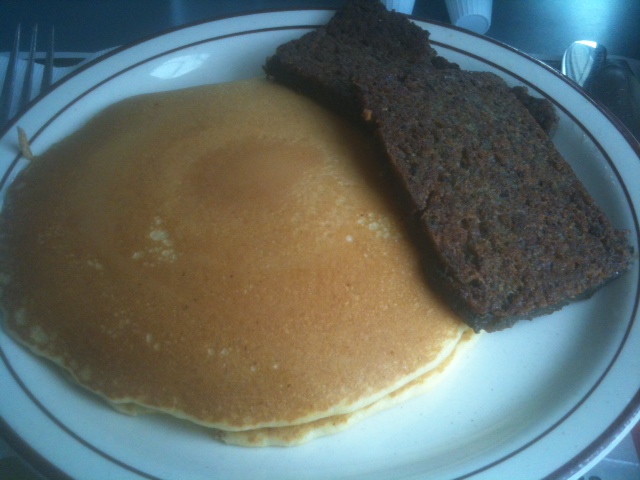
– Delaware, like many mid-Atlantic states, features scrapple. Scrapple is a fried pork loaf invented by the Pennsylvania Dutch to make use of offal and scrap meat. I had some at Countrie in Dover on my way home. It looked like this:

People seem to judge scrapple because of its constitution. They shouldn’t because it’s good. It tastes like a breakfast sausage, but with a different and interesting texture. The hog meat is mixed with cornmeal to make the loaf, then slices are pan-fried before they’re served. The fried outside is crispy, but the inside is mushy like tasty pork pudding.

Is it time to panic about sports?

I missed most of the Braves’ thrashing of the Mets this weekend. I caught the series finale yesterday on radio — Braves radio, no less — but only saw the box scores for Friday and Saturday’s game. Let me guess: some bullpen meltdowns, some poor defense, the Mets losing games the way the Mets lose games.

The difference this time, of course, is that David Wright mustered only two hits in the series and both R.A. Dickey and Johan Santana turned in underwhelming starts. Those three stars carried the Mets to a successful first half, so when they disappoint — however briefly — to kick off the second half, the flaws they’ve helped cover become more striking.

Plus, with Dillon Gee out until at least September, the healthy rotation that worked to keep the ball out of the hands of the woeful bullpen suddenly looks, well, it looks like it might have Miguel Batista in it. Gee is second on the team in innings pitched, so the Mets need people to occupy those innings — ideally as capably as Gee did.

Where have you gone, Mike Pelfrey?

At this point in this post, I intended to point out that Matt Harvey is pitching tonight, putting him on turn to pitch Saturday when the Mets next need a fifth starter. And so I was planning to note that it does not benefit the Mets in any way to commit to putting Harvey in the rotation until they accidentally do, and that if Harvey pitches well tonight he could well be pitching at Citi Field on Saturday.

It turns out that’s pretty much exactly the case, and I missed Terry Collins saying as much on Saturday. If Harvey puts up a clunker or the Mets see something they’re sure won’t translate to the Majors, they can start Batista on Saturday without rolling back on their word. If Harvey pitches anything like as well as he has since the middle of June, he should make his next start for the Major League Mets.

Harvey has thrown 158 innings in the high Minors over the last two years, about 20 more than the minimum the Mets want before Major League promotions. Toby covered this last week, but to reiterate: Calling up Harvey is not optimal for his development, but it’s hardly crippling. He’s 23, he’s been their best Triple-A starter this year, and his last five starts have been excellent.

Harvey’s acceleration through the Mets’ system has earned comparisons to Pelfrey’s, but beyond the surface-level they don’t really bear out. Pelfrey dominated High-A and Double-A in his first professional season, 2006, then got called to the Majors and into the thick of a pennant chase after only two starts in Triple-A. He returned to Triple-A to start the 2007 season, but Harvey already has 58 more Minor League innings under his belt than Pelfrey ever did.

Also, Pelfrey whiffed the world in Single-A and Double-A but never really did at the Minors’ highest level, where — by reputation at least — professional hitters can turn on a mid-90s fastball and lay off breaking pitches out of the zone. Check this out: in 82 innings in Triple-A across 2006 and 2007, Pelfrey struck out 62 batters. Harvey has struck out 102 batters in 98 1/3 innings at Buffalo this season. That seems to me like a pretty important distinction between the two.

More importantly, Harvey is his own unique snowflake, as is Mike Pelfrey, as we all are. Supposedly he still needs some work on his secondary pitches. I buy that. But the Mets do have coaches and side sessions and video scouts and everything. Presumably it’s easier to sharpen your changeup against lesser hitters and away from the Major League spotlight, but the Mets have a shot at a Wild Card and a hole in their rotation and Harvey looks like the best person to fill it. No reason he can’t keep working on his arsenal in Flushing.

Also, for what it’s worth, I think scouts are very important and that baseball teams should put a lot of stock in the things scouts say. But I suspect that among many fans, the pendulum of trust in Minor League evaluations has swung a bit too far back toward traditional scouting. Results matter too. And putting too much faith in the opinions and biases of any one scout or even a small handful of scouts seems sort of silly, what with the human element.