I spent a good portion of my afternoon down a Wikipedia wormhole trying to wrap my head around what this all means and how it works. No dice.
Quantum entanglement somehow even more confusing than it sounds
Reply

I spent a good portion of my afternoon down a Wikipedia wormhole trying to wrap my head around what this all means and how it works. No dice.
Reader Ben passes along this image that George Takei shared on Facebook, because f- yeah, the future:

Now I don’t know how George Takei gets down or if I’m supposed to take something he shares on his Facebook page as an endorsement of its beliefs, but who makes a sandwich with two slices of bologna? And while there’s something noble about the precise construction of the sandwich in the bottom right corner, who’s really going to take a knife to bologna?
 I get that this is more of a math/puzzle thing than a sandwich thing, but it seems as good a segue as any to discuss the proper way to make sandwiches at home, from cold cuts, to take to work (or school, or on a picnic, or wherever you’re going) and eat at lunch.
It starts at the deli or the deli counter of your local supermarket. If you care about the way your sandwich tastes — and lord knows you do — don’t buy pre-sliced, shrink-wrapped lunchmeats. C’mon. You’re better than that.
You’re going to have to feel out the deli man or woman. Ideally, check out how he’s slicing meat for the person before you. If he produces a thin, even cut without being specifically asked, that’s your guy. If it’s someone who gives samples, bonus. Pretend to browse around the deli until he’s available, like, “oh, maybe I need to buy this dusty old jar of olives!” But don’t buy that jar of olives. Also, be careful about looking creepy while you’re sizing up the person slicing the salami.
Speaking of: Salami’s one of the meats you can request sliced thin and know everything’s going to work out OK. With a good slicer and a conscientious deli man, you can get even slices of salami that are damn-near paper-thin. As an added bonus, salami’s really light, so if you get 1/2 pound of thin-sliced salami you’ll end up with a huge stack of it.
It’s the rest of the meats you need to be careful with for special requests. Most places slice meats pretty thin by default, so if you’re too naggy about it and they go overboard, you could wind up with a pile of practically shredded turkey that’s impossible to separate. That’s bad. Also, you don’t need them to slice cheese thin, and if they do so with softer cheeses, you’ll end up with a huge block of it.
Why do you want lunchmeat sliced thin? It’s about surface area and texture. You don’t want lunchmeat bulk, you want lunchmeat flavor. And big thick hunks of sliceable lunchmeats are going to be chewy and weird. If it’s sliced thin and piled appropriately (more on that in a bit), it should be tender and tasty.
I generally make two-meat sandwiches to keep things interesting. What you pick depends on your tastes and your deli’s selection, but I like to combine a bolder lunchmeat flavor with a more mild one. I tend toward Boar’s Head products because they’re reasonably priced and good.
There are a bunch of particulars about which meats go best together, but that’s a feel thing. Use your instincts. Get creative, but be prepared to dial it back a notch if you take it too far. Maybe the new Jerk Turkey goes well with cappy ham, but I doubt it, and I’d want to have some of the plain roast chicken around to pair with the turkey if the ham didn’t work out.
I find I use about 1/4 pound of meat and 2-3 slices of cheese per sandwich, assuming I’m using regular sliced bread. So prepare for that when you buy your meat and cheese and figure out how many days you’ll be taking a sandwich to lunch.
Bread is your call. My general approach to buying bread is to buy whatever whole-wheat bread in the supermarket has the latest sell-by date, though I do play favorites.
Once you’ve got sliced bread, two meats and a cheese, you’re ready to make a sandwich. Oh, and you’ll need some sort of dressing or else that sucker’s going to be way too dry. We keep a pretty impressive array of mustards and hot sauces at the analog TedQuarters. I vary the dressing based on what seems to go best with the meat. Some are obvious: horseradish mustard with roast beef, ranch with Buffalo chicken. Others less so: Inglehoffer Sweet Hot Mustard on… well, basically anything. That’s good stuff.
Now to the actually making the sandwich part:
Spread an even coat of dressing onto one of the two pieces of bread. Onto the dressed side, pile 2-3 slices of your first lunch meat, then 2-3 slices of your second lunchmeat.
IMPORTANT: Do not just stack the meat on the bread flat. It’s a little more time consuming, but you need to pile the slices of meat on one at a time, not folded or rolled but in gentle ribbons. You want your pile of lunchmeat to be as fluffy as possible. Also, maneuver the meat so it covers all the bread, obviously. If it hangs over the sides a little, that’s fine. Sorry, George Takei.
Once your meat is piled on, lay your cheese on top of the meat. No need to ribbon the cheese. If you want to use some sort of vegetable, you can put it on top of the cheese, but I generally find that any vegetable that seems like a good idea on a sandwich at 8 a.m. seems like a bad one by noon when it’s crushed and wilted. Then put the other piece of bread on top. Don’t put dressing on that side of the bread if it’s going directly on the cheese, because you don’t want to dress cheese. I can’t really explain why, but have you ever dipped a piece of cheese in mustard or a mayo-based dip? Would you ever? Does any part of that appeal to you, beyond the curiosity aspect? I suspect no, and so you don’t dress cheese.
Then you have a sandwich. OK bye.
Over at Amazin’ Avenue, Chris McShane examines Dillon Gee’s start to the season and wonders if the 26-year-old’s improved peripheral numbers indicate some real improvement.
It’s actually something I’ve been planning to ask Gee about next homestand: He’s striking out more guys and walking fewer hitters, but his batting average on balls in play is up, as is his home run per fly ball rate. He’s yielding more ground balls, but also more line drives.
Those results seem to indicate he’s throwing more pitches in the zone and getting hit a bit harder in the process, but this data suggests he’s throwing strikes at a similar rate to last year and yielding less contact (with more swinging strikes). He’s also throwing fewer fastballs. Maybe he’s fooling more hitters more often with breaking stuff, but paying for it when they don’t get fooled?
Beats me. And this is all classic small-sample-size stuff.
To date, Gee has pitched differently in 2012 than he did in 2011, and in some way that’s more amenable to the peripheral-based ERA predictors but that hasn’t yet paid actual dividends — his WHIP, ERA and ERA+ are all worse than they were last year.
This type of return — striking out a decent number of guys while not walking many but getting hit pretty hard — seems more in keeping with Gee’s Triple-A numbers than his 2011 campaign did, so it’s not hard to imagine it continuing. Given that history, though, I’d be pretty shocked if his actual ERA dips down close to his strong FIP and xFIP.
One upside — and again, small sample size — seems to be that Gee has gone deeper into games. This could just be because Gee has to date avoided the type of clunker start that has befallen all his rotation-mates, but he’s averaging 6.3 innings per start, up about a half an inning per start from last season.
Flash back to March of 2011, a Mets off day in Port St. Lucie. Davis decides to see “The Adjustment Bureau,” a movie about career vs. happiness. Matt Damon and Emily Blunt are in love, but a shadowy organization tries to keep them apart, because their important careers will be spoiled by a relationship.
On the way out of the theater, Davis and then-third base coach Chip Hale run into one another, and discuss whether they would rather find true love, or hit 800 home runs.
“Gotta go with the home runs,” Hale says.
“I would take the true love,” Davis argues.
– Andy Martino, N.Y. Daily News.
Well that’s gonna make ’em swoon, Ike. Of course, there’s a minor, unfortunate chicken-egg scenario, since, as they say, chicks (and dudes) dig the longball. Still, you have to figure if he can rattle off a few more backbreaking 430-foot bombs like the one he hit Wednesday in Philadelphia, he’ll again earn True Love from Mets fans, if not true romantic love. And I’m still waiting on my first big-league homer but managed to win the love of a beautiful, awesome woman anyway. So there’s hope for us all, on both sides of the Mendoza Line.
All that aside, Davis could enjoy his day off yesterday seeking true love with whatever confidence comes from his most encouraging game in weeks. Andrew Keh at the Times has more on the mechanical adjustments the Mets’ coaching staff believe Davis made — and needs to make — to get out of his early season funk.
It happened to Dickey a few times earlier in his career, first when he played for the Texas Rangers and later when he was in the Milwaukee Brewers’ farm system.
He once spent three days at a hotel in St. Louis while the Brewers mulled calling him up. And because he was flown in to possibly replace a struggling player, not an injured one, the team didn’t want any major leaguers to see him. Dickey had to stay in his room until players left for the field in the early afternoon.
“It’s lonely,” Dickey said. “Nobody there would talk to you. You get a random call at random times. ‘Hey, we’re not going to activate you tonight. Just spend the night. We might activate you tomorrow. Beeeeeep.’ It’s really bizarre. You feel like an MI-6 agent.”
– Brian Costa, Wall Street Journal.
Lots of good stuff from Costa on baseball’s new taxi-squad rule and the shady tradition it grew out of.
Via Amazin’ Avenue.
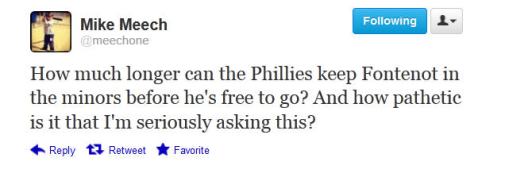
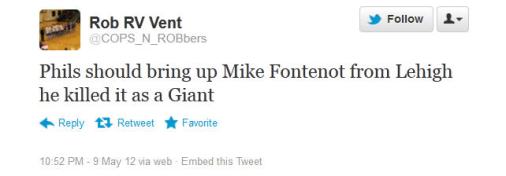
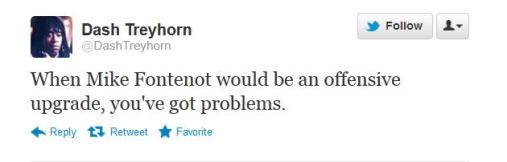
Extremely longtime readers from the ol’ Flushing Fussing days — i.e. my mom — probably don’t even remember that before the 2007, when the last good Mets team was starting to fall apart and I didn’t realize it yet, I advocated the Mets’ acquisition of then-Cubs Minor Leaguer Mike Fontenot to play second base because Fontenot had enjoyed success against Triple-A pitching and seemed to be stuck behind a logjam (including Ronny Cedeno) in the Cubs’ middle-infield mix.
After Jose Valentin went down with a knee injury in the 2007 season, I maintained a half-kidding regular section at the bottom of posts called “Fontenotes,” tracking Fontenot’s progress. I stopped, I believe, when the Mets traded for Luis Castillo.
Toby Hyde tipped me to the current Phillie-fan clamor for Fontenot on the podcast we recorded last night that should be up later today. The situation is very different than the Mets’ in 2007: For one, Fontenot’s actually in the Phillies’ system, so it’s a lot less ridiculous for fans to be calling for him.
For another, no Phillies fan is viewing Fontenot as a potential longtime regular — he’s not an unproven 26-year-old anymore, and they’ve got Chase Utley slated to return at some point. Fontenot will turn 32 in June, and he’s got five years of being a worthwhile but unspectacular part-time infielder under his belt (and a World Series ring on his finger). Phillies fans see him as a potential offensive upgrade over Freddy Galvis and his .538 OPS.
Still, with Met-fan optimism/delusion running high after the team’s three-game sweep of the Phillies in Philadelphia, the symbolism seems to rich to ignore. Fans of crumbling, aging teams hamstrung by a lack of roster depth demand Mike Fontenot.
I’m way too scarred by the last five seasons to say the Phillies won’t bounce back from their rough start. Plus, they’ve got too much pitching. But in this stretch, isolated by a small sample size and amplified in our heads by one woeful series against the Mets, the cracks are really starting to show.
Also, while writing this post, I became crushed by the overwhelming weight of time. In the time I’ve been covering roster minutiae on the Internet, Mike Fontenot has gone from one side of his prime to the other.
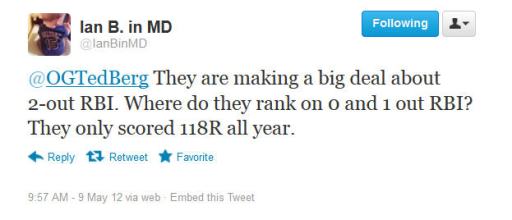 The Mets’ strong offensive performance with two outs to date this season comes up a lot, but the numbers are often presented without context. So here’s some:
The Mets have scored 67 of their 118 runs with two outs. That’s not typical, though I don’t know that it’s meaningful either.
Generally, the league as a whole scores just under 38 percent of its runs with two outs, about 38.5 percent with one out, and by far the fewest of its runs with no outs (which makes sense). There’s some variation every year, and the numbers are close enough that it’s not at all uncommon for a team to score more runs with two outs than it did with one out (the Mets did last year, for example, and the National League as a whole did in 2008).
It does seem weird for a team to score 56.8 percent of its runs with two outs, as the Mets have to date in 2012, but since it doesn’t appear the Mets are doing anything appreciably different with two outs than they are with one out or no outs, I’d guess it’s just a heaping helping of early-season randomness. And part of it certainly has to do with how bad they’ve been with one out — hitting to a .618 OPS, well below their .707 team rate. That’ll even out, and when it does, the two-out stats won’t seem so extraordinary.
Want more weirdness? The Braves have scored 50.6 percent of their runs with one out. Why? Randomness. Sorry, but it’s going to take a hell of an explanation to convince me otherwise.
But if the randomness thing doesn’t satisfy you as an explanation for the Mets’ two-out heroics, try spreading this around and hope it catches on: The Mets never attempt sacrifice bunts with two outs, so they score lots of runs.
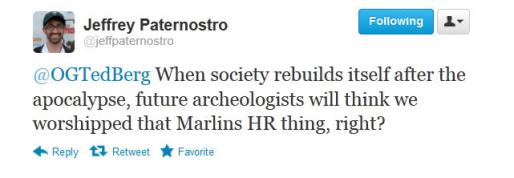 Yes, and I don’t think they’ll be far off. Presumably by the time the apocalypse rolls around, a good portion of the human population will indeed worship Giancarlo Stanton.
Seriously though, I think about what future civilizations will assume about us a lot, even though it’s utterly pointless because whatever they think will be filtered through their all their future-people frameworks and we have no idea what those will be. This especially happens whenever I go to DC and tour the monuments at night, since our memorials to great leaders look a bit like those from earlier civilizations that we assume and/or know to be temples to religious figures — at least in their stateliness.
And of course, the way future civilizations perceive us all has to do with how much of our information survives, and we’re documenting everything much more thoroughly (and archiving it all better) than we ever have before. Basically, as long as there’s no dark-ages stuff, some massive worldwide event or series of event that prevents the advancement and preservation of technology, future people are going to know more about us than we know about anyone from the past. But will the people of 3012 have a way to play Blu-ray? Will they even have the right cables? Because if there’s no way to watch Crank 2: High Voltage in stunning HD quality, the future sucks.
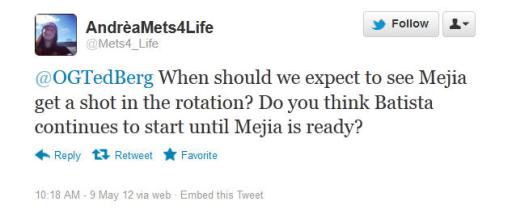 There were a couple of questions about Mejia, who’s set to make a 75-pitch rehab start today in St. Lucie. It’ll be interesting to see how the Mets handle him. For all the hype around him dating back a few years now, he’s still only 22 and he’s still only made six starts in Triple-A — he is younger than Matt Harvey with less experience starting at the highest level of the Minors.
Mejia’s got the Jerry Manuel-fueled taste of big-league mop-up duty under his belt, so it’s unfair to call him less experienced than Harvey. But it’s worth noting that he’s yet to throw more than 100 innings in a season at any level. I have to imagine the Mets will want to proceed cautiously with him for that reason, and he’ll wind up starting games in Buffalo. This article from the Daily News suggests Mejia could see a spot start at Citi at some point before Chris Young is ready, though.
Everything out of the Mets seems to suggest they’re bullish on the prospects of Young returning, which is weird since he’s coming off shoulder surgery and has spent most of his last three seasons on the disabled list. But I have not seen Young throw and presumably the Mets have, so maybe they’ve got good reasons. And ideally, they just need Young to stay healthy until one of Harvey, Familia and Mejia proves ready for the Major League rotation later in the summer.
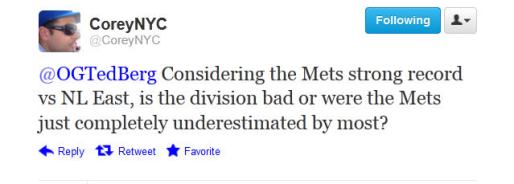 Well I definitely don’t think the division is bad: There’s only one team in it below .500 (and it’s the Phillies, everybody! The Phillies!) and it has the best collective winning percentage in the National League. I do think many people underestimated the Mets before the season, what with the silly 60-win predictions and such.
But I wouldn’t read much into the Mets’ record against their division. It’s nice and it’s a great way to start the season, but it’s also a small sample. They happened to play the Braves before the Braves got hot and the Marlins before the Marlins got hot. All credit to the Mets for beating those teams when they did, but at some point they’re going to run into some divisional opponents playing at their best and their record against the NL East will balance out a bit. The good news is they probably won’t put up an ofer against the NL Central all season.
Presumably you know about this already, but last night Josh Hamilton went 5-for-5 with four home runs and a double. I’m posting it here for posterity: Four home runs in a game is easily my favorite single-game accomplishment, because it requires four home runs in a game.
Now you join the ranks of Mark Whiten!
Other awesome things include the Mets’ come-from-behind win over the Phillies last night. Here’s how this goes: When the Mets lose a series to the Phillies, I say, meh, just another series, sure it’s a division rival but it’s only a couple of games. When the Mets take a series from the Phillies, it represents not just a notch in the standings but a triumph of good over evil, a victory for the human spirit in the face of adversity.
A sweep would be the best thing.
If you’re not a myrmecologist, you might have missed last year’s news that a fungus attacking carpenter ants in the Brazilian rainforest was infecting their brains, prompting them to walk to someplace where the fungus can grow, and killing them. It’s widely known as “the zombie-ant fungus,” because people who study insects in rainforests get slaphappy after a while.
Now it turns out the zombie-ant fungus is itself being attacked by a fungus, only unfortunately this fungus does not turn the zombie-ant fungus into a zombie-zombie-ant-fungus.
Ant researchers say this is evidence we should be doing way more ant research.
 Tedquarters