
Last year’s Digital Domain food post: The Remix

I wrote this last year on March 30, at the very end of Spring Training when it wasn’t of much use to anyone but the St. Lucie Mets faithful. So I’m reposting it now for anyone who’s in town for a Grapefruit League game or heading down this way for some hardxcore Spring Training action later this March. Here are the five best things to eat at Digital Domain Park. And I really can’t stress the pretzels enough. Try the pretzels:

5. Nathan’s Hot Dog nuggets: Nathan’s fans from the Northeast may know these already; my sister has long been a fan. They are essentially miniature, dippable corn dogs. All the glory of hot dogs battered in cornmeal and deepfried, but without that pesky stick. They’re available down the left field line at Digital Domain Park. Maybe elsewhere too, but I’ve only seen them advertised there.

4. Deep fried Oreos: If you haven’t had a deep fried Oreo yet, you should. Not necessarily here in Port St. Lucie — though they’re plenty delicious here — anyplace they’re available. It’s almost impossible to imagine that a deep-fried Oreo could taste better than it sounds, but somehow it does. The cookie part of the Oreo softens up under the heat of the oil, so it’s like chocolate and sugar-stuffed fried dough. Oh, and then it’s topped with more sugar. They’re behind third base at Digital Domain, at a stand that serves deep-fried snickers and funnel-cake sticks as well.

3. Cheeseburger: I should be more specific: I mean the cheeseburger from the Ulti-Met Grill behind home plate. It’s not quite Shake Shack, but the real charcoal grill provides a beachy barbecue flavor that pairs well with the pace and climate of Grapefruit League baseball.

2. Hot pretzel: Crazy, right? There are fried Oreos in the park and I’m telling you the second-best thing is a hot pretzel, something you can get at any stadium in the country? Believe it. This is everything a ballpark pretzel could ever be. They are heated to order over hot charcoal, then salted if you so choose, then heated some more. These are not the lukewarm cardboard pretzels of Shea Stadium’s upper deck*. They are soft and piping hot, and they taste fresh. Also, the park offers both yellow and spicy brown mustard. I go with spicy brown, and I actually put a little ketchup on my pretzels as well. I’m weird like that.

1. Taco in a Helmet: Taco in a Helmet is a taco in a helmet.


*- Fun fact: Pretzels in the upper deck was the worst assignment — by far — for Shea Stadium vendors. They were terrible for commissions because they didn’t sell as well as beer, hot dogs, soda or cotton candy, and for some reason there was only one spot in the stadium that distributed pretzels: right behind home plate. For all other items there was a place on every level, but you had to haul pretzels from the field level to whatever level you were assigned. And that big silver pretzel-holder thing was a pain in the ass to get up to the upper deck. Often the assignment seemed like a punishment; the only times I ever got it were after I got caught wearing my hat backwards, which was a huge no-no in the eyes of Aramark.
Mets over-under

Context: Josh Thole allowed 16 passed balls in 102 games last year after allowing only seven in 77 games across 2009 and 2010. Most of Thole’s passed balls came with knuckleballer R.A. Dickey on the mound. Dickey is still on the team (thankfully). Thole appears set to start more games than ever in 2012, but passed-ball totals come in small enough numbers that they’re certainly subject to randomness.

[poll id=”77″]

Brief notes from the STEP intrasquad game

I spent most of the day at the Minor League side of the Mets’ complex here, watching the team’s young players in STEP camp compete in an intrasquad game.

I’m no scout, so there’s not a hell of a lot substantive I can report without overstepping my bounds. But here’s some:

– The pitchers were all working with 20-pitch limits. Zack Wheeler threw an impressive inning, striking out two, walking one and yielding a fly out to center field. This could be confirmation bias, but it looked like he threw the hardest of any pitcher who went. There’s an audible sizzle on his fastball. I’ll have some video of Wheeler’s outing shortly.

– Sandy Alderson, J.P. Ricciardi, Paul DePodesta and John Ricco were all in attendance. Terry Collins came by for a few innings and greeted some of the players in the dugout. It’s easy to forget that Collins was the team’s Minor League Field Coordinator just two years ago.

– Overheard from the dugout: Minor Leaguers talking about Chipotle.

– Huntington native Cam Maron, a lefty-hitting catcher who played most of last season in rookie ball, had the game’s only home run — a bomb to right field off Yohan Almonte.

– The pitchers appear to be pretty solidly ahead of the hitters at this point of the spring. Jack Leathersich and Domingo Tapia also pitched well.

– Outfielder Sean Ratliff, who missed all of last season after surgery following a scary eye injury suffered in Spring Training, played in the game. Ratliff didn’t do much besides put the ball in play a few times in the game, but he hit the hell out of the ball in Double-A in 2010. He’s 25 now, so hopefully for his and the Mets’ sake the year off didn’t set him back too much, he feels few lingering effects of the surgery and can pick up where he left off and play himself back into the Mets’ outfield mix.

– At second base, Luis Nieves made a gorgeous diving stop going to his left and righted himself in time to make a strong throw to first to get the runner.

– The Mets have a lot of short Minor Leaguers. I don’t know if they have appreciably more than other teams or if this is just a coincidence, but 2011 draft picks Leathersich, Philip Evans and Danny Muno all appear as if their listed (sub-6′) heights are a bit generous. Am I connecting too many dots to wonder/hope/fantasize/speculate that I’m onto some Paul DePodesta secret? Yes, yes I am.

– Brandon Nimmo struck out twice in three at-bats. But he was facing pitchers several years older and several levels ahead of him.

– Major Leaguers are way, way better at baseball than Minor Leaguers. The Minor Leaguers are still inexplicably good by normal human standards, but it’s not hard to see the differences between the STEP-camp guys and their big-league counterparts.

Beginning of discussion

“Hey Murphy, how about an autograph for a second baseman from a second baseman?” asked a kid behind a fence off Field 4 at the Mets’ Spring Training complex in Port St. Lucie, Fla. on Friday.

Daniel Murphy pivoted. “Which one of us is a second baseman?”

On Thursday, Murphy took hundreds of grounders at second. He stood on the infield grass as coaches with fungo bats hit slow rollers to him and his teammates. Then he moved back to the dirt for harder grounders, then to the lip of the outfield grass for sinking line drives. Of all of them, he botched only two: A consecutive pair of bouncers to his right late in the session, the first off his right foot, the second off the heel of his glove. He cleanly corralled the rest.

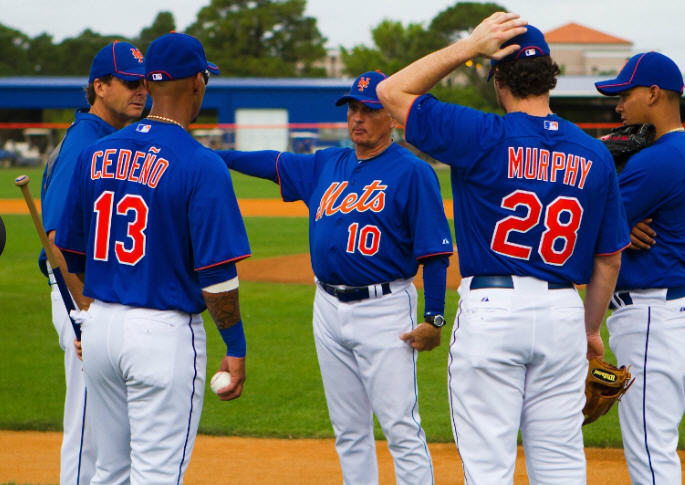
Every day here, after the Mets stretch around 10 a.m., Murphy practices his defense at second base: Taking relays from the outfield, covering first on bunts, negotiating the messy ballet of a rundown routine. Some days he works alone at the keystone, others he’s joined by Ronny Cedeno or Justin Turner. Ike Davis is always at first.

To a layperson, it’s easy to spot a difference in the way Murphy and Davis field. The lanky Davis is smooth: The ball heads his way and he is there, long right arm extending his huge first baseman’s mitt, gobbling up grounders and fluidly readying himself to throw. Even considering the confirmation bias that undoubtedly affects many empirical evaluations of Murphy’s defense, there are some particulars about the way Murphy approaches a grounder that are unique among those practicing in the group: Subtle extraneous movements, frenetic little steps in place — like Peyton Manning in the pocket.

Still, to layperson, it’s hard to see if it matters. Murphy gets to the balls. He makes the plays. His throws look sharp.

After the defensive drills, Davis and Murphy usually move to Field 7 for batting practice. In the cage, their styles are equally distinct. As the pitch comes in, Davis’ hands come down and loop back, he swings his front leg back and then kicks it forward, his bat following. It works for him; it produces what Jerry Manuel liked to call “easy power.”

Murphy keeps his stance wide. As the ball approaches, he rocks back ever so slightly, then twists his toe and unfurls on the ball. It doesn’t quite appear effortless, but optimized for efficiency. There’s little wasted motion, and Murphy slices and hooks line drives around the outfield.

But though the aesthetic differences between the Mets’ first and second basemen are stark on both sides of the ball, they are merely that: Aesthetic. The Mets and their fans seem confident that Davis will prove a strong offensive and defensive player if healthy in 2012. And they know Murphy will hit.

Many in the Mets’ fanbase and media are skeptical of Murphy’s ability to ever play second at the Major League level. Some, if pressed, will amount that he could produce more runs with his bat than he’ll cost with his glove, but they’ll never allow the possibility that he’ll become even an average fielder. The more impatient and dubious contend that if the club should entrust him with its starting second-base job, he’ll kill the Mets or get himself killed. And sometimes, instead of just ending the sentence and finishing a discussion, they’ll emphasize the way they’re doing both by saying or writing, “period, end of discussion.”

Only it won’t be the end of discussion. Right now, barring injury, Murphy appears ticketed to be the Mets’ starting second baseman come Opening Day.

Advanced defensive stats don’t have much value in small sample sizes, and Murphy doesn’t have enough time at any infield position for us to wean anything predictive from those metrics. But taken only as an indication of what has happened so far, and keeping in mind that UZR is fluky enough to say Carlos Lee was the second-best defensive left fielder in baseball in 2011, it’s worth noting that Murphy has played as a plus defender in the infield so far. Statistically speaking, there’s not much evidence yet that he’s as bad a fielder as everyone seems certain that he is.

When presented with that information, Murphy doesn’t seem struck one way or the other. Nor is he concerned about any skepticism outside the Mets’ clubhouse about his defensive ability.

“I’m more concerned about what my teammates think,” he says.

Davis, from his locker nearby, chimes in. “We haven’t made an error yet.

“I’m not happy with my defense now,” Davis says. “No one is; it’s Spring Training. If I still feel this way April 10, we’ve got a problem.”

Davis, supporting his teammate, means to imply that there’s a reason baseball players head south in February and spend seven days a week preparing for the regular season. Murphy is a professional athlete working every day at the position. This is the first spring he has spent exclusively at the keystone, a change he says he thinks is helping.

This isn’t a video game or the Army of McGwires scenario. It’s not just a matter of sliding a guy into a new position and docking his defensive rating some set number of points. Murphy appears to have the arm and hands for second base and the stats seem to like his range. He made some mistakes in his limited time at second in 2011, but none so egregious to damn his entire future at the position. He sustained injuries there two seasons in a row, but is working on the pivot and his footwork around the bag.

Maybe there will never be enough improvement, and the long-awaited Murphy-to-second experiment will implode in 2012. There will likely be some growing pains along the way, but maybe with practice Murphy will prove a capable defender and, as a young, strong-hitting, cost-controlled middle infielder, one of the Mets’ most valuable commodities. And maybe it will never look pretty, but it doesn’t much matter. All that matters is if it works.

Nothing can be concluded yet. This is the beginning of the discussion.

Mets over-under

Context: The Mets’ 2011 bullpen posted a 4.33 ERA, but the team overhauled its relief corps in the offseason, adding Frank Francisco, Ramon Ramirez and Jon Rauch. Manny Acosta and Tim Byrdak appear set for two of the remaining jobs, with a slew of guys including Bobby Parnell, Pedro Beato, Miguel Batista, D.J. Carrasco, Danny Herrera, Chuck James, Garrett Olson and Josh Stinson competing for the others. The average big-league bullpen posted a 3.69 ERA in 2011.

[poll id=”76″]

Valley Fever: A timeline

Here’s a section of a MetsBlog post from Feb. 23, 2012:

9:19 am:Ike Davis is back in Mets camp, according to SNY’s Matt Dunn.

The team told Dunn that Ike’s physical showed an infection in his lung, but after being checked out in New York, he’s been cleared to resume workouts.

He feels no effects of it and he’s been told it will go away, though he will continue to be monitored.

Here’s a section of a Mets.com report from March 3, 2012:

Davis is not the picture of health. He has, in fact, contracted Valley or Desert Fever, a malady that can interfere with a season and even end a career….

Davis, who lives in Arizona in the offseason, says he has experienced no symptoms. “I feel normal. I don’t feel anything,” he said.

Here’s the Mets’ statement on Davis’ condition, also from March 3, 2012:

Ike Davis underwent a routine physical exam after his arrival in PSL.  The exam included an abnormal chest X-ray.  Following additional tests here and in NYC, pulmonary and infectious disease specialists have concluded that Ike likely has Valley Fever, which is expected to resolve itself over time.  Ike is not contagious, is not taking any medication for his condition and does not currently exhibit any of the outward symptoms associated with Valley Fever.  However, Ike has been instructed to avoid extreme fatigue.  No additional tests or examinations are pending, but Ike will have a follow up exam when the team returns to NYC in early April.

Here’s some sections of the National Institute of Health’s page for Valley Fever:

Most people with Valley fever never have symptoms….

The disease almost always goes away without treatment.

So we’ve got: In February, a test in Port St. Lucie shows something on Davis’ lung that requires him to fly back to New York for more tests. The tests reveal an infection, but Davis has no symptoms and is cleared to resume playing, though he will be monitored.

In March, it comes out that the name of the infection is Valley Fever, Davis still has no symptoms and is still playing and still being monitored. Both the NIH and Mayo Clinic‘s websites confirm that most people with Valley Fever never show symptoms. The Internet freaks the f@#$ out.

I’m leaving out the facts that seem to be terrifying most Mets fans — that in some cases Valley Fever can be serious, and that Conor Jackson’s career was derailed by the same disease in 2009, though Jackson’s case wasn’t diagnosed until after he already had symptoms and it led to pneumonia. That is presumably why the Mets are monitoring Davis’ condition.

It’s not good business to defend the Mets’ medical staff these days, but it’s hard to see what the major issue is here. We knew Davis had a lung infection, that he had no symptoms, that he was being monitored and that he was cleared to play. Today we learned that the asymptomatic lung infection for which he is being monitored is called Valley Fever. Hard to see how it merits the type of woe-is-me LOLMets stuff spilling out in all corners.

Davis went through his scheduled Spring Training routine today: stretching, then infield, then batting practice, then four innings of the Mets’ intrasquad game. About five hours of baseball activity in the Florida heat, plus whatever cage work and weightlifting he might have done before and after. Then he talked to me about Daniel Murphy’s defense and sandwiches for a few minutes. He seemed tired, but no more than I was and not at all sick.

Here’s hoping he stays healthy. It sure seems like the panic is premature.

Ike Davis on sandwiches

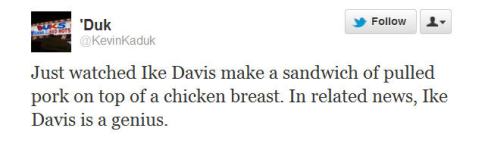
I finally got a chance to speak to Ike Davis about this report today. It turns out Kevin was mistaken, though understandably: What Davis added to the grilled chicken breast was not pulled pork but pulled chicken in barbecue sauce. Ike Davis reports that it was “really good, actually.”

Asked if he considers himself a sandwich innovator, Davis hesitated then confirmed, adding that he likes to mix up his condiments to keep his sandwiches interesting.

“I’ll add chips to a sandwich, hot sauces, different kinds of mustard,” he said. “Sometimes, even if I don’t like the mustard, I’ll put it on my turkey sandwich just for something different.

“You can’t just eat the same turkey sandwich every day.”

Amen.

R.A. Dickey on the slow knuckler

During his two shutout innings in the Mets’ intrasquad game today, R.A. Dickey threw a couple of his extra-slow knuckleballs, drawing “oohs” and “ahhs” from the crowd.

After the game, Dickey cited the velocity readings on the Digital Domain Park on his fastballs and said he needed to be conscious of building up his arm strength before Opening Day. He said he’d like his fastball to sit between 80 and 85 mph, and it seemed like it was generally topping out around 80 today, though — and as Dickey noted — it’s hard to put too much stock in one stadium’s radar (it’s Spring Training for the scoreboards, too).

As for the slow ones, Dickey said he threw two of them intentionally, and that he wants the slow knuckler in the low 60s. He noted that he threw a 57 mph pitch in 2011 — the slowest pitch in baseball last year.

“But that’s too slow,” he said. “When it’s that slow, the hitter has time to see it and adjust.”

Dickey added that while he’s not a flamethrower, he generally stays conscious of the velocities on his pitches.