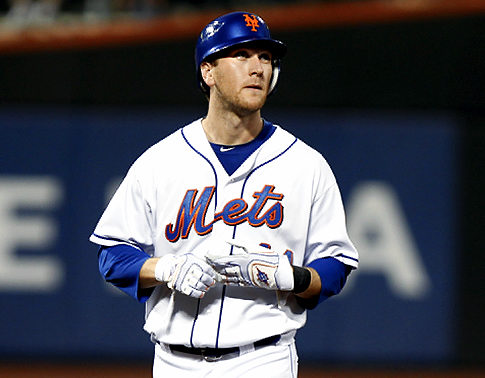
Just to clarify

No one is predicting a 94-win season for the Mets. Last I checked, I am not a crazy person. That number was meant to represent the Mets’ best possible outcome, based on very lazy and inexact addition and guesswork. I actually thought it was pretty damning to say that the best the Mets could hope for if absolutely everything went right was a Wild Card — that they’d be limited to second place by their talent, even in the best-case scenario — but the post was nonetheless met with tons of LOLs and readers wondering what I was smoking.

Anyway, just for a point of reference I went through the same routine with all the other teams in the NL East, looking up and down the roster and trying to guess the best possible but still vaguely reasonable estimate for what each player might do in 2012.

As a Mets fan, I’m probably a bit harder on the Mets than I am on their competitors. Plus I’m less informed on the day to day machinations of the Braves and Phillies. But by my total, meaningless guesswork, the best-case scenario, ceiling win totals for the other teams in the NL East look like this:

Phillies: 116 wins
Braves: 106 wins
Marlins: 105 wins
Nationals: 98 wins

Now someone’s going to run to say I’ve just predicted three teams in the same division to win over 100 games, which is — if you’ve been reading — obviously not the case. Everything going right for the Phillies would mean many things going wrong for the Braves, Marlins, Nationals and Mets, so the Phillies winning 116 games would likely preclude the rest of the division from coming close to their here-speculated best-case win totals.

One thing that surprised me was the relative thin-ness of the Nationals, who seem to have become the Internet’s darling this offseason. I’m not sure how much of that excitement stemmed from their rumored pursuit of Prince Fielder, but I tried to be particularly generous with them and still couldn’t come up with a way they’re close to the Braves or Phillies on paper at the season’s outset. They’ve got a bunch of good young players and pitchers, yes, but they’ve also got some pretty big holes in their lineup and at the back of their rotation.

As for the hated Phillies: It’s exceptionally unlikely they’ll be anything like that good. The Phillies’ average hitter was over a year older than every other team’s in the National League last year. Ryan Howard will likely miss the start of the season after surgery on his Achilles tendon, which means 33-year-old Chase Utley, who has missed large parts of the last two years to injury himself, will be the Phillies’ youngest infielder on Opening Day. They’ve still got enough firepower and pitching to remain competitive in 2012, but — though a lot of Mets fans refuse to believe this — no one is immune to time. Their window will close.

And our Mets? Well, this is all a roundabout way of suggesting they have the least immediate upside of any team in their division, but it’s not to say they can’t do a better job capitalizing on their upside than their competitors or that they can’t enjoy a prolonged run of good luck. And since it’s boring to remind you that anything can happen, I’ll remind you this: If you’re absolutely certain in January that any Major League club can not win more than 60 or 70 or 80 games by September, you’re certainly a fool.

Daniel Murphy as the 2012 Mets

This much we know: Daniel Murphy does not look pretty playing the field. Hell, Murphy himself will tell you as much. He rarely appears comfortable at any position, even the ones where he seems to be decent. His instincts in the infield look strong on balls hit near him, but he is prone to errors of aggression and of inexperience. His movements are at best herky-jerky, even awkward – at least by the standards of professional athletes.

Yet last week, Terry Collins called Murphy the favorite to open the Mets’ 2012 season at second base, where he has played all of 43 games in his professional career and where he suffered season-ending knee injuries in both 2010 and 2011.

But that’s a good thing! Not the injuries or the inexperience, of course — those are bad things. Rather, the Mets’ willingness to try the relatively untested Murphy at second base appears to be, given their circumstances, the right move.

As we all know, the circumstances are woeful: They apparently can’t afford to compete for big-name free-agents anymore (though there weren’t any available for the keystone anyway), and for a variety of reasons (Murph’s latest injury among them) it didn’t seem to make much sense to trade Murphy or anyone else to try to bring back a more obviously viable middle infielder. They need good, inexpensive hitters in their lineup, and with Ike Davis at first, David Wright at third and Jason Bay’s contract in left, there’s no better way to get Murph regular at-bats than by trotting him back out to second and hoping no overeager or ill-intentioned baserunner comes at him too hard too early in the season.

So they’ll go with it.  And I think Daniel Murphy the second baseman — in January, at least — stands as perhaps the best metaphor we’ve got for the Mets’ 2012 season.

In penciling Murphy in for second, the front office seems to be making the smartest possible move for a team with such limited resources. But it presents a great risk with the potential for a good reward.

If it goes well and Murphy proves an adequate defensive second baseman, he’ll likely rank among the better players in the league at the position. But since he’ll probably never be as good as Dustin Pedroia was in 2011 on either side of the ball, the best possible outcome for Murphy — like the Mets — appears to be “very good.”

Mets fans have come to celebrate Murphy’s offense and seem to assume, given the offensive standards at second base, he’d be among the very best at that position if he could hack it there. But his strong 124 wRC+ from 2011 would rank him sixth among Major League second basemen in both 2010 and 2011 — not quite elite — and certainly less-than-stellar defense would mitigate his value. Plus, though Murphy will turn 27 in April and might still improve a bit at the plate, his success last year was largely batting-average driven.

That is to say: We strongly suspect Murphy can hit a bit and we really have no idea if he can field. If he proves he can do both and stay healthy, he’ll be good, but he’s unlikely to be good enough at either to be great. And all of that, to me, sounds a hell of a lot like the 2012 Mets.

The very believable downside to playing Murphy at second is the chance that it’s an unmitigated disaster. He could get hurt again, or he could prove so unspeakably bad at fielding the position as to make Mike Pelfrey gnaw his whole damn hand off and R.A. Dickey eschew Shakespeare for Sartre. And no matter what the ultimate outcome, we must recognize now that every one of Murph’s hiccups along the way will be berated and GIFed and plastered all over back pages and blogs.

LOLMets, you know?

It’s important to note that I’m not saying the Mets’ 2012 season hinges on Murph. Not at all. He could be awesome and the team could suck, or — though it’s inherently less likely — vice versa.

What I’m saying, and the conclusion to all that bestcase scenario stuff, is not really all that groundbreaking: At second base and elsewhere, the Mets’ front office seems to be doing the best it can with its limited resources. But because the resources are limited, they have been and will continue to be forced to take risks with limited rewards.

The good news is that they’ve still got enough talent that the rewards, if they all pay off, are high enough to allow the team to contend. And it’s good that many of the players, like Murphy, are homegrown, likable and appear to be dedicated, and are under team control for long enough to be part of the club when next it is they do start fielding more inherently competitive teams.

The bad news is that risks are risky, and spreading first basemen all over the field, going with untested players at multiple positions, relying on several guys to return healthy from long injury absences, counting on a very shallow pitching staff, and hoping that an adjustment to the walls will fix the franchise’s best player add up to a hell of a lot of risk. And the contingency plans are basically Justin Turner, Ronny Cedeno and Miguel Bautista.

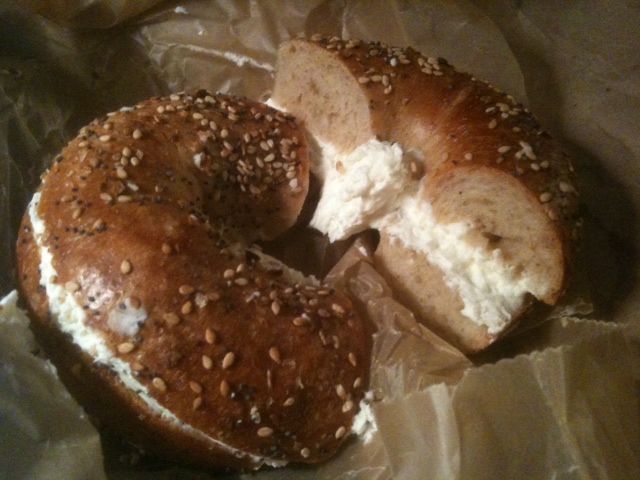
 

Scotland’s “Brad Pitt Special” sounds reasonably delicious, considering

Thanks to a Scottish sandwich shop there’s now a panini named after the Hollywood hunk. The Metro Sandwich Company devised a tribute to Pitt after the 47-year-old arrived in Glasgow this week to work on filming the post-apocalyptic zombie war movie, World War Z. When Pitt caught wind of the “Brad Pitt Special” from his film crew, the man himself sent his assistant to get the chorizo, salsa and cheddar sandwich, and quite literally ate himself.

So pleased with the nosh, he signed the outdoor poster promoting the mouthful of Pitt, writing “with extra onion and jalapeno…a delight for the senses. Many thx [sic] BP.”

PopCrunch.com.

Before you fly off to Scotland in search of this sandwich, I should warn you about my experience with Scottish cuisine. My dad’s mother, the occasional White Castle craver, was born in Port Glasgow, Scotland and came to the U.S. at five or eight or 12, depending on how old she was claiming to be when telling the story. She was a smart, strong and hilarious woman, but an absolutely woeful cook. And every once in a while she’d get a hankering for the old-world cuisine, and on rare occasion she’d subject us to it.

Brutal. I can’t even figure out why Scottish meat pies would be gross, since they’re just pastries stuffed with meat and I’m on the record as loving that stuff. But somehow they’re remarkably dry, and the meat inside is gray and flavorless. Hell, just look at the names of some traditional Scottish cuisines: “Cullen Skink,” “Cock-a-leekie soup,” “Arbroath smokies,” “Collops,” “Clapshot.”
Excuse me for working blue, but is it me or do all of those things sound more like sexually transmitted diseases than foods? (I guess, for that matter, a similar case could be made for the “Brad Pitt Special.”)

And maybe all those things are actually delicious and I’m just biased because of my beautiful, awesome grandmother’s “cooking.” But until I’m convinced otherwise, I’m going to side with the Mike Myers line in So I Married an Axe Murderer? that says, “I believe most Scottish cuisine is based on a dare.”

All that said, a chorizo, salsa and cheddar sandwich sounds like it could be pretty delicious, assuming the chorizo is good.

Oh, one other thing about my grandmother and food: Every year around the second weekend of December, my dad and I went to go set up her Christmas decorations — a remarkably laborious process because she had a huge nativity set made of cement. And every year when we finished, she invited us in for tea and these really dry shortbread cookies she had, the type that come in a plaid tin.

One year I suggested to my dad that I thought she might be putting out the very same cookies every year, so I scratched the date on the back of one that I didn’t eat — 1995. Two years later that same cookie showed up on the plate, looking no worse for the wear. She must have kept them in the freezer, next to the meat pies.

So who ya got?

Every Jets fan has to resolve this conflict to his or her own satisfaction, but the way I see it, you should root for the Patriots. Maybe Bill Belichick would decide to step down if he secured another ring. Maybe Tom Brady works out with a little less fervor in the offseason if the Pats capture the title. The Giants are your rival, sure, but you won’t see them in the regular season again until 2015. Hope the Patriots get fat on satisfaction, and deny the Giants the opportunity to rule the city.

David Ferris, SNY Why Guys.

No way. Just… no way.

I understand the dilemma, and since I deal with way more Giants fans than Patriots fans on a regular basis I can even see how from a pure exposure standpoint it might make sense to favor New England, but there’s just no way I could ever bring myself to root for a team coached by Bill Belichick and featuring Tom Brady.

But I don’t hate the Giants the way some Jets fans do. Not at all, really. They’ve got too many lovable players, and as a longtime Eli Manning apologist I’m enjoying the evidence this season is providing for future arguments with Giants fan/hater friends.

To me this isn’t nearly as much of a debate as it was with the Yankees-Phillies World Series in 2009, and even then it was pretty obvious to me the Yankees were the good guys.

Seriously, though — and excuse the woe-is-me-ness here — how can this keep happening? Why do my teams’ crosstown rivals and divisional rivals keep winding up playing for their sport’s championship?

I’m not going to bother with a poll because I know a lot of you are Giants fans. And congrats to you, if that’s the case. We’re in this together now. Let’s hold on to this:

If absolutely everything falls right (pt. 3)

I lied when I said this would be a four-part series. I’m running out of steam and ways to say “hope,” so it’ll be three parts. Then for good measure, I’ll throw in a metaphor-heavy summary-type thing pre-previewing the 2011 Mets. That could come later today or tomorrow, depending on how busy I get with other nonsense.

This is the one about the pitching staff.
The rotation: First things first, in a best-case scenario, Johan Santana stays mostly healthy. Given the nature of his injury and recovery, I’d say the best you could reasonably hope for is 25 starts at a solidly above-average but sub-Santanan level.

R.A. Dickey, we know, is totally sweet. And though Dickey’s ERA jumped a little last year, his rate stats all stayed remarkably consistent with his breakout 2010 campaign. The best we can hope for is another season of good health, great facial hair and great knuckleballs from Dickey, all of which should make him — hard as some find this to believe — among the top 25 starters in the league. Perhaps not a True No. 1 Ace, but a legit frontline starter regardless.

Jon Niese is more of a wild card. Niese’s peripheral stats indicate he might be very good, but he has a nasty habit — or, depending on whom you ask, the nasty misfortune — of allowing a ton of base hits. I’m not sure it’s likely, but I think it’s fair to hope the still-young Niese stays strong and healthy through the season, lives up to those peripherals and joins Dickey on the outer fringes of Ace-dom with an ERA in the low 3s.

Mike Pelfrey we’ve pretty much got pegged by now. He’s going to yield a lot of balls in play. The hope is that the Mets prove better than we expect at turning those into outs (or Pelfrey enjoys a run of great luck) and eats up 200 palatable innings with an ERA around 4.

For Dillon Gee, as with all pitchers, the everything-falls-right scenario must include a seasons’ worth a full health — no safe bet. And given Gee’s underwhelming peripherals in 2011, it’s hard to hope for more than the modest improvements suggested by all three of his projections on Fangraphs. In the interest of optimism, though, it’s worth noting that Gee struck out four times as many guys as he walked in the Minors.

And of course, if we’re talking about absolutely everything falling right — and we are, remember — then by sometime in the middle of the season one of Matt Harvey and Jeurys Familia will prove ready for prime time and an improvement over some member of the big-league rotation. Pitching prospects being pitching prospects, it’s probably unreasonable to expect success from both even for the purposes of this exercise. Which one surfaces first is anyone’s guess: Familia has had more success and a handful more starts in Double-A to date, but most prospectors are higher on Harvey.

The bullpen: The Mets put a lot of work into their bullpen this offseason, but bullpen construction tends to be something of a crapshoot. The Mets’ 2012 bullpen looks to have a nice combination of guys with histories Major League success, guys who can actually strike people out, guys who throw really hard and guys who can occasionally find the plate, though, so it’s not crazy to imagine them having one of the league’s better relief corps. It really only requires a couple of dudes having good seasons.

So here’s what I’ve got: I’m painting with very broad strokes here and doing all sorts of shoddy math, but the way I see it if absolutely everything falls right for the Mets, they could get about 33 wins’ worth of production beyond the replacement level from their position players and maybe 14 from their pitchers. If a replacement-level team can be expected to produce about 47.4 wins, these Mets, in this best-case scenario, would wind up with about 94.

Again: I can’t stress enough how inexact a science this is. And I guess the conclusion really isn’t all that stunning: If the Mets enjoy an unprecedented run of good health and every single player on the team produces as well as anyone could reasonably expect at the season’s outset, the team would be good enough to make the playoffs. I expect this would prove true for most teams. And that doesn’t really account for any unexpected Jose Bautista success, which happens on rare occasion (and to lesser degrees than Bautista’s, of course), or much assistance from the farm system.

The counter, of course, is that the Mets need nothing to go wrong to get to 94 wins, and several things will inevitably go wrong. How many things and how wrong they go will determine how far away the Mets finish from their best possible outcome, and since their best possible outcome is probably only a Wild Card berth, it doesn’t make a postseason run look particularly likely.

But in short: The good news is the Mets do probably have the talent to get to the playoffs if absolutely everything goes right. The bad news is that never happens, and they don’t have a lot of flexibility for when it doesn’t.


In search of: The 49ers’ Sammy Hagar Guy

The Giants won yesterday and are bound for the Super Bowl, which is a) very exciting for fans and members of that team and b) yet another reminder that we — and by we I mean me — should really never count professional sports teams out until they’re mathematically eliminated. Hindsight now says otherwise, but the Giants looked as good as dead at multiple points during the regular season.

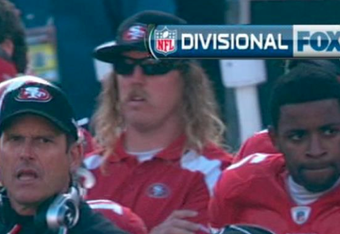
Anyway, there was an old Dave Letterman gag where he’d take some photograph of a notable event and focus on some rando in the background and say, “But what about that guy?” (He might still do it, I just haven’t watched the show in years.) And anytime the FOX cameras showed Jim Harbaugh on the Niners’ sideline last night, they presented one of the greatest but-what-about-that-guy opportunities of all time. Somewhere behind Harbaugh, at most times, stood some dude in a 49ers shirt with long, curly blond hair that might have been a mullet and a strong, well-manicured mustache.

I asked Twitter for his identity last night and again this morning and got nothing, but it turns out I’m not the only one curious. Brandon Eddy passed along this from Bleacher Report:

No one (at least no one in my circle of sports friends) can seem to figure out who he is, how he got there or what grooming products he must use to make his jaw-dropping hair and handlebar-teaser combo kick so much righteous ass that it delivered a San Francisco 49ers team from 2010 despondency to 2011 postseason-storybook heroism.

And the screengrab:

An update to the Bleacher Report story reveals “The Bro” has a Facebook page, which claims he’s an “equipment manager with the San Francisco 49er’s.”

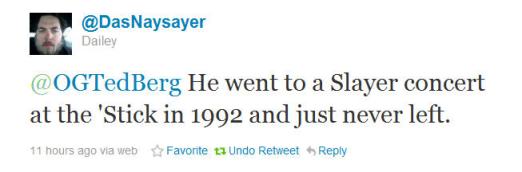
I kind of prefer my friend Dailey’s explanation:

America’s top 20 new(ish) sandwiches

This post by Brandon Spiegel at the Daily Meal is almost a year old, but I hadn’t seen it before today so it’s new to me. He lists his 10 favorite new sandwiches and follows it with the top 10 reader-suggested new sandwiches. The only one of these I’ve had is the fried-chicken sandwich from Bakesale Betty’s, a Hall of Famer.

Lots of good ideas here, but I’m toying with something I’m going to make myself that should blow them all out of the water if I can get it right. I’m not going to scoop the post I make when it’s perfected, but TedQuarters comments-section completists might have some idea what I’m working toward.

Awesome NL West tidbit

Lincecum and Kershaw matched up four times in 2011, Kershaw winning all four contests, all four of them tremendous duels. In the four games Lincecum pitched 29 innings with a 1.24 ERA, but an 0-4 record. Kershaw was 4-0, pitched 30.1 innings with a 0.30 ERA.

Bill James, Grantland.com.

So that’s pretty awesome. It’s cool when matchups between the best pitchers in the game play out like matchups between the best pitchers in the game. Poor Tim Lincecum pitches for a team with no offense to speak of.

If absolutely everything falls right (pt. 2)

I meant to get to this yesterday but there was a meeting I forgot about. To the half-full outfield:

Left field: Jason Bay is probably the toughest Met to guess about here. If you think whatever happened to Jason Bay when he signed with the team was some sort of light-switch situation and that if someone or something to turns it back on he’ll go right back to being the hitter he was in Boston, then maybe you could guess that the fences will make the difference and he’ll put up an .880 OPS or something. I suspect that for a player of Bay’s age it’s more of a dimmer control than an on-off switch though, and that we should consider ourselves pretty lucky if something can move Bay’s dial halfway back toward full intensity. That’d mean about an .800 OPS, which by last year’s standards would actual put him in the upper tier of left fielders offensively. His defense is what it is.

Center field: It seems too much to ask for Andres Torres to repeat his outstanding 2010 campaign since he’s now two years older and coming off a disappointing season. But if Torres can even hit to his Bill James projections of .255/.332/.405 and play his typically excellent defensive center field, he’ll prove a fine addition.

Right field: Duda falls into the Ike Davis/Ruben Tejada/Daniel Murphy category: The best we can hope for from him offensively is that he puts up a full season of the production he showed in 2011. An .850 OPS will play anywhere, but Duda will need to prove he can handle right field, so in our optimistic projection, he shows he’s at least not-terrible out there.

The rest: Actually, if you want to pen the most dream-world Polyanna scenario, you can hope a) Bay torches the ball in April, May and June, b) some slugger on a contending team with payroll flexibility gets hurt, c) Kirk Nieuwenhuis picks up right where he left off last year in Triple-A and quickly shows he’s ready for the next level and then d) the Mets can trade Bay to the contender, shift Duda to left and call up Nieuwenhuis to play right without losing much. Though I guess if Bay is torching the ball, they would be losing much. So there’s a paradox there.

I think you can pretty much ink in Scott Hairston for an OBP between .300 and .315 and a few big pinch-hit home runs. His optimistic, pessimistic and realistic projections are all about the same.

The fifth outfielder will probably hit left-handed, so you have to hope he can hit righties well because he’s going to have a hell of a lot of pinch-hitting chances against them, given Terry Collins’ appreciation for platoon matchups.

The Mets’ starting outfielders can all boast elements of stardom: Torres has the defense, Duda has the power, Bay has the contract. None of them appears to be a complete player, even in a best-case scenario.

I should probably say now where I’m going with this: I’m using Fangraphs, looking over last year’s positional leaderboards and making very rough estimates at Wins Above Replacement values for Mets if they perform to their most optimistic expectations.

If you’re into that thing and on board with this exercise, take a stab at it: What would you say is the best total WAR the Mets could reasonably hope for from their position players?