
If absolutely everything falls right (pt. 2)

I meant to get to this yesterday but there was a meeting I forgot about. To the half-full outfield:
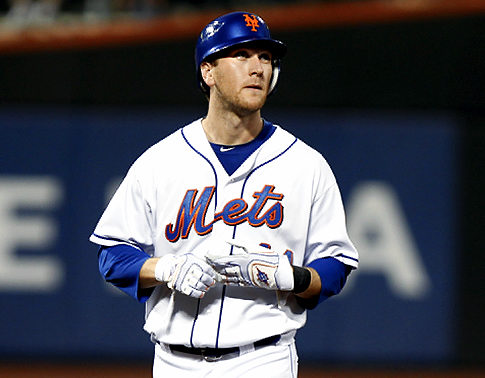
Left field: Jason Bay is probably the toughest Met to guess about here. If you think whatever happened to Jason Bay when he signed with the team was some sort of light-switch situation and that if someone or something to turns it back on he’ll go right back to being the hitter he was in Boston, then maybe you could guess that the fences will make the difference and he’ll put up an .880 OPS or something. I suspect that for a player of Bay’s age it’s more of a dimmer control than an on-off switch though, and that we should consider ourselves pretty lucky if something can move Bay’s dial halfway back toward full intensity. That’d mean about an .800 OPS, which by last year’s standards would actual put him in the upper tier of left fielders offensively. His defense is what it is.

Center field: It seems too much to ask for Andres Torres to repeat his outstanding 2010 campaign since he’s now two years older and coming off a disappointing season. But if Torres can even hit to his Bill James projections of .255/.332/.405 and play his typically excellent defensive center field, he’ll prove a fine addition.

Right field: Duda falls into the Ike Davis/Ruben Tejada/Daniel Murphy category: The best we can hope for from him offensively is that he puts up a full season of the production he showed in 2011. An .850 OPS will play anywhere, but Duda will need to prove he can handle right field, so in our optimistic projection, he shows he’s at least not-terrible out there.

The rest: Actually, if you want to pen the most dream-world Polyanna scenario, you can hope a) Bay torches the ball in April, May and June, b) some slugger on a contending team with payroll flexibility gets hurt, c) Kirk Nieuwenhuis picks up right where he left off last year in Triple-A and quickly shows he’s ready for the next level and then d) the Mets can trade Bay to the contender, shift Duda to left and call up Nieuwenhuis to play right without losing much. Though I guess if Bay is torching the ball, they would be losing much. So there’s a paradox there.

I think you can pretty much ink in Scott Hairston for an OBP between .300 and .315 and a few big pinch-hit home runs. His optimistic, pessimistic and realistic projections are all about the same.

The fifth outfielder will probably hit left-handed, so you have to hope he can hit righties well because he’s going to have a hell of a lot of pinch-hitting chances against them, given Terry Collins’ appreciation for platoon matchups.

The Mets’ starting outfielders can all boast elements of stardom: Torres has the defense, Duda has the power, Bay has the contract. None of them appears to be a complete player, even in a best-case scenario.

I should probably say now where I’m going with this: I’m using Fangraphs, looking over last year’s positional leaderboards and making very rough estimates at Wins Above Replacement values for Mets if they perform to their most optimistic expectations.

If you’re into that thing and on board with this exercise, take a stab at it: What would you say is the best total WAR the Mets could reasonably hope for from their position players?


If absolutely everything falls right (pt. 1)

This is often considered a depressing time of year even for those who aren’t Mets fans, but it’s especially bad right now for the Shea Faithful, what with… well, pretty much everything except reports of R.A. Dickey doing stuff.

So I’m squinting at Patrick Flood’s pre-preseason-preview and trying to think of if there’s any way the Mets could have one of those magical seasons where everything falls right, as unlikely as that now seems. So this’ll be a four-part series, I guess, in which I look at the position players and then pitchers likely to be on the roster and take a stab at making the most optimistic predictions for what they might produce for the club in 2012 to figure out if even then the Mets would turn out good.

And I’ll try to keep it at least vaguely reasonable. Technically the most optimistic prediction would be that every hitter on the team suddenly busts out a la Jose Bautista 2010, and the Mets become a ridiculous juggernaut that steamrolls the National League. But since Bautista’s case is exceptional, I’m not about to predict a 1.000 OPS for Ruben Tejada in 2012.

Catcher: Josh Thole has been about average offensively for a catcher in his career, and his ability to get on base and youth seem to bode pretty well for his future at the plate. He struggled defensively in 2011 after appearing to improve that part of his game in 2010. So if all goes well in 2012, he keeps getting on base, turns on a few more pitches for extra-base hits, and puts the defensive growing pains behind him. The most optimistic of the three projections on Fangraphs gives Thole an on-base heavy .736 OPS, but let’s go crazy and raise that to .750 and hope he can play average defense.

It’s hard to realistically hope for much from Mike Nickeas offensively, given his career Minor League numbers. But if we’re half-fulling here,  maybe Thole stays healthy enough to play the bulk of the Mets’ games behind the plate, Nickeas’ defense lives up to its billing and he hits well enough to prove an above replacement-level backup catcher. That doesn’t take much: Even a .600 OPS with good enough defense would do the trick.

First base: Ike Davis spent the first month of 2011 hitting about as well as we could reasonably hope he could, but given the long injury layoff I’d say it’s unfair to project a .925 OPS even in this useless exercise. But they are moving the fences in and we are trying to be as optimistic as possible, so let’s say Ike is healthy and stays that way and can maintain an OPS around .880 while playing his typically excellent defense. 

Second base: The most optimistic thing you can hope for at the keystone is that Daniel Murphy can hack it there well enough to avoid injury and embarrassment and keep his bat in the lineup. If Murph can maintain something around his .809 OPS from 2011 and just be better than Dan Uggla defensively, he’s a pretty valuable guy to have in the middle infield.

Third base: It was all the fences. David Wright again performs like his 2005-2008 vintage, when he was one of the very best players in baseball. He’s still probably a step slower defensively, but that part of his game improves a bit too as he grows more confident that he can again be awesome.

Shortstop: As with Davis and Murphy, with Ruben Tejada the most reasonable optimistic expectation would have to be that he’s capable of repeating something close to his offensive performance from 2011 over a full season. And there’s not much in Tejada’s Minor League past to suggest he should do that, but he’s so young and has always been so young for every level that we can still cross our fingers and hope he’s coming of age before our eyes, and that he can play capable defense at a premium position.

Backups: Ronny Cedeno sees some time as a defensive replacement and makes a bunch of fancy plays. Justin Turner forever wins the hearts of Mets fans everywhere with clutchness and grit in a right-handed pinch-hitting role. Neither needs to start that often, obviously, because all of the regular infielders are staying healthy and having career years.

How many wins is that infield worth? The way I see it — and again, I know this is all very unlikely — it’d have two legit stars in Davis and Wright, a solidly above-average player in Murphy and at least average guys in Tejada and Thole.

Donut-related hostility on the 6 train

The 6 train sucks at rush hour. It comes every couple of minutes, but it inevitably fills way past the threshold at which a commuter can enjoy an inch of personal space. And even despite that, plenty of idiots still block the doors at stops, refuse to move all the way into the train cars and shove their way on instead of just waiting for the next train like everyone else on the platform.

As the doors were closing at the 68th St. stop this morning, a guy tried to scramble in only to meet an unyielding wall of humanity. The door caught him on the side and jostled him forward into the train and into a collision with another dude, who, it turned out, had a deep, booming, Ving Rhames voice and a bag he was working hard to protect.
“MOTHERF@#$ER!” He yelled. “Can’t you see I’ve got f@#$ing donuts!?”

The first dude, inches away from and face to face with the angry donut-holding guy with nowhere to move, mumbled something inaudible as the train started moving.

“OH YOU WANT SOME OF THESE F!@#ING DONUTS?” the angry guy continued. “I’LL SHOVE THESE DONUTS RIGHT IN YOUR F@#$ING FACE!”

“Ay, dios mio!” said a woman holding a baby, sitting nearby. The perpetrator looked down and mumbled something else. Here’s my favorite part:

“YEAH, YOU BETTER F@#$IN’ HOPE THEY CHOCOLATE!”

Between 59th St. and 51st, Donut Guy announced to the man in front of him and basically everyone else on the train that he was getting off at the next stop. He appeared to do so without incident and, fortunately for everyone, without in any way compromising his prized bag of donuts.

So if some basso profundo co-worker brought donuts to your Midtown office today, make sure to thank him profusely. He put a lot of effort into getting those donuts to you intact.

Guesstimate with me

You ever walk past one of those rotisserie chicken places and see like 30 chickens rotating on spits and wonder how many chickens available for sale in New York City are actively cooking at that moment?

I do, and I have ever since one of my friends first brought the subject up for debate. I’ve got a ballpark estimate, but I’m curious what you’d guess.

To clarify: I’m not talking about chickens people are cooking in their homes here, or else I imagine the number would be astronomical.

And I don’t mean raw chickens that are about to be cooked. I mean chickens cooking in restaurants and takeout places and supermarkets and anyplace else that might sell cooked chicken in the five boroughs of New York City on any given Wednesday night around 7 p.m.

[poll id=”52″]


Sandwich investigation continued

Then Mr. Berg asks if a burger is a sandwich, and even brings in the legal definition and NPR to bring us to a “protein encased in a bread product” (it’s quite the series).

Let me suggest something that may throw a wrench in the works: portability. After all, open-faced sandwiches are not only “stupid,” they have a French name: tartine. And why was the sandwich created if not for portability and ease of ingestion? Clearly, portability is part of this thing, even if it doesn’t end up in the definition.

Eno Sarris, EnoSarris.com.

Oh, Eno, portability is a big part of this thing. Fear not.

Now featured at the analog TedQuarters

This is not a great picture of the thing, but my dad made me this baseball-card mural for Christmas. For better or worse, the reflection of the living-room light blocks out Willie McGee’s face in the photo:

The cards all came from the duffel bag full of cards in my parents’ basement. Somehow a now-creased 1987 Topps Barry Bonds was in there, even though my brother and I once worked pretty hard to separate the cards we thought might be good from the duffel-bag cards.

I made a couple of similar murals before I first moved to Brooklyn about seven years ago, but I didn’t do nearly as good a job with them so some of the cards were a little crooked and a bunch eventually fell off. I got the idea from the Park Slope music venue Southpaw, which has its basement basically wallpapered in old cards.

Anyway, if you have a lot of old, hilarious baseball cards laying around somewhere, I suggest putting them to this good use. I find myself staring at the thing all the time, transfixed by all the amazing mustaches and awful uniforms of yesteryear.