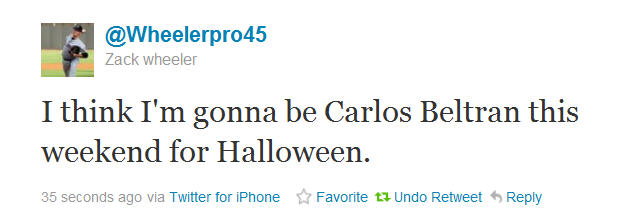
New favorite Met?
Reply

So that was… whoa.
People seem eager to mark last night’s World Series game with some superlative, which is pretty damn understandable considering how crazy it was. But I don’t think it’s right to call it “the best World Series game ever” or anything close. To me, “best” implies well-played, and for the first several innings it was a pigsty.
So let’s do it this way.
[poll id=”41″]
Packing up to move, I came across a notebook I kept to entertain myself while I worked in a high school in 2004. Like many of my old notebooks, it’s mostly filled with bad song lyrics, odd and usually quite pretentious free-writing exercises, and lists of things I needed to do. (Obligations listed in this one include: “Wash dog,” “return football,” “eels CD,” and “play guitar.”)
It also contains a poem I wrote about the Crunchwrap Supreme right after it first came out. This was written years ago, while I was still developing my Taco-Bell-writing voice. So it’s a bit raw. But because computer trouble at work prevented me from posting anything more substantive here this afternoon, I figured I’d transcribe it:
 A Crunch Supreme
Prepared fresh and expedient,
the same five ingredients
in a new combination;
synergistic innovation.
Soft yet crunchy,
edible contradiction
Mexican Pizza, Soft Taco,
in a whole new position.
Beef, lettuce, nacho cheese,
no tomatoes for me please.
At a dollar ninety-nine,
it feels like a crime.
I’d like it “supreme”
(Mexican for “with sour cream”).
How? Who? When?
I’m filled up with questions.
What is responsible for
this delectable invention?
Who sat around
for hours and hours
creating this medium
for raw taco power?
Wrap and Crunch,
together at last.
I just ate two,
bring another one fast.
Toby and Patrick interview Mets’ prospect Collin McHugh about life in the Arizona Fall League while I’m out running moving-related errands. I join them for further discussion of the Babe Ruth vs. Albert Pujols thing, because it’s fun to talk about.
On
Reader/commenter Non_banned_ryan passes along Gordon Edes’ list of potential managers for the Red Sox. Included:
JERRY MANUEL, 57
His nine years of managing experience with the White Sox and Mets include a division title in Chicago in 2000, when he was named AL Manager of the Year. But Manuel was never able to overcome the stigma of the Mets blowing a seven-game lead with 17 to play in 2007, and was fired in 2010 after two seasons in which the Mets were decimated by injuries. Cerebral and low-key, Manuel scores high in communication skills and would seem to fit the Sox profile of seeking a players’ manager.
As Ryan points out: “Cerebral” is code for “wears glasses.” “High in communication skills” means “impresses the media with his one-liners while he neglects to talk to players for weeks at a time.”
Also odd that he wouldn’t be able to shake the stigma of 2007, when Willie Randolph managed the Mets. But I suppose Manuel was the bench coach then.
I’m hearing that the Mets could trade David Wright for prospects or pitching or a proven veteran leader or a big-time power threat or a dirty-uniform guy or some combination thereof.
 The Mets have considered and will again consider dealing Wright, even though it is extremely unlikely that they do so. Nearly every other front office in baseball has internally discussed acquiring Wright, regardless of if they have the requisite pieces to pull off such a trade or the money with which to pay Wright’s salary or even the need for a third baseman.
And though Wright could void the 2013 club option in his contract if he is dealt — making him more valuable to the Mets than any acquiring team — there remains some chance the Mets will flip him to a potential contender looking for a one-year rental at third base if that team can return a package that Sandy Alderson believes is worth more to the Mets than Wright’s next two seasons.
The Mets are interested in re-signing Jose Reyes, but not if his demands exceed what they’re willing to pay. If the Mets sign Reyes, they might trade Wright to free up salary or keep Wright in an effort to compete sooner rather than later. If the Mets don’t sign Reyes, they will consider both trading Wright and not trading Wright.
For the Mets to trade Wright, they will need to find a willing trade partner offering one or more players that could contribute to their future more than Wright will, then hammer out the details and fill out a bunch of paperwork. Though it is possible all of that could happen this winter, it is improbable.
If the Mets retain Wright, they could also trade him during the season or keep him for the length of his contract or sign him to an extension.
The plan, according to Viola, is to have Leathersich be a starter in Class A ball next year. If he thrives, so much the better. But the Mets just want him to gain as much experience as possible by throwing the extra innings.
“We’re going to have him build up his arm, but I see him as a closer or set-up man somewhere down the line because he’s overpowering for short periods of time,” Viola said.
Via Amazin’ Avenue comes this solid read on lefty Jack Leathersich, the Mets’ fifth-round pick in 2011.
 If you read this site with any regularity you know how dismissive I normally am of both far-off prospects and small sample sizes. And Toby tells me to never read too much into NY-Penn League stats, which I suppose makes sense: A lot of guys in that league are adjusting to wood bats and the rigors of life in the Minors for the first time. And even a full (short) season there is a pretty small sample.
So it is with several grains of salt that I note Leathersich’s ridiculous rate of 18.5 strikeouts per nine with only six hits and three walks allowed in the 12 2/3 innings he pitched for the Cyclones. That’s about as dominant a line as you’ll find anywhere in the professional ranks. Given the tiny sample, it could mean little to nothing, but it’s certainly better than, you know, not striking out more than more than half of the batters you face.
And it’s interesting that the Mets are going to stretch Leathersich out next year for reasons that make a ton of sense. If they want him polishing his full arsenal of pitches, he’s best served getting as many reps as possible. Plus, if he succeeds as a starter, then, you know, sweet.
Also, and most importantly: The guy’s name is Jack Leathersich.
The Albert Pujols vs. Babe Ruth debate was silly enough that I figured I’d drop it and move forward, but then someone mentioned it today in an email and now I’m fired up. And I know the game has changed so much as to make the whole conversation essentially pointless, but whatever. It’s on my mind.
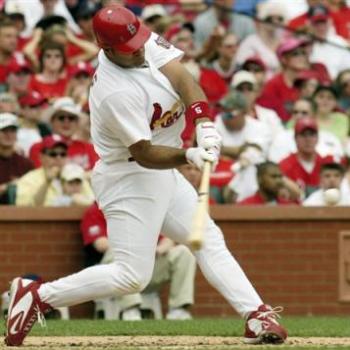 So I’ll state this again: Albert Pujols is a better hitter than Babe Ruth was.
Not relative to their eras. No Major Leaguer was ever better than Ruth when held up against the players against whom he played. That much is obvious. But I’m talking about right-now Albert Pujols vs. 1930 (or 1927, or 1920, or whenever) Babe Ruth.
And not “oh but what if Ruth had this advantage or that advantage that Pujols now has?” He didn’t. That’s part of the point. I’m talking time-travel scenario: Ruth hits his third home run of the 1928 World Series and as he crosses the plate is magically transported to April, 2011, then gets traded to the Cardinals since the Yanks already have Nick Swisher.
Ruth doesn’t match Pujols in 2011. No way.
Let’s consider some of the factors. The only reason I didn’t pursue these in more depth the last time around is that I thought I was making a pretty obvious point.
There were only 16 teams then and there are 30 now, so that might mean Ruth faced a higher concentration of talent. But consider that by the 1930 US Census, there were 122 million people in the country, compared to 308 million in 2010.
There are nearly three times more people in this country now, and nearly all of them grow up exposed to baseball in some form or another. In 1930 there were no Major League teams west of St. Louis, and lots of people in the U.S. still got polio and stuff. It was a very different time, and one in which the road to the Majors was more difficult to traverse.
Obviously a lot of people still played baseball, and yeah, back then baseball didn’t have to compete with as many other sports for a young athlete’s attention. Still, there was certainly nothing like the type of youth baseball structure we have now, with the fundamental instruction and competition that begin when kids are 5 or 6.
If a kid in the US has the ability and desire to become a Major League Baseball player in 2011, he will almost certainly get an opportunity to prove himself in organized ball with somewhat knowledgeable coaches, not by impressing the townsfolk playing against old men in the local farm-league game. Professional-caliber players can’t slip through the cracks these days.
And that doesn’t even consider the impact of the game’s global popularity on the Major League talent pool. 125 guys from the Dominican Republic alone played in the Majors in 2011. You know how many foreign-born players there were in 1930?
Six: Two from Cuba, two from Canada, one from Norway and one from Austria-Hungary. Six dudes born elsewhere, and no doubt at least a few of them grew up in the ol’ U.S. of A.
But that’s all just about the talent pool. What about the game itself?
In 1930, teams scored on average 5.55 runs per game. In 2011, it was 4.28. Pitchers walked guys at about exactly the same rate, but struck out about half as many as they do now. Teams got more hits but fewer home runs, and defenders made nearly twice as many errors.
You can explain all that in a variety of ways: Maybe guys struck out less because they were more focused on hitting for contact than power, and maybe official scorers of the 1930s were harder on infielders.
But the way it looks to me, and the explanation I’m certain is correct, is that the Major League game was just crappier across the board in 1930. I’m sorry if that offends your sense of nostalgia.
Pitchers struck out fewer batters because they couldn’t boast the same arsenals as their 2011 counterparts, and more balls in play meant more hits and more errors because the fielders weren’t very good either. Not by today’s standards, at least.
I could go on, but I’m getting bored and I imagine I’ve long since lost you. But the important thing is this: Major League Baseball keeps getting better. As the talent pool grows, so does the competition for spots on rosters. Advancements in medicine, nutrition, scouting and communications help players become faster, stronger and smarter.
That’s not to take anything away from Ruth. Ruth was unutterably awesome, and deserves any praise directed his way. I have, and probably will again, called him the greatest player ever, because I think that term implies “relative to his competition.” But it is only relative to his competition that he is the greatest player ever.
From the Wikipedia page for “Pitching machine:”
In 1897, mathematics instructor Charles Hinton designed a gunpowder-powered baseball pitching machine for the Princeton University baseball team’s batting practice.[1] According to one source it caused several injuries, and may have been in part responsible for Hinton’s dismissal from Princeton that year.[2]
Patrick Flood continues his look back at the best and worst free-agent contracts by examining outfielders signed since 2004. Any guesses whose contract was the best?
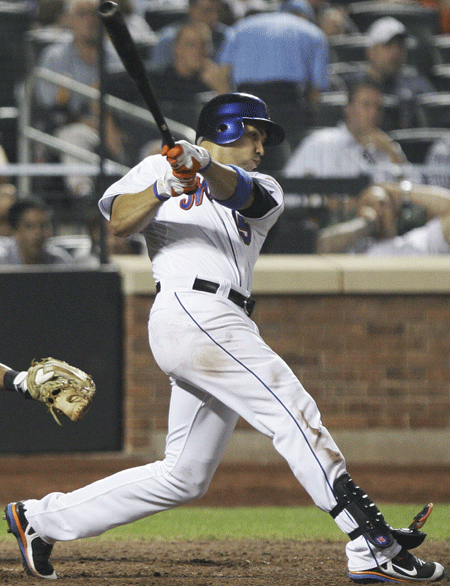
Worth noting: Not only did Carlos Beltran earn his money with the Mets, as Flood points out. He also — in the final awesome flourish of his tenure — brought back Zack Wheeler, now considered one of the Mets’ top prospects.
 Tedquarters