
Henry Sims for President of everything

In other words, it’s good to see Georgetown center Henry Sims — who is apparently running for vice president of the Georgetown student body — approaching his candidacy in that spirit.

Eamonn Brennan, ESPN.com.

Sims, if you don’t know, is a junior backup center for the Georgetown Hoyas basketball team. He has been a bit of a disappointment since entering the school as a pretty big recruit a couple of years ago, but he has developed into an important role player on the ninth-ranked squad this year and has had his share of exciting, highlight-reel moments on the floor. He is extremely tall.
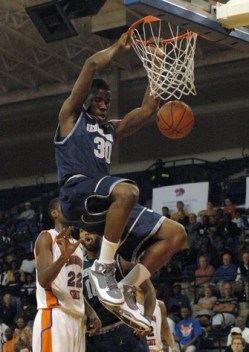
And here’s what sucks about Georgetown University: The student-government election isn’t going to be anywhere near the runaway it should be whenever a member of a ninth-ranked college basketball team runs for office, because Georgetown students are just that lame. Instead of being like, “Holy crap, Henry Sims, remember that awesome dunk?” undergrads are going to be all, “well, I’m glad that Henry Sims is exercising his right to run for student office but what are his opinions on the important student-government issues?” even though there are no important student-government issues.

Then some other students, I guarantee you, will be like, “Well, Henry seems like a plenty qualified candidate, but I’m concerned he won’t have time to dedicate himself to his student-government duties, considering his commitment to the basketball team.” And still others will probably say, “Henry Sims is lying to us! I bet he’s not from Baltimore at all! Don’t vote for Henry Sims!”

So if you happen to be a Georgetown undergraduate and you’re reading this, please, do the right thing and make this student-government election the popularity contest all student-government elections should be. I promise you that in his 4.1 points, 3.3 rebounds and 0.6 blocks per game this season Henry Sims has already done more for you than any other candidate ever will. Consider his the first ticket to ever earn the official endorsement of the Harry Balls campaign.

Q&A with Joe McEwing

More clearinghouse from Fantasy Camp. Busy day today, limited time for actual thinking.

Joe McEwing is precisely as energetic as you’d expect Joe McEwing to be. Before I interviewed him, during one of the Fantasy Camp games he was managing, he had taken hold of a camera from one of the camp photographers while simultaneously coaching first base.

TB: I see you’re taking up photography.

JM: I’m trying to broaden my horizons. I don’t think it’s going to be the best piece that they get.

TB: Well you played everywhere, maybe you can take over…

JM: Oh no no, I’m OK to stay on the field.

TB: Where are you going to be managing this year?

JM: In Triple-A with the White Sox, in Charlotte.

TB: Do you think you bring the same style do managing as you did to playing?

JM: Yeah, I try to take bits and pieces of everyone I’ve come across managing-wise and player wise and try to mold it into my own style. One thing I don’t forget is how hard this game is to play. It’s not an easy game to play. I go out there and treat everyone the way I want to be treated, and I think that has helped me a lot.

TB: Do you have your eye on managing in the Majors?

JM: Yeah, it’d be another dream come true and it’s something I look forward to. But for me, right now, I’m in no rush. It’s nice to see other kids’ dreams come true now.

TB: You played with some of the current Mets. Are you still in touch with any of them?

JM: I stay in touch with David Wright. We’re still good friends.

TB: Did you talk to him during the season at all?

JM: Yeah, we talk all the time, during the season and in the Winter. It’s a friendship. Mostly we talk about stuff off the field. He’s got enough going on with competing in New York and playing on the field.

TB: What’s your best memory from your time with the Mets?

JM: Oh, I had many. Obviously, playing in the World Series in 2000. Fulfilling a dream, being able to compete in the World Series, unfortunately we came out on the losing end. But I think the best was the relief efforts after 9/11. It was an opportunity to give back to the city and the whole world. To allow people to free their minds for a few hours, after that tragedy, that was special for me.

Robocop statue a go

Probably not the best $10 I ever spent, but hey. If I ever make it back to Detroit, I’ll know I was in some small part responsible for civic greatness. Follow up — Best song about Detroit: KISS’ “Detroit Rock City,” Rancid’s “Detroit,” Marvin Gaye’s “Inner City Blues,” Dire Straits’ “Telegraph Road”, or basically any Eminem song?

More Q&A with Wally Backman

Look: I intended these quotes from Mets Fantasy Camp to be used for something a little more, ahh, journalistic. But then one thing led to another and I got all busy and now here we are and it’s Spring Training already and, you know, yeah.

I wanted to write about the way the players at Fantasy Camp, like many Mets fans on the Internet and apparently many of Backman’s Minor League charges, seem drawn to Backman personally. I think it has something to do with how he talks. He seems to love talking baseball, like, presumably, all of us do. He does so constantly, and he talks to even the most ill-informed fan like he’s a 30-year MLB insider. It’s kind of awesome, and it makes it really tough not to like the guy.

Watching his team’s games in fantasy camp from the bleachers, you can hear his gravely voice running throughout, even if you can’t make out the words. And his players seem to behave just a bit differently from those on Tim Teufel’s team and Doug Flynn’s team: they curse louder and more often, like I might have when trying to impress my older brother and his friends on the rare occasion I got to hang out with them. An opposing pitcher, from the mound, yells to Backman about the strain in his ass.

Anyway, here’s the portions of the taped interview I did with Backman that I didn’t post here:

TB: What changes in an organization at the Minor League level if the front office changes? Does anything change?

WB: It might change because we’re going to have a lot of new coaches. We’re going to have a new field coordinator in Dickie Scott, and he might have some different philosophies. The game of baseball is based on fundamentals, especially on the Minor League side, and fundamentals are pretty basic. The amount of time that’s spent on fundamentals, that might change. But there’s really not a whole lot that can change.

TB: Are there differences, in terms of strategy, in what a manager has to do at the different Minor League levels?

WB: I think, the managing side of it, the way the organization has been and I hope would continue to be, it gives you, as the manager, the freedom to run the game the way you feel it needs to be run. You know you’re not going to hit for your prospects –- that’s the difference from the Minor Leagues to the big leagues. But running the game shouldn’t change.

TB: The Mets were pretty candid: You were a finalist for the managerial position and didn’t end up getting it. Did you learn anything from that process?

WB: It’s the third time that I’ve interviewed. I interviewed when I was with the White Sox and Ozzie got it, then I had the whole Diamondbacks thing happen. I think you learn a little bit each time; but the questions always kind of stay the same.

TB: Do you mind if I ask, what are the questions?

WB: They ask about the team and what ideas you might have. Some of the questions that were asked of me were, for instance, what was I going to change about me because I had been a Minor League manager but had never managed in the big leagues. So, how was I going to change to the players in the big leagues. And my answer was that I’m not going to change. I played the game in the big leagues, I’ve coached in the Minor Leagues. I believe when you respect the players you get the respect from the players.

That was the first time that question had ever been asked of me, but that’s all the player wants. The player wants respect.

TB: Is there any part of your managerial game your working on, or are you set?

WB: No, I’m set.

Dignity in humanity’s demise

Watson has lots in common with a top-ranked human Jeopardy! player: It’s very smart, very fast, speaks in an uneven monotone, and has never known the touch of a woman.

Ken Jennings.

A few big takeaways from the Jeopardy! IBM Challenge: First, the first two days of the show were kind of annoying. The computer’s cool and all, but show the circuits and move on. I tuned in to watch Jeopardy!, not an IBM commercial.

Second, clearly Watson’s big advantage was on the buzzer. At some point it became clear that Jennings and Brad Rutter were just trying to buzz in as quickly as they could and then think of the answer, just to beat Watson to the draw. That didn’t seem entirely fair; there were plenty of clues that Watson didn’t know or got wrong, but the computer got the opportunity to buzz in first on almost every answer on which it was confident. I wonder how it would have fared against Jennings and Rutter in a written trivia quiz, like bar trivia or something (and yeah, I realize it was designed to play Jeopardy!).
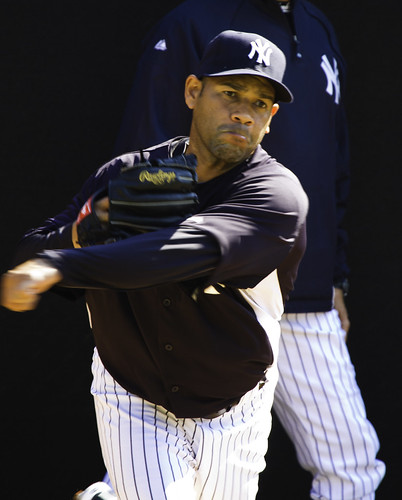
Third, Ken Jennings is awesome. He’s hilarious on Twitter, for one thing. Also, upon conceding to Watson in Final Jeopardy!, he referenced the Simpsons — “I for one welcome our new computer overlords.” Awesome. Plus it turned out it was Jennings’ initial run of remarkable Jeopardy! success that inspired the Watson project in the first place; a bunch of IBM designers were eating in a restaurant trying to come up with something awesome to do when they noticed everyone in the restaurant empty into the bar to watch Jennings dominate some suckers. That begat Watson.

I’m disappointed and a little surprised that machine beat man in the IBM Challenge, but at least Jennings has a good sense of humor about it. Plus they say the computer’s going to help humanity in the long run, so that’s cool.