Look, it’s Pedro Martinez and he’s (maybe slated to be) doing stuff

Rob Castellano notes in his winter league update for Amazin’ Avenue that Pedro Martinez is on the Licey roster in the Dominican Winter League. I thought maybe this was big news and I missed it entirely, but the only Google News return on a search for “Pedro Martinez Licey” is this article, which, at least by the Babelfish translation, makes it sound like Pedro will be given the opportunity to prove himself. If anyone who can actually read Spanish wants to clarify, I’d appreciate it. But please refer to shortstops as “torpedo boats,” as the auto-translator does.

From the Wikipedia: Lucy the Elephant

Outcome of a Wikipedia digression.

From the Wikipedia: Lucy the Elephant.

Lucy the Elephant is a six-story high building shaped like an Asian elephant, built in 1882 by novelty architect James V. Lafferty. Unlike many examples of novelty architecture which are really just whimsical sculptures, Lucy the Elephant is an actual functional building that has, at times, served as a restaurant, business office, cottage and tavern.

Lafferty designed and built Lucy in a misguided attempt to sell real estate in the area. Though the Wikipedia mentions nothing about the structure’s effectiveness in luring home-buyers, I confidently write “misguided” because I can’t imagine anyone in 1882 or today being particularly eager to move in next door to a completely terrifying 65-foot high wood-and-tin elephant.

Still, no one before Lafferty had thought to erect a zoomorphic building. He was awarded a patent for Lucy’s design, earning him the exclusive right to make and sell animal-shaped buildings for the next 17 years, undoubtedly a prized distinction.

Though the patent, per the Wikipedia, extended to all animals, Lafferty specialized in elephants. Just five years after completely Lucy, he built an elephant-shaped hotel in Coney Island called Elephantine Collosus, which I believe is the name of the Decemberists’ next album. The hotel burned down in 1896.

Lucy the Elephant was scheduled for demolition in the 1960s, but a group of concerned citizens canvassed the community and saved the structure, moving and refurbishing it and eventually getting it onto the National Register of Historic Places Shaped Like Elephants.

Lucy the Elephant still stands proudly in Margate today, though the tips of its tusks were blackened by a 2006 lightning strike.

Also, the Wikipedia article refers to Lucy the Elephant as “she” throughout, even though a) It has tusks, which only male Asian elephants can boast and b) it is a building and does not actually have a gender.

Final Frenchy Tracker

Unless there were some N.Y. newspaper sidebars I couldn’t dig up on Google News, the Frenchy Tracker stopped dead in its tracks at eight.

That means Francoeur did finish the ALCS with an impressive 5:4 at-bats-to-articles ratio, and enjoyed only four times as many features as he did times on base in the series.

In the meantime, the Frenchy Tracker has been misconstrued as some kind of personal attack against Francoeur. It certainly is not. I have nothing personal against the man, only something against watching him hit.

More, the Frenchy Tracker only meant to reflect my wonderment with Francoeur’s ability — through smiles and charisma — to convince the media of his value to his club as a baseball player, and the media’s willingness to look past all the evidence suggesting otherwise.

I find it vaguely amazing that Francoeur still plays baseball and has not yet entered the world of politics. It strikes me that he is way, way better at making people like him — a skill, no doubt — than he is at laying off breaking balls. I suppose baseball pays better.

Anyway, here are your eight Jeff Francoeur articles from New York papers during the ALCS, in case you want to revisit the series through the prism of Francoeur:

Oct. 14: Jeff Francoeur happy to be playing meaningful baseball in New York…
Oct. 14: Francoeur enjoying life with Rangers
Oct. 14: Francoeur Misses his Friends but is Happy in the Playoffs
Oct. 15: Francoeur thrilled at shot to star in Texas
Oct. 15: … ex-Met Jeff Francoeur finds grass is greener in Texas
Oct. 16: Francoeur finds a role in Texas
Oct. 19: Francoeur fitting in nicely for the Rangers
Oct. 21: Jeff Francoeur says mistakes cost Rangers in Game 5…

Wither the Phillies?

Optimistic Mets fans everywhere, this one included, spent all day Sunday considering the symbolic value of Ryan Howard’s caught-looking strikeout that ended the Phillies’ 2010 World Series hopes. “Just like Beltran,” we said, hoping Howard and the hated Phils would suffer the same fate Beltran and the Mets did after the 2006 NLCS.

The Situations were far from identical, of course. The Phillies won the World Series in 2008 and got back there in 2009. Howard earned the love of the Philadelphia fanbase with three home runs in that series, and — though these things can turn quickly — probably will not soon suffer the same nonsensical and misdirected hostility from the fans and media that Beltran endured.

Many Mets fans tend to overrate the Phillies’ intangibles (underrating at the same time their very-tangibles). The Phillies have been the bad guys in the N.L. East for four seasons now, so we look at them like they’re 25 T-1000s, ignoring their humanity and trumpeting their apparent inability to be destroyed, citing their arrogance and their will and their remarkable capacity to overcome injuries.

But no team is invincible in a five- or seven-game series, and though Brian Wilson hardly cast the Phillies into a vat of molten steel, that 3-2 slider on the low-outside corner reminded everyone that the Phillies might not be so mighty after all, and inspired columns like this one and this one examining wounds in their mechanism that might not heal themselves instantly.

(OK, enough of that metaphor. </terminator2>, if you will.)

Truth is, the Phillies will still have Roy Halladay, Roy Oswalt and Cole Hamels at the front of their rotation next year, and a trio that good makes them unlikely to collapse completely. And if we — me — here at TedQuarters are unwilling to accept that Beltran and the Mets became magically unclutch and weak-willed upon the Wainwright curveball, we must recognize that the same will be true for the Phillies.

But since we’re in a celebratory mood, we can look down the road with rose-colored glasses on and find more important similarities between those Mets and these Phillies.

Those Mets locked up a ton of payroll in some longterm deals that rendered them financially inflexible. These Phillies already have $143 million spent for 2011 and and $89 million committed to seven players in 2012. Both clubs thinned their organizational ranks with a series of trades aimed to help at the Major League level. Injuries, you already know, took their toll on those Mets teams. Jimmy Rollins and Chase Utley, both on the long side of 30, both missed time with injury this year.

So though it’s probably silly to expect the Phillies to fall apart as dramatically as the Mets did in 2009, it is certainly reasonable to expect that they won’t be able to dominate the division much longer.

The Braves, I am concerned, could be a problem.

This

Excellent interview with Alderson from DuckSnorts in 2008. Obviously it’s a lot easier to say the right things than to actually put them in practice while running a baseball team, but kudos to Alderson for saying just about all the right things. 

Sandwich of the Week

The thing about making pulled pork, it turns out, is that then you have an absolute ton of pulled pork you get to eat. That’s a good thing, no doubt, but it requires a pretty serious commitment to pork-eating. You don’t want any of that pork going bad — especially not after you labored over it for 13 hours or whatever — so you’re going to have to come up with a bunch of ways to prepare it: pork tacos, pork and eggs, creamed pulled pork on toast, pork chili.

None are better than the O.G. pulled pork sandwich, though. I had this for five consecutive non-breakfast meals.

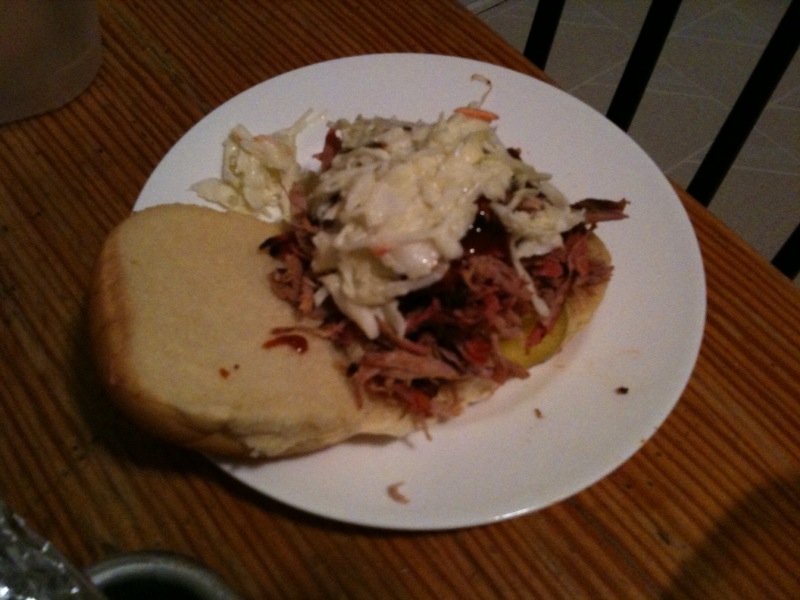
The sandwich: Pulled pork sandwich from the TedQuarters kitchen.

The construction: Smoked pulled pork on potato bun with sliced pickle, barbecue sauce and cole slaw.

For the buns I used Martin’s hamburger buns, a good, consistently soft potato bun. The sliced pickle and cole slaw were store bought. The sauce is something I sort-of made. It’s what barbecue guru Steve Raichlen calls a “doctor sauce,” made by combining other barbecue sauces then adding honey, vinegar, apple juice and spices. The recipe is here. I recognize it’s not a traditional Carolina-style barbecue sauce that would typically top this sandwich, but I had some left over from an earlier barbecue project and thought it was pretty delicious.

Important background information: I fear that sandwiches are never quite as good when you make them yourself as when someone else makes them for you, even if you are — like me — unbelievable at making sandwiches. Still delicious, mind you, but I think there’s something deep inside our minds that knows the sandwich is a significantly less convenient meal if we’ve had to construct it from its elements, which in turn makes us appreciate the sandwich ever-so-slightly less.

What it looks like:
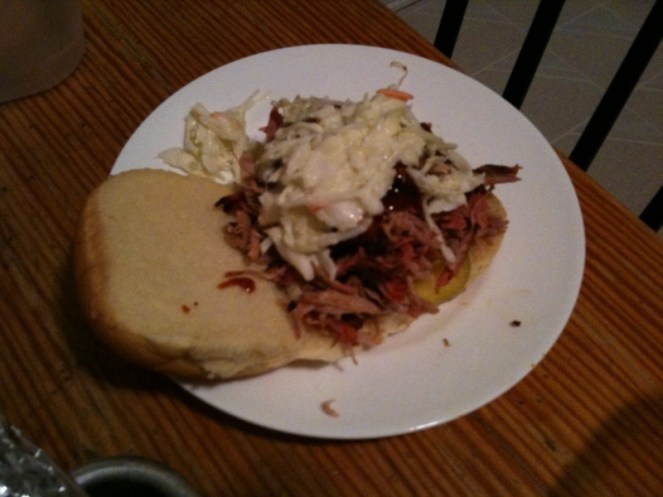
How it tastes: Good. The pork is outstanding; really caught a lot of the smoke flavor without being overwhelming, and the cut of pork itself turned out to be moist (read: fatty) throughout. The crusty outside parts add nice spice from the rub and some variance to the texture. Real delicious stuff we’re talking here. I mean, it’s pulled pork.

But despite that, and despite tasty and fresh ingredients throughout, I never managed to make a Hall of Fame sandwich in the five pulled-pork sandwiches I endeavored. Maybe if I were preparing them for guests I would have gone a little further to make sure the pork was warm, the barbecue sauce was room temperature and the pickle was crunchy, but at home, negotiating all the ingredients from my refrigerator, I don’t know. I guess I knew the sandwich was going to be awesome if I just piled on the right proportions of each ingredient — and don’t get me wrong, it was awesome — but I never took the type of care I should have to maximize its sandwich potential.

I think the pickle was at least part of the problem. I used sandwich-stacker pickles that had been sitting in my fridge for months, so they were never really crunchy. Plus I think I would have been better off with a couple slices of bread and butter pickles or something, which offer more skin, more surface area, and so, more crunch. The cole slaw — which was good, but unexceptional, just cole slaw — adds some crunch, but the pork is so soft that it’d be nice to have it bookended by crunchy things, and the pickle didn’t pull its weight. Plus it sogged up the bun with pickle juice. Delicious, delicious pickle juice.

The bun was really good though. So was the barbecue sauce. Honestly, if you’re bored, try that recipe. It’s easy to make and spicier than most barbecue sauces (depending on what rub you use, I suppose), plus adding all that vinegar really gives it some tang.

What it’s worth: The pork wasn’t all that cheap and there was a lot of labor involved here, but the pork butt yielded so much meat that the total cost of this sandwich, to me, was probably less than $3. Pretty amazing when you think about it. All you need to do is spend 13 hours smoking a pork butt and commit yourself to only eating pork for a week.

How it rates: 80 out of 100. A tantalizing sandwich with the potential to be an all-time great, but sidetracked by poor work ethic and unable to maximize its talents. There are a ton of baseball players like that, but not many I can find from North Carolina. So I’ll call this the Otis Nixon of Sandwiches, even though Otis Nixon is probably not an 80, but mostly because I’ve always wanted to create “the Otis Nixon of Sandwiches.”