
Raul Valdes: Actually pretty good?

I’m not sure I’m willing to go that far just yet, but the 32-year-old Cuban defector who came to the Mets on loan from Tabasco of the Mexican League is quietly quieting some doubters — this one included — in 2010.

Valdes has struck out more than a batter an inning and more than three times as many guys as he’s walked. And he has induced enough weak contact that it’s reasonable to argue he’s unlucky to hold a 3.20 ERA. He has yielded a high .361 batting average on balls in play despite an 18.8% line-drive rate, and his FIP is nearly a run lower than his ERA. Plus, in small samples, Valdes has actually been much more successful against right-handed batters than lefties.

Valdes’ solid but unspectacular five innings in relief of John Maine last night has Mets fans speculating that Valdes could take Maine’s place in the rotation if Maine is actually injured.

Dillon Gee has struggled of late for the Triple-A Bisons. Pat Misch has pitched well, but with predictably unexceptional peripherals. (Also, his name is an anagram for “Sh-t Camp.” “Raul Valdes,” on the other hand, is an anagram for “Larva Duels,” which I imagine would be awesome to watch.)

The problem with starting Valdes is mostly that there’s almost nothing in his past to suggest he’s anywhere near this good. In the Minors from 2005-07, Valdes struck out 6.8 batters per nine innings and allowed a ton of hits. He was a starter for most of it, so it’s reasonable to expect he would pitch a bit better in a relief role. Not this much better, though.

Way, way crazier things have happened in samples this small, so the early success is not necessarily an indicator that it’s all suddenly clicking for Valdes, or something like that.

But since Valdes hasn’t pitched in the U.S. since 2007, there’s some chance he picked up a new pitch or approach in Mexico that has made him more effective. I can’t find any Mexican League stats for Valdes, so I don’t even have any clues. There’s not much about Valdes’ tenure in Mexico in Adam Rubin’s excellent profile of the pitcher from last month.

Finally, I’m open to the possibility that the Valdes pitching for the Mets is the beneficiary of some sort of international identity conspiracy. Mostly I’m open to that because I think it’d be kind of awesome and not because I think it’s actually plausible, but check this out: Not only is Valdes pitching far better at the Major League level than he ever did in the Minors, but the headshot on his MiLB.com player page is clearly not him.

Could that be the real Raul Valdes, the one who suffered a 6.30 ERA in 131 1/3 Triple-A innings? Did the Olmecas de Tabasco loan the Mets a ringer?

No, probably not. But it’d be pretty sweet if they did.

A victory for us all

He’s 88, but Federal Judge Jack Weinstein is no old fogy.

The jurist sided Thursday with a city teacher who was suspended after she let eighth-graders use vulgar sex terms during a lesson on AIDS.

Weinstein said there’s no regulation against the way Faith Kramer taught the lesson – which involved words like “hooters,” “wiener” and others less printable.

John Marzulli, N.Y. Daily News.

Finally, there is legal precedent defending our right to say “hooters” and “wiener” in New York City middle schools.

It’s probably better to get a job in a middle school before you start, though. I can’t imagine they take kindly to random citizens strolling through the halls of middle schools all, “Wiener! Wiener! Hooters!’

Habitually not so good

By now you know the whole saga that unfolded last night, during and after the Mets’ 10-7 win over the Nats. Jerry Manuel pulled John Maine after five slow and ineffective pitches, even though Maine wanted to continue pitching. After the game, the Mets told reporters that Maine was heading to see a doctor in New York.

Only they forgot to tell Maine. Maine lashed out at his manager and pitching coach for doubting him, then Dan Warthen capped the evening by calling Maine a “habitual liar, in a lot of ways, as far as his own health.”

First things first: Manuel was absolutely right to pull Maine from the game. I’m never quick to defend the Mets’ beleaguered manager, but if he left Maine in and Maine got shelled (or hurt, or more hurt), we would be torching Manuel today for trotting out a fastball pitcher who couldn’t crack 85.

And it’s hard to blame Maine for wanting to stay in the game. John Maine didn’t become a Major Leaguer by rolling over at the first sign of a challenge or without desperately wanting the ball in his hand every fifth day. If Maine was throwing fastballs in the low-80s, something was likely wrong with him. But it’s not on John Maine to diagnose or police himself. Baseball players should want to play baseball.

Where everything went wrong, as it so often does with the Mets, was when it came time to communicate what had happened. Maine claimed he never got a good explanation from his manager, no one thought to tell Maine the Mets wanted him to see a doctor, and then Warthen went ahead and called Maine a liar.

So really, the only breaking news here is that the Mets, for once, actually pulled an aching player before he further injured himself. John Maine getting hurt is no surprise. The Mets improperly communicating a message internally is nothing new. And Dan Warthen throwing players under the proverbial bus isn’t, either. Remember, this is the same guy who tried to blame some of the team’s 2009 pitching woes — his primary responsibility — on catchers who couldn’t call games.

It’s vaguely notable that Warthen said even a single negative word about Maine, a pitcher whose career has taken a veritable nosedive since the Mets hired their current pitching coach. Under Rick Peterson, Maine averaged 5.9 innings per start (and didn’t miss many starts), a 3.83 ERA and a 4.28 FIP. Under Warthen, he’s averaged 5.1 innings per start (and missed a bunch of them) with a 4.86 ERA and a 4.91 FIP.

It’s the worst type of post hoc ergo propter hoc argument to say Maine’s struggles are the result of Warthen’s hiring, as there are plenty of other factors — especially injury — that could turn a pitcher’s fortune. But since there have always been concerns about Maine’s arm strength and stamina, and since Peterson is a renowned expert on biomechanics, it’s at least worth noting that Maine’s run of arm issues started a little over a month after Warthen replaced Peterson.

It should also be noted that after calling Maine a habitual liar, Warthen called him a “warrior” and “a competitor” and basically said all the right things. But if I’m Dan Warthen right now, with all sorts of internal change looming on the horizon, I’m not saying anything at all — especially if someone asked me about John Maine, the embodiment of all the struggles the Mets’ staff has had in the past two years.

Mike Hessman making Val Pascucci look like a punchless slap hitter

In case you’ve missed it, Buffalo Bisons slugger Mike Hessman is mashing homers at a Ruthian rate up by Lake Erie.

This is Hessman’s ninth season in the International League. He hits right-handed and plays most of the corners, though he’s also logged time in the middle infield at points.

This video is his 13th home run of the season. He hit his 14th last night, but it wasn’t quite as impressive to look at:

How to become a folk hero

Chris Carter is not at all shruggy. He is rabidly committed to self-improvement. Carter did not know the Mets lineup this afternoon, a few minutes after the clubhouse opened. He asked me for it, and I handed him my Blackberry.

“Oh man,” Carter said, upon seeing that he was not starting. He quickly brightened. “I’ll get better today,” he said, before walking away. “I’ll be better tomorrow. Get better every day.”

He was serious.

Andy Martino, N.Y. Daily News.

I’ve got nothing.

In France, they call it ‘deauxping’

Floyd Landis, the American cyclist whose 2006 Tour De France victory was nullified after a positive doping test, has sent a series of emails to cycling officials and sponsors admitting to, and detailing, his systematic use of performance enhancing drugs during his career. The emails also claim that other riders and cycling officials allegedly participated in doping, including seven-time Tour de France winner Lance Armstrong.

Reed Albergotti and Vanessa O’Connell, Wall Street Journal.

And so concludes a run of public denial and bald-faced lies hilarious enough to make Roger Clemens look like Honest Abe. No word on why Landis fessed up now, though he claims he wanted to “clear his conscience.”

If you weren’t forced by your work to follow cycling in 2006, you might not know that Landis tried to explain unnaturally high testosterone levels by claiming he was out drinking the night before his test (during the Tour De France, because lots of successful cyclists break from the grueling, 2,200-mile race to get all liquored up), and then suggesting that he’s just some special superman who produces twice as much testosterone as everyone else. Because, you know, Floyd Landis is obviously the face of immense virility.

And because, of course, having the type of testicles capable of producing twice the normal amount of testosterone wouldn’t in any way make cycling unbearably uncomfortable.

Also, if you’ve never followed international cycling, you might not realize that every single person who has ever been on a bike has endeavored some sort of illegal doping activity. No term was bandied about on the now-defunct WCSN.com more than “disgraced cyclist,” because international cycling, for those who get broken up about cheating athletes, is a complete disgrace.

Oh, and I almost forgot the most ridiculous part: At some point, cycling legend Greg LeMond told Landis about the sexual abuse he endured as a child, and Landis detailed his doping regimen to LeMond.

And so when LeMond was preparing to testify against Landis in court, Landis’ business manager — from a listed number — placed a threatening call to LeMond during which he said, no joke, “Hi Greg, this is your uncle. I’m going to be there tomorrow… and we can talk about how we used to hide your weenie.”

Floyd Landis: One weenie apparently unwilling to go into hiding.

Retiring to the nerdery with my spreadsheets

Jerry Manuel said after last night’s game that Fernando Nieve has not “hit a wall,” citing the fact that the frequently used pitcher’s velocity has been about the same all season long.

Before we filmed the Baseball Show yesterday, Bob Ojeda and I talked about Nieve, and Bob suggested that though Nieve’s velocity is the same, it looks as if his fastball has flattened out. Bob said that could be because it requires more effort from Nieve to throw the fastball so hard, and so he gives up movement on the pitch.

Sorting through PitchF/X data is certainly not my area of expertise, but I figured I’d take a crack at it to see if there was data to back up what Jerry and Bob were saying. And since Nieve seemed so effective early in the season and has struggled so mightily of late, I hoped to note something that would explain what happened.

For all the graphs below, I only used games in which Nieve threw at least 15 pitches. That’s reasonably arbitrary, I realize, and 15 pitches is still a very small sample. But I figured that would be a decent enough way to sort out what noise might result from a five-pitch outing.

Plus, you know, I don’t have all day, and Nieve pitches a whole lot. That’s sort of the whole thing.

All the data came from BrooksBaseball.net and Baseball-Reference.com, two sites with tons and tons of data.

OK, first Nieve’s average fastball velocity:

There’s some fluctuation there, as would be expected, but it appears both Bob and Jerry are right: Nieve’s fastball has not slowed down this season. If anything, he’s been throwing it a bit harder of late.

Now the movement on that fastball:

The most interesting thing here? Those two data points in mid-April that appear to be outliers in both horizontal and vertical break are the two games Nieve pitched in Colorado. I’m sure someone has done way more research into it, but it’s a pretty funny statistical anecdote to see the way (I presume) the air there affects the break on pitches.

As for Bob’s point about Nieve’s fastball? I’m not sure, but it certainly looks plausible from the chart. The vertical movement has remained reasonably steady through the season, but the horizontal movement — the cutting action — on the pitch has lessened somewhat steadily. On April 9 the average v-break was at -7.79, and it held around there on April 17 and April 27. In his outings on May 13, 16 and 19, Nieve’s average horizontal break was at -4.62, -5.55 and -5.27.

Is that significant? I really have no idea, but it certainly looks so. Maybe someone with more pitchF/X knowledge than I have can help us out here.

And really, I have no way of knowing if the decreased movement is due to overuse or just Nieve not throwing his fastball effectively. Since he’s been used so frequently (and warmed up and not used pretty frequently, too), I’d bet on the former.

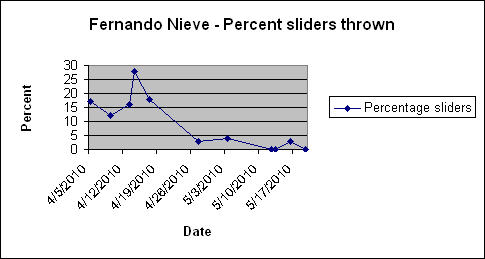
But one thing I noticed that seems both clear and reasonably significant is that Nieve has almost entirely stopped throwing his slider. PitchF/X isn’t perfect at identifying pitches, but check this out:

That’s particularly telling because, according to Fangraphs, the slider has been Nieve’s most effective pitch this season. I’m not sure if he’s not throwing it because he’s sore or if his coaches or catchers have talked him out of it — and again, we’re dealing with a lot of small numbers here. In either case, it seems a reasonable enough indicator that something actually has changed for Nieve since his effective start to the season.

Cashman and Minaya on developing pitchers

Hat tip to the Book Blog: Read this excellent piece by David Lennon at Newsday examining the way the Yankees and Mets handle their pitching prospects. The money quotes:

“I don’t care what an old-school person wants to say, the old school is what we’re learning from. Too much, too soon and it’s bye-bye to the asset. Just like back in the day, when they said it was OK to smoke, that smoking wasn’t bad for your health, and then it turns out everybody is dying of cancer. Now they don’t say that anymore. They learned from what happened in the past and so you evolve, and you improve, and you tweak, and continue to grow.” – Brian Cashman.

“I just don’t think there’s one formula that you can say is the perfect formula… The other day, against the Phillies, having [Jenrry Mejia] go out there and having to face Placido Polanco, Shane Victorino, Chase Utley and Ryan Howard — that’s a great experience. In the minor leagues, there’s no way you’re going to learn the adrenaline of facing those kind of guys. So that’s development right there.” – Omar Minaya.