Here’s me talking to Wilmer Flores, and talking to Mets Minor League Field Coordinator Terry Collins about Wilmer Flores.
Wilmer Flores stuff
Reply

Here’s me talking to Wilmer Flores, and talking to Mets Minor League Field Coordinator Terry Collins about Wilmer Flores.
Rod Barajas leads the Mets with nine home runs. He is hitting .233 despite a .164 batting average on balls in play, a mark that likely reflects a little bit of misfortune and a whole, whole lot of fly balls.
 Barajas swings hard. Not sure if you’ve noticed that yet. And he swings often.
To date, Barajas has only walked twice. He has a very respectable .823 OPS with a downright bizarre .253/.570 on-base/slugging split.
How bizarre (Ed. note: How bizarre! How bizarre!)? In the history of baseball, no one with enough bats to qualify for the batting title has ever finished a season with an OBP below .275 and a slugging above .550. In fact, no qualifier has ever finished with an OBP below .275 and a slugging above .500.
In fact, if you restore those first parameters and lower the plate-appearance minimum to 50 — arbitrary, no doubt — the search returns only two players: pitcher Don Drysdale in 1958 and Rod Barajas so far in 2010.
This is something I’ve covered before: If you’re swinging at a whole lot of the pitches you see and crushing a fair share of them, you’re not going to continue seeing a lot of good pitches to hit.
It seems like Barajas covers a whole lot of territory with his bat and can put some bad balls in play, but every hitter has his limit. Pitchers will eventually put enough balls in places Barajas can’t reach to either force him into a more patient approach or retire him at an even more frequent pace.
In other words, this won’t continue. Barajas will still hit home runs, but there’s almost no way he will maintain this pace. Of course, if you think Rod Barajas is going to hit 50 home runs this season you’re either heavily medicated or probably should be, so it’s probably silly to even bother explaining why he won’t keep up this pace.
Either way, Barajas has been awesome so far. For a discounted rate, he is providing all the power and staff-handling acumen the Mets could have hoped for from Bengie Molina. Plus, as noted, he has excellent taste in music and comes to the plate to “California Love” and “Low Rider.” So file Rod Barajas under cool.
Cool, and valuable, but not likely to keep hitting this many home runs. It should be interesting to monitor whether he can total more homers than walks this season, an accomplishment that should probably be named for Dave Kingman.
Only in the eighth, when Aaron Rowand hit a two-run homer over the right field wall off Jennry Mejia – who really needs to go back to Triple-A and hone his starting skills – did the wind finally blow a favor to the Giants.
– Bill Madden, N.Y. Daily News.
Emphasis mine. It’s not particularly surprising, but it’s certainly amusing that the city’s newspaper columnists now appear to unanimously agree that Jenrry Mejia should be starting games in the Minors. I don’t recall any newspaper writer but Joel Sherman making so much as a peep about it during Spring Training, when countless Mets blogs were furiously lobbying on behalf of Mejia’s longterm development.
 That quibble aside, as far as I’m concerned it’s the more the merrier on the let-Mejia-grow bandwagon. The Mets seem to react to media pressure as much as any team in baseball, so it’s good when the media clamors for something that will actually benefit the team.
Anyway, here’s the thing: Not only is Mejia’s development likely being hindered by irregular work in short bursts — he has thrown 83.7 percent fastballs — he’s also being questionably handled, given his youth. Both appearances and bullpen sessions tax relievers’ arms. Mejia has pitched in 15 of the Mets’ 31 games, but warmed up in plenty more.
For all I know, the Mets do have some sort of Jenrry Rules governing Mejia’s usage, but they certainly don’t manifest themselves in his game logs. And that’s a bit worrisome, because Jerry Manuel’s overuse of certain bullpen arms is one of the aforementioned early-season trends very likely to continue.
It’s nothing new. And with the proverbial axe perpetually hanging over his head, Manuel has little motivation to concern himself with the condition of his relievers late in the season.
Fernando Nieve has pitched in 20 games, putting him on pace for 104 appearances. Pedro Feliciano has pitched in 18, putting him on pace for 94 — a career high even for the guy who has led the league in appearances two years running. And like Mejia, both guys have been “dry-humped” numerous times.
Granted, at least some of the blame lies on the Mets’ starting pitchers — the Mets are second in the Majors in relief innings. But Manuel’s team leads the league by a pretty wide margin in relief appearances on zero days’ rest. Mets pitchers have 35. The league average is 18.
In all likelihood, this will eventually catch up with the club.
In baseball stats and elsewhere, I abhor small samples in isolation. Too often they tempt otherwise reasonable people — myself included — to make rash judgments on insufficient evidence. It’s frustrating, and it makes for some pretty terrible baseball analysis.
One upside to fleeing town for the last week and a half is it allowed the Mets to play more games and accrue a bit more data upon which to base whatever the hell it is I write about here. We’re still dealing with only a fraction of the season, mind you. Livan Hernandez is second among Major League qualifiers with a 1.04 ERA. Smart money says that won’t last.
As a means of helping myself get up to speed with what the Mets have been doing, I’ll be sorting through some of the early returns here the next couple of days to try to determine which are real and which will ultimately go the way of Livan’s ERA.
I caught a few Mets games on my vacation, so I’m not completely out of the loop. I saw parts of the triumphant Rod Barajas win in a New Orleans bar, and heard parts of the triumphant Henry Blanco win while driving between Breaux Bridge, La. and Houston.
I also ate a ton. Perhaps literally. Holy lord; I should probably only eat vegetables for the next month or so. SPOILER ALERT: I probably won’t.
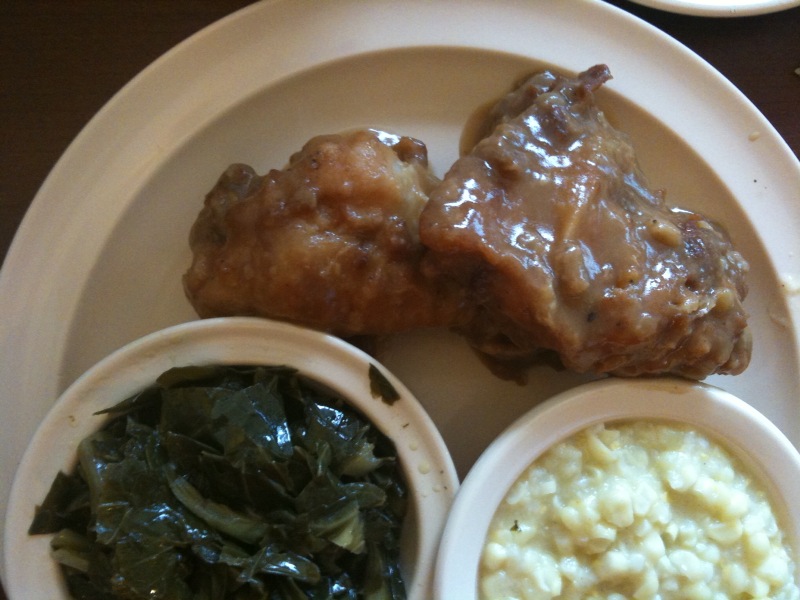
I think the most delicious of many delicious things was this gravy-smothered fried chicken from the Busy Bee Cafe in Atlanta:

Uploaded by www.cellspin.net

Uploaded by www.cellspin.net
More of me talking to Ralph Kiner. You might have seen this earlier in the week on SNY.tv or MetsBlog. My apologies; the hotel Internet connection in New Orleans has been down and it’s an old brick building so it’s bad for wireless. Plus I’ve been busy consuming tons of food and funk music.
In this part, he tells me about facing Satchel Paige when he was 17, plus about coming up with the Pirates.
Talking to Ralph Kiner about facing Satchel Paige goes on the short list of coolest things I’ll ever get to do.
I was going to piece together a whole From the Wikipedia post about the Vulcan statue in Birmingham, which I visited a couple days ago. But I’m in New Orleans now and I’ve got important things to not do.
So in lieu of that, here’s a picture of the Vulcan statue’s backside. For some reason, the sculptors provided the city of Birmingham (well, initially the 1904 St. Louis World’s Fair, but you can check the Wikipedia for that) with tons of gratuitous buttcrack. I really don’t know why Vulcan is apparently naked under his blacksmithing apron, but I guess maybe he’s freaky like that.

Thanks to the whims of our road-trip schedule combined with the storm that ravaged the South earlier this week, I have seen the last three Birmingham Barons games. In all three games, the Barons took the lead early, squandered it when their starting pitcher started to tire in middle innings, and fell behind for good in their opponent’s final at-bat. Check it out.
Smart money says I won’t see any other Birmingham Barons games this season, so thanks to the caprices of small samples, I will conclude that the Barons’ bullpen is a big bunch of choking chokers who ruin everything for their offense and starters in every single game.
Not the type of stuff that will make Barons alumni like Razor Shines, Robin Ventura or Michael Jordan proud.
Outside of Historic Grayson Stadium on Friday night, a group of Lexington Legends stood near their team bus talking on cell phones. I didn’t linger as I walked by them toward my rental car, but I overheard one sentence’s worth of conversation: “I love you.”
 The opportunity to play baseball professionally is a pretty amazing one, and something I’m sure few of those guys would willingly trade for the cramped college dorm rooms enjoyed by many of their contemporaries. But the Minor League life is a difficult one.
That night or sometime shortly thereafter, the Legends’ players and coaches would endure the 9 1/2-hour trip back to Lexington in that bus. They will spend this season riding the bus to Delmarva and Lakewood and Charleston and all the far reaches of the South Atlantic League. And if any of them are lucky enough to advance to the next level at any point, they’ll have to adjust to a new home city and a new bus and a whole slew of new destinations.
It’s all part of the game, of course, and it has been a long time. Still, I wonder if there’s a way the system could be improved. If the Minor Leagues are aimed at maximizing the potential of prospective Major League baseball players, is that best accomplished by forcing 19-to-22-year-old kids into nomadic lifestyles?
Here’s a half-baked thought: As far as I understand, there are teams in the Sally League that draw as well as some International League teams. And there’s some overlap in the areas covered by the Class A South Atlantic League, Class A Advanced Carolina League, Double-A Eastern League and Triple-A International League.
Not many Major League teams own a lot of their own Minor League affiliates. But, in theory, could a big-market club purchase Minor League franchises in four strategically located markets and switch around each team’s level every season?
In other words: Could a team start a crop of prospects in the Sally League, then keep them together and in the same city the next season, but have them play in the Carolina League? They could move to the Eastern League the next year and the International League the next, but stay in the same home city the entire time. That way, prospects get a full slate of Minor League experience, but can maintain some degree of normalcy.
For what it’s worth, it would benefit the various Minor League fanbases, too. Fans in each city would have a chance to get to know their particular group of players before the best ones moved onto the Majors.
There are logistical problems, of course: For one, I’m not certain there are enough appropriate markets to make it work, nor do I know if Minor League Baseball would permit clubs to so rapidly jump levels. Plus I’m near-certain there’s some minimum stadium capacity required for the different levels, even if the higher levels aren’t necessarily drawing more fans.
And it doesn’t all make sense from a development standpoint: A team that endeavored that plan would lose a lot of the flexibility afforded by the current system, since it would likely try its best to keep players in the same place for as long as possible. Certainly there would still be players who moved too quickly to be held back and players who demonstrated they had no business jumping a level, so some guys would still have to move every year. But likely the players at the margins would be socially promoted with the rest of their guys in their “class” every offseason.
Plus the system breaks down for Quadruple-A types, since presumably a city will only host the Triple-A team once before the whole system shuffles again. So any player entering his second season in Triple-A would finally be forced to move, and he’d have to move again every season until he cracked the Show.
Are all the logistical problems and hangups worth it to give developing players a rooted home base for the several years they spend in a system? I have no idea. Hell, maybe the going thinking is that they’re better off not getting too comfortable in any one city, since comfort probably leads to girlfriends and social lives and all sorts of non-baseball distractions.
I don’t know. I’m just thinking out loud, and thinking that as awesome as playing Minor League baseball certainly is, it probably doesn’t always feel that way. And maybe a system that makes life a little easier for the athletes would pay off for teams down the road.
 Tedquarters