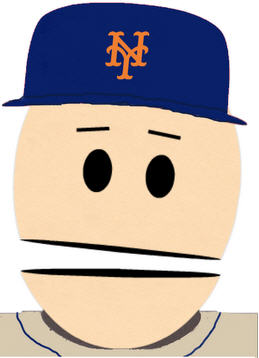
Jason Bay’s Canadianness knows no bounds

The big talk in Mets camp today is that Jason Bay showed up. Adam Rubin has a full recap of the outfielder’s Q&A with reporters. Some highlights:

What happened to the Canadian hockey team?

“I knew that was coming. That stung a little bit. They beat us. We were almost kind of out-hearted a little bit. I mean that last goal, that empty-netter by Kessler, kind of proved it right there. Outshot, what, 45 to 19 or 20 or something like that? If this were a medal game we were talking about, I’d probably hang my head a little lower. Being as we have a pretty good shot to get in tonight, I’d still take our chances.”

But you became a U.S. citizen. Root for USA?

“No way. I can’t do that. And I’d never be able to go back home. I’m still a Canadian through and through.”

You have MEDIUM EST NUNTIUS written on your T-shirt. What’s that mean?

“I have no idea. I bought it at Nordstrom’s before I came. I needed some T-shirts for the spring.”

You’re really into curling?

“I played a couple of years when I was in high school. They needed an extra guy. I wasn’t any good. It’s more of an excuse to go out on the ice and sweep around for a couple of hours and get a little exercise, and then drink a couple of beers afterward. I don’t have high school baseball where I’m at.”

OK, so let’s recap: A bunch of hockey info teeming with optimism, followed by the very redundant “I’m a Canadian through and through” quote, and then, of course, the admission that in high school he liked to “go out on the ice and sweep around” then “drink a couple of beers” afterward. Molsons, I assume.

My favorite part, buried among all the righteous Canucking, is the note about his t-shirt. Jason Bay had to buy a bunch of t-shirts right before Spring Training, presumably because his lumberjack wear was inappropriate for the Florida humidity.

Anyway, the Internet tells me that “MEDIUM EST NUNTIUS” actually is Latin for “the common good is the message,” which sounds a bit socialist to me. Even when haphazardly picking out t-shirts, Jason Bay is drawn to vaguely Canadian ideals.

Jason Bay: He’s your guy, buddy.

I apologize to any Canadians who may be offended by this post. I actually love Canada. It’s beautiful and fun and the people are pleasant, and often themselves beautiful. And I’m sure curling is a fantastic sport if you understand the rules.

(Jason Bay image courtesy Patrick Flood.)

Items of note

There are times when even Mets fans have to give kudos to members of the Phillies, and I’d be remiss if I didn’t credit Jayson Werth for his excellent offseason beard.

Beautiful German biathlete Magdalena Neuner, who will break your heart then gun you down with pinpoint accuracy, feels mistreated by anti-doping officials.

W.T.F. Some fool must have hit the wrong button and dropped LT by accident in the Yahoo! league. Now’s the time to scoop him up if you’ve got the top waiver spot. Quick, before the commish overturns it.

Carlos Beltran’s feelings have healed. Good.

Doubting Carlos Beltran’s fashion sense will get you nowhere, Craig Calcaterra

Carlos Beltran arrived in Port St. Lucie today, and HardballTalk’s typically excellent Craig Calcaterra writes that, though it’s great that Beltran’s knee and relationship with the Mets appear to be progressing nicely, his sense of style is lacking:

Less than hunky dory was Beltran’s fashion sense, as evidenced by these pictures by Howard Simmons of the Daily News.  Note the ugly shirt tucked into jeans! Behold the two-hole-deep white belt which was EXACTLY like one your old man had back in the 70s!  Note also that Beltran, not content to rock a mere trucker’s hat, rocks what appears to be a very expensive takeoff on a trucker’s hat.

Look: We here (by which I mean “me here”) at TedQuarters are not above judging professional athletes for their fashion choices. It is clearly my right; just look at Shane Victorino’s stupid suit.

But doubt Carlos Beltran at your own peril, Craig Calcaterra. I certainly don’t dress like Beltran does here — these clothes are not available at Old Navy — nor would I necessarily advocate doing so, but I’ve come to assume that whatever choices Carlos Beltran makes are the correct ones, even if they may seem wrong on some surface level.

So when Carlos Beltran elects not to slide into home plate, I like to assume he had some good damn good reason — like maybe somehow he instantly calculated that his chances of scoring would actually be lessened by sliding in some way we, mere mortals of baseball-understanding, could not possibly conceive. Or, perhaps more likely, he was playing injured and considered the possibility that a collision with the catcher could have hastened his inevitable trip to the disabled list.

Probably Beltran’s tucked-in t-shirt and white belt are so outrageously hip that folks like me and Craig Calcaterra can’t even process how awesome they are, and we’ll only begin to understand in several years, when the rest of the world stylistically catches up with Carlos Beltran.

And yeah, I recognize that the vaguely Affliction-style t-shirt and trucker-ish hat he’s wearing have already come into vogue, but you gotta understand: Beltran’s so far ahead of the curve that he’s actually wearing them for the next time they’re in fashion, in some much hipper way. It’s not something I can fully grasp because I am not Carlos Beltran.

OK, sorry about that. I’m pretty excited about Beltran, is all.

Hooray for fixing things

OK, I apologize for the lack of posts today, but some minor good news:

The “categories” linked on the right column of this blog have been broken since the start. Until today, when you clicked them, you could see the entries in those categories, but not the titles of those entries, making them pretty much useless.

Today, with some nifty copy-and-paste work and way too much time spent staring at code, I fixed them. So now you can more easily browse the things I’ve written about Taco Bell.

Also, last week I added an e-mail link to the box to the immediate right of this post. Please, if you see anything hilarious or awesome that you feel merits a TedQuarters post, send it along.

The Mejia rules

Here’s what Jerry Manuel had to say on Sunday, when asked if he saw Jenrry Mejia pitch:

“Oh, lord, did I see him. Don’t get me started on him. This press conference is over, Jay. Oh, it’s tough not to get excited about him. That’s real electric stuff.”

(Quote courtesy Matt Dunn of SNY.)

There’s been early talk, some of it stemming from Manuel himself, about Mejia breaking camp as the Mets’ 8th-inning guy.

That’d be exciting, for sure, and as a Mets fan I’m definitely psyched to see the electric stuff everyone keeps raving about.

I’m not sure it’s such a good idea, though.

Mejia’s only 20 years old, and since he walked 4.7 batters per nine innings in his stint at Double-A, it’s a safe bet he needs a little more work on his controlling his pitches before he’s unleashed on Major League hitters.

And, perhaps more importantly, he just needs to pitch more.

Mark this down: A good starter is more valuable than the best 8th-inning man in baseball. I promise. I could delve into way more detail, but just think of the difference in total innings: A good starter throws about 200 in a season. A good reliever throws about 80.

So ultimately, unless the Mets feel Mejia is no more than a late-inning reliever, they should want him to become a starter. And by all accounts, they do.

The so-called Verducci Effect states that young pitchers suffer regression after increasing his innings load by more than 30 from one season to another. There are inherent flaws in the notion, as my colleague Michael Salfino has been pointing out for years, and as Jeremy Greenhouse examined in detail at The Baseball Analysts last week.

Still, despite all that, no one would argue that teams should throw caution to the wind and haphazardly handle young pitchers. The Mets will — and should — want to be careful with Mejia’s workload. He threw only 94 2/3 innings last year in a season partly shortened due to a middle-finger injury.

The Mets will likely want to up that in 2010 to prepare him for the rigors of a full season as a Major League starter in 2011. Starting him out in the bullpen will not do that. Starting him out in the bullpen will push his innings count in the wrong direction.

Beyond that, hard-throwers like Mejia can rely mostly on their fastballs in relief roles, even at the big-league level. I don’t know how good Mejia’s secondary arsenal is currently, but I know that to succeed as a Major League starter, a pitcher needs more than one pitch. He should be given the opportunity to develop his full array of weapons as a starter in the Minors instead of risking letting them atrophy under the pressure to perform as a big-league reliever.

If, as Mejia approaches his 2010 innings limit later in the season, the Mets have a need in the bullpen, then sure, call him up and use him conservatively in late-inning work. Plenty of great starting pitchers have gotten their first taste of Major League action in bullpen roles.

But no matter how good Mejia looks this Spring, the Mets cannot afford to rush him into a big-league relief role to start the season. Simply put, it’s way easier to find a good 8th inning guy than a 20-year-old prospect with “electric stuff,” and there’s no reason to hinder the development of the latter for one season of the former.

Items of note

Awesome, awesome story about Josh Thole’s time in Venezuela from David Waldstein at the Times. And it comes with a new nickname for the kid: El Infierno.

The guy who played Boner in Growing Pains is missing in Vancouver.

Holy lord, David Wright is monstrous.

Patrick Flood visits the cloned-team-full-of-Player-X idea, but only using offensive win percentage. Dammit, when will the Internet tell me, definitively, how my team full of Mark McGwires would fare?

Rod Barajas: Sure

Look: Rod Barajas isn’t all that good. I don’t mean to cut the guy down the day after he got a $1 million contract from the Mets, but he posted a .258 on-base percentage last year in 460 plate appearances. That’s abysmal.

Even allowing that he could have been a bit unlucky — his batting average on balls in play was .024 below his career average — his career .284 OBP is bad enough that it’s inappropriate to expect much from him at the plate, even if he’ll hit a few homers.

He’s a very good defensive catcher by almost all accounts though — something Omir Santos cannot quite boast — and, as bad as his offensive performance was in 2009 (look past the 19 home runs, folks: a .258 OBP is miserable), it was likely his floor. Barajas has been around long enough that we can be pretty certain he won’t be much worse a hitter this season than he was last season, even if he’s 34 and on the decline.

With Santos — whose paltry offensive numbers last season were actually better than his career Minor League lines would project — there’s some non-zero chance he totally collapses and hits like Tony Pena Jr., leaving the Mets to either rush Josh Thole or go with some combination of Henry Blanco, Chris Coste and Shawn Riggans.

So Barajas represents a defensive upgrade over Santos with a little more certainty — even if he’s certainly not good — on the offensive side. For $1 million with another $1 million in easily obtainable incentives, that’s probably worth it to the Mets, if only to buy Thole some more time for seasoning in Buffalo.

Barajas is not a great player, but it’s not a bad deal.

My only quibble with the move is, of course, that Felipe Lopez is still flopping around on the free-agent market. I’m convinced that the difference between Lopez and Luis Castillo is greater than the difference between Barajas and Santos, so the Mets — if forced to make only one move — would get a bigger upgrade over what they’ve already got by signing Lopez than by signing Barajas.

Still, it’s not something I’d cast in stone, because Lopez has been inconsistent across his career and because catching defense is so hard to quantify.

And signing Barajas should not preclude signing Lopez, and since the latter recently parted ways with Scott Boras, I’ll hold out hope that the Mets can swoop in and scoop him up on the cheap. I’m almost certain it won’t happen, since the Mets already have $8 million committed to lesser second basemen, but until he signs elsewhere, I can cross my fingers.

Finally, one last note on Barajas: Earlier this offseason, Sagiv Edelman — Twitter’s @FireJerryManuel — suggested referring to him as “Bod Rarajas.” I’m on board. Switching the first letters of the first and last names of defense-first backup catchers for comic effect has long been a hobby of mine.

So credit Sagiv for the idea, or, perhaps whoever wrote this SNL sketch, way back when. Long live Bod Rarajas.

Art Attack: Shaq’s Size Does Matter exhibit

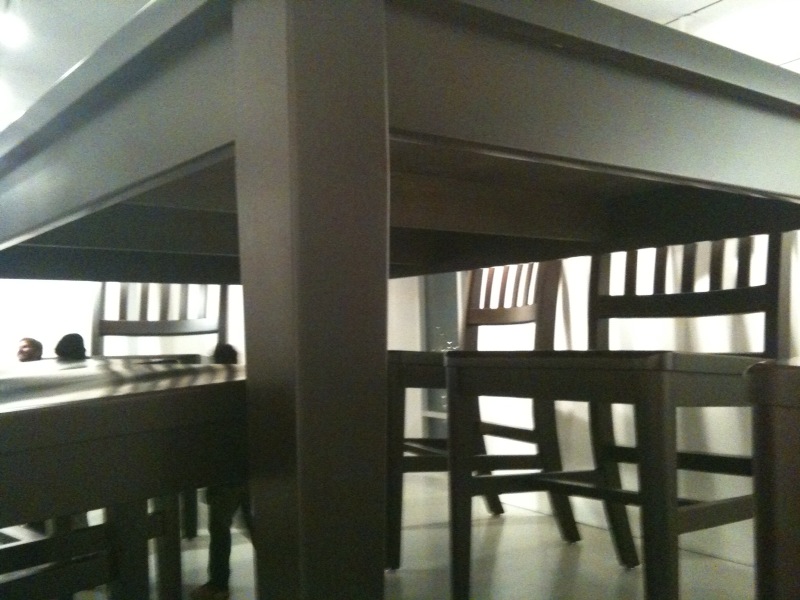
“Now this is a table for Shaq,” said a girl with day-glo orange hair and tattered leggings to a man in a black jacket with all sorts of extraneous zippers.

They stood under Robert Therrien’s No Title (Table and Six Chairs) and gawked at the massiveness of the work. The piece is not hard to describe: It is a plain-looking table and six chairs, just tremendous. The seat of each chair stood nearly five feet high, the back stretching to just shy of 10 feet, almost scraping the ceiling. The table — like the chairs, made of aluminum painted to look like dark wood — stood almost as tall, at about nine feet. And, at 12 feet wide and 18 1/2 feet long, its awesome dimensions tested the confines of what should have been a large gallery space at the FLAG Art Foundation in Chelsea.
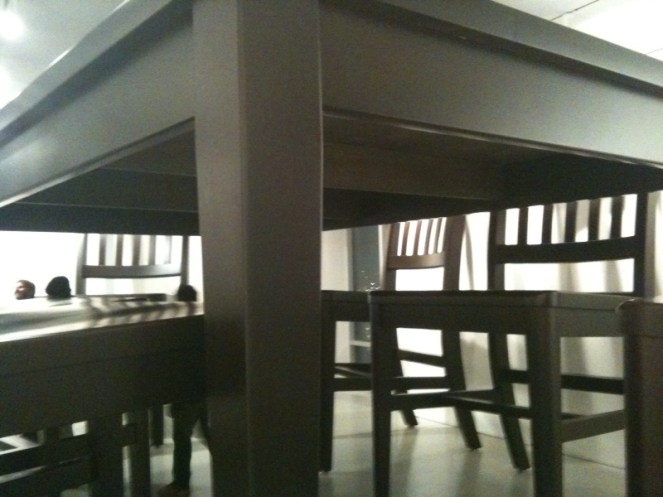
Size Does Matter, the first art exhibition curated by Shaquille O’Neal, opened Friday night to a large crowd that appeared to be some mix of New York aesthetes, curious hipsters and intrigued basketball fans. It was difficult to tell — in Manhattan, one person could easily be all three — and there was no dominant draw among the few people I asked. Some came because it was Shaq’s art show, for sure. Others came to see the works on display from high-profile artists like Jeff Koons and Ron Mueck. One noted “all the buzz” around the show.

Hype breeds hype and crowds attract crowds. Shaq curated an art exhibit and landed some big-name works, and a bunch of people showed up. No surprises there, I guess.

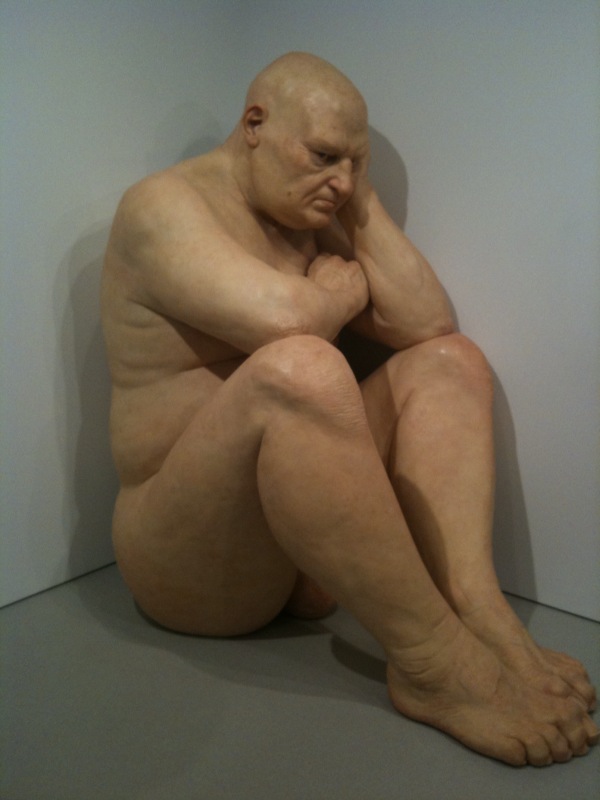
Though Shaq himself is colossal, the exhibition was more than just impressively huge things. There were tiny things too — like Willard Wigan’s (literally) microscopic sculptures of the Obama family and Shaq inside the eyes of needles, and Jim Torok’s Self Portrait with Yellow Sunglasses.

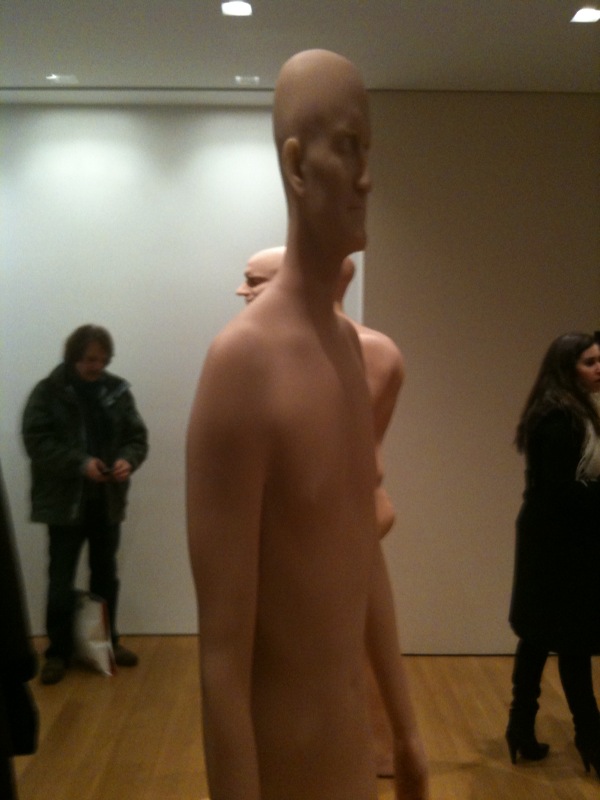
More than anything, though, the show was about jarring proportions. Richard Dupont’s Untitled (Terminal Stage), which cannot really be adequately represented by a photograph, featured three sculptures, modeled after the artist, in cast polyurethane resin, set up a few feet apart from one another in a triangle.
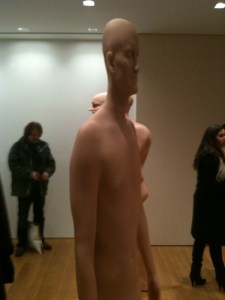
Though from some angles, the sculptures might look identical — and in realistic human scale — each was skewed in some unique way so that, from a certain perspective, it looked like it was being viewed through a funhouse mirror or, as one onlooker said, “through someone else’s glasses.”

It was fascinating to behold, and to feel my eyes try to adjust and process information that clearly did not connect with my brain’s long-conditioned notion of what humans and sculptures of humans should be shaped like.

And it was even more fascinating, of course, to watch other people go through the same process.

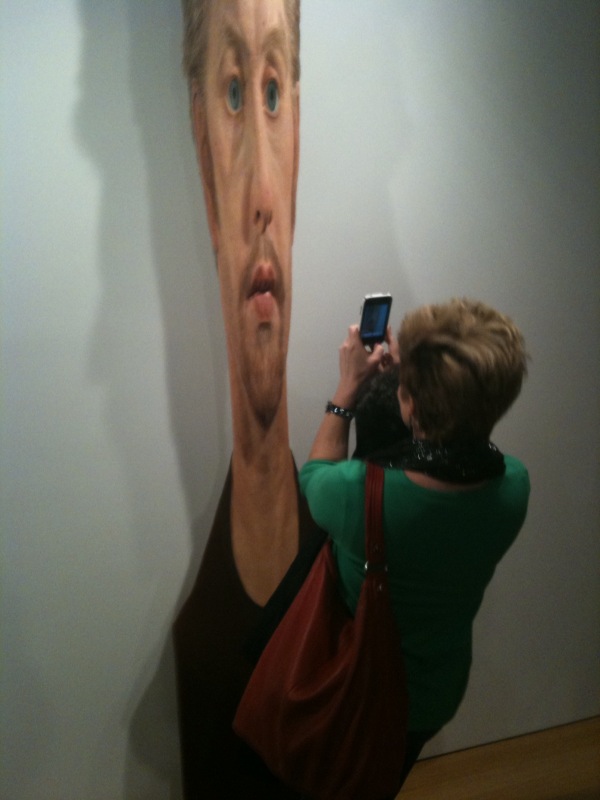
Evan Penny’s amazing Stretch #2, while not as dizzying, inspired a similar reaction. A nine-foot tall silicon sculpture of a stretched head, the work impressed crowds and baffled amateur photographers.
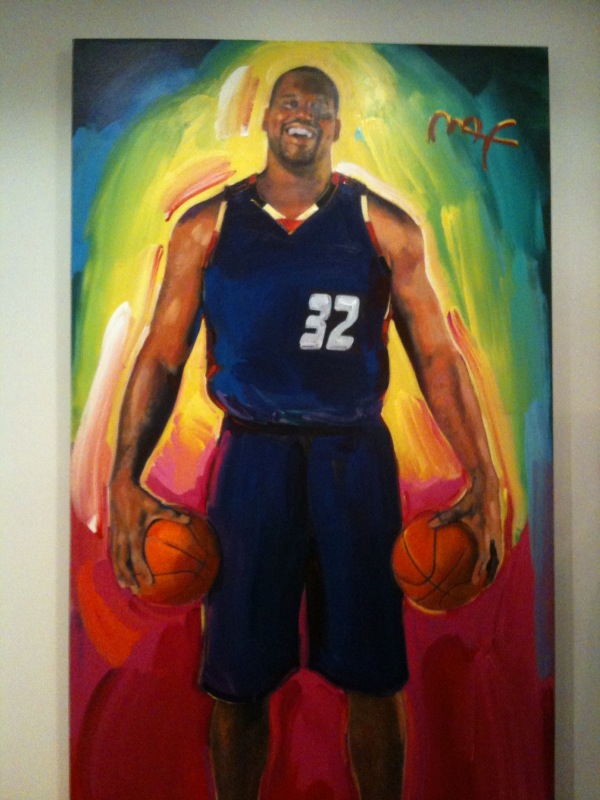
There are traces of Shaq’s persona throughout the exhibit, beyond just the life-size portrait of a smiling Shaq by Peter Max that graces the gallery’s reading room.

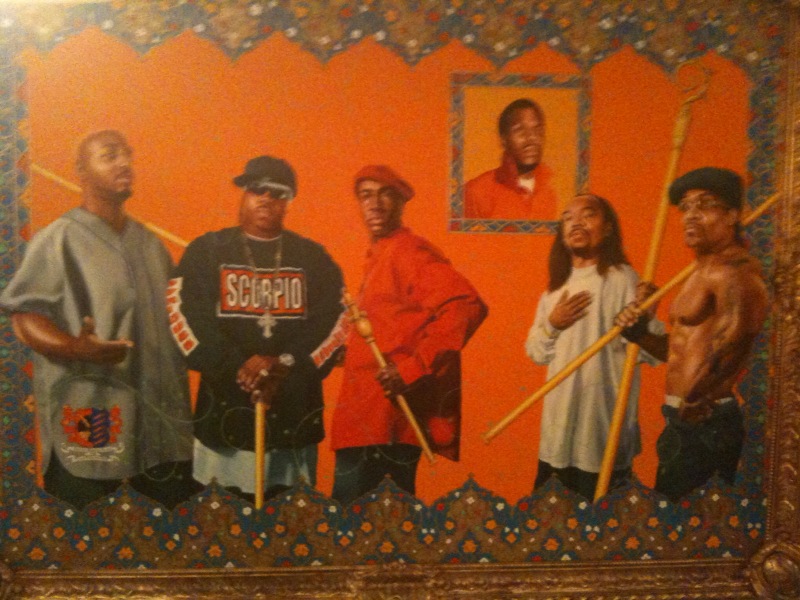
A photograph from Paul Pfeiffer’s basketball series, Four Horseman of the Apocalypse, is on display, as is a reminder of one of Shaq’s previous forays off the basketball court: his hip-hop career.  Kehinde Wiley’s portrait, Grand Master Flash and the Furious Five, hangs directly across from Max’s piece.

Still, even with two floors packed with cool pieces to look at, I kept going back to Therrien’s table.

It’s tough to say, with a work like that, who should get credit for the way it’s displayed, and whether it’s even reasonable to assess a piece based partly on the room that contains it. The Internet shows me that the same work has previously been shown in much bigger rooms, and even outdoors.

But someone — presumably Shaq himself — chose to show Therrien’s piece in a Manhattan space probably not really suitable for works of its scale. And someone set it up in that particular room at the FLAG Art Foundation, alone, filling every last bit of it, each chair sitting mere inches from the wall. At some step along the line, someone — or some collection of someones — made conscious choices to cram that table and those chairs in that space, and so I think it’s reasonable to assess its effect as displayed, even if its not necessarily the original one Therrien intended.

Because that table moved me in a way I did not honestly expect to be moved by Shaq’s art exhibition. Looking up at the tremendous table jammed into the room, and seeing all the people coming in and staring and laughing and taking pictures with it, it made me feel Shaq somehow, for a fleeting second, and it was so damn sad that I had to brace myself against the wall.

How uncomfortable must it be, sometimes, to be that big? How claustrophobic? Our world is not built for 7’1″, 350 pound men, just as that room was not built for an 18 1/2 foot-long table. What desk did Shaq sit at in middle school?

The Shaq we know, his public persona, is playful, and the work is a playful piece, too — make no mistake. It’s a giant dinner table, after all. It’s fun. But something about all the people enjoying it, reveling in its gentle giantism, made me wonder if Shaq ever wants to hide. You can’t hope to blend in when you’re 7’1″ and 350 pounds. Maybe on the court in the NBA, but never once the game is over.

And when I thought about it that way, it made perfect sense that Shaq’s art exhibition would not be a mere celebration of big things, but a more complex exploration of scale and perception. Shaq’s sheer size is a big part — maybe the biggest part, no pun intended — of what made him a great basketball player and of what makes him so entertaining a character. But I would venture to guess it has also complicated his life in ways I cannot entirely comprehend.

I don’t know. Maybe it’s just a big table.

It all made me remember this tweet from the Big Aristotle himself, though:

If u feel alone and by yourself, look in the mirror, and wow, there’s two of you. Be who you are. Who are you. I am me. Ugly, lol. Shaq

Smile, Shaq. You’re money.

Seriously, the iPhone pictures here don’t do these works justice. If you’re in New York, go see the show. It’s at 545 W. 25th St, between 10th and 11th, it’s free, and it’s open Wednesday-Saturday from 12-5 p.m.
Mets fans now just kind of shrugging at weird news

Today Jerry Manuel, for the second straight offseason, said he’d consider batting Jose Reyes third.

Matt Cerrone followed with a poll, and his readers are currently split right down the middle on whether it’s a good idea. It’s actually 50-percent yes and 50-percent no after 3540 votes. I don’t know if I’ve ever seen that before.
Obviously it’s a bit more complex than a straight yes-or-no, good idea/bad idea thing, which might be the source of the Met fan ambivalance. It’s certainly the source of mine.

I’ve always assumed Reyes would develop a little more power as he aged. I don’t have a ton of evidence to back that up, but he’s impressively broad if you see him up close, and it feels like when he does hit home runs, they’re not ones that just edge over the wall — he knocks the crap out of ’em.

That’s a biased and unscientific assessment, but I’m open to Manuel’s notion that Reyes, if healthy for a full season in 2010, could produce a few more extra-base hits than we’ve come to expect from him.

The thing is, if he’s not going to be batting leadoff, he damn well better be replaced by someone who gets on-base as frequently as he does. I touched on this a little last week: The most important quality for a leadoff hitter is not actually speed, but the ability to get on base.

So if Luis Castillo, David Wright or Jason Bay is manning the leadoff spot, I suppose I’m cool with Jose hitting third. Since no one else is likely to post a higher OBP, no one else should lead off.

I’m looking at you, Angel Pagan.

Since there’s no chance Wright or Bay will lead off, that pretty much leaves Castillo. He’s not a lock to get on base at a higher clip than Reyes, but even on his old knees he’s a decent fit to bat leadoff. He’ll certainly find his way to first base with some frequency, and it’s not like he has any power that would go to waste at the top of the order.

I still like him as a ninth hitter with Reyes leading off, since that’d be a good way to make use of Castillo’s OBP and then, after the first time through the order, Reyes’ power, while maximizing Reyes’ at-bats. But that’s probably not happening.

And I’ll settle on the status quo on this one: Let Reyes do his thing, leading off and stealing bases and making things fun to watch. If he’s going to start hitting for more power, make him force the issue. That’s a good type of problem to have.

Mike Jacobs is not like Matt Stairs

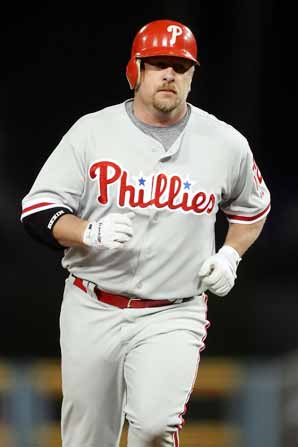
So Jerry Manuel said he could see Mike Jacobs serving as a power bat for the bench, like what the Phillies had with Matt Stairs.

But Mike Jacobs is not like Matt Stairs.

Matt Stairs was notable for a several reasons: He looked like a beer-league softball player, got on-base a lot, hit home runs, and couldn’t really play defense. Mike Jacobs only shares two of those qualities.

Matt Stairs finished his career with a .358 on-base percentage. Mike Jacobs is currently rocking a  lifetime .313 on-base percentage.

I tweeted this information a few minutes ago, and several Mets fans responded — perhaps accurately — that the Mets would only be asking Jacobs to be a lefty pinch-hitter off the bench who wouldn’t have to play defense, and so Manuel wasn’t comparing the two as players so much as he was suggesting Jacobs could fill a similar role.

That’s all well and good, and far be it for me to complain about the Mets finally adding a bench bat with a little pop.

But I’m guessing — and I haven’t run the numbers on this — that for a player to be valuable to his team while only being asked to do one thing, he has to be very good at that one thing. And Jacobs is not that good at that one thing.

Yes, he can hit home runs. That’s great.

What he can’t do — at least probably not well enough to earn a roster spot — is get on base. Not like Stairs could, and maybe not like Quad-A Spring Training invite Chris Carter could, either.

Why’s that important? Well, it’s not like all the situations that call for pinch-hitters only call for a home run. Hitting a home run is always the best possible thing a pinch-hitter can do, of course, but in instances where the team is down by more than one run, getting on base, well… you know.

Plus, if the pinch-hitter is being used to replace the pitcher — as he most often is — his getting on base means the top of the order will get to bat with a man on to drive in. And the top part of the order is where the good hitters hit.

It may feel like I’m on some sort of campaign against Mike Jacobs, but that’s really not the case. I have no personal agenda against the man, and I’m sure he’s a really nice dude. I just bristle when people bandy about Matt Stairs’ name haphazardly.