Cutting Danishes is a real problem

If you’re anything like me, you almost never have danishes because of the cutting issue. Those things are so unwieldy! They’re so soft and potentially flaky that you’re almost never going to get an even-edge cut, and then at that point, why do you even want to eat the thing? Plus, you’re inevitably going to get delicious danish goo all over your knife and be forced to lick it off the blade, putting your tongue at risk. I mean danishes are good, but c’mon already.

Luckily Canada has you covered. Check this thing out. This is a highly pressurized blade of water:

Apparently it has other uses, like cutting peaches and linoleum. Also it’s just pretty awesome in general. Mostly I’m just thankful we can finally eat danishes without so much fuss.

You think that sucked?

Yeah, this installment of the Subway Series was bad, but not nearly as bad as the script of Prometheus. And I get that you might share your office with some obnoxious Yankee fans and put extra stock in the three games, even realizing that they’re only three games against an opponent outside the Mets’ division in the course of a 162-game series. And you probably recognize that Prometheus is a summertime sci-fi action thriller, not exactly Oscar bait.

But though a series including a blowout loss with Johan Santana on the mound, a couple of solid starting-pitching efforts wasted, a slew of strikeouts in big spots and a bullpen meltdown culminating in a walk-off Yankee Stadium home run, it’s hardly as taxing or as baffling as the plot of Prometheus, a movie apparently aimed to clarify one moment in another movie from 33 years ago that mostly opens up dozens more questions that need clarification.

Why is the cyborg the most relatable character? Why does he start acting irrationally and in some way that doesn’t seem to benefit his maker/programmer, even though he’s a cyborg? Why is handsome-ass Guy Pearce in the movie to play an old guy in awful old-guy makeup when there are hundreds of capable old guy actors looking for work? Why does the dialogue seem like it’s written by a 9th grader? Without SPOILERing this, why are certain humans affected certain ways by the things that happen in the movie when other humans are affected in other ways? Why do they bother doing the thing so many movies do now where they set up an obvious sequel when nothing about the movie really makes me care what happens next?

And yeah, just like enjoying a brutal series of Mets losses is still way better than not watching professional baseball games, Prometheus was still great to look at as a computer-graphics spectacle. But really, if the outcomes are going to be so wholly unsatisfying, why bother with things like standard nine-inning games or a loosely rendered plot? Next time maybe just have a home run derby or a story-free celebration of contemporary computer-graphics technology in IMAX 3D and we’ll all enjoy the awesomeness without the accompanying heartache and confusion.

Idris Elba and Scott Hairston are still sweet though.

Working remotely

Couch potatoes everywhere can pause and thank Eugene Polley for hours of feet-up channel surfing. His invention, the first wireless TV remote, began as a luxury, but with the introduction of hundreds of channels and viewing technologies it has become a necessity…

In 1955, if you wanted to switch TV channels from “Arthur Godfrey” to “Father Knows Best,” you got up from your chair, walked across the room and turned a knob. Clunk. Clunk. Clunk.

Or you could buy a new Zenith television with Flash-Matic tuning. The TV came with a green ray gun-shaped contraption with a red trigger. The advertising promised “TV miracles.” The “flash tuner” was “Absolutely harmless to humans!” Most intriguing of all: “You can even shut off annoying commercials while the picture remains on the screen.”

Carla K. Johnson, Associated Press.

Good read from the Associated Press about the history of the remote control upon the death of its inventor, Eugene Polley. What’s more, look at what the OG flipper looked like:

Well that’s just awesome. Obviously we need more than one button now, but I would gladly give up a little bit of convenience for a remote control that looks what people thought the future would look like in the 1950s.

Also, we never had a remote control in my house growing up. Not until I was a teenager at least. I guess we lost the one that came with the TV we had, and for whatever reason we were the only family on the block whose cable ran direct into the TV instead of through the cable box, so we couldn’t use one of those ubiquitous little black box Cablevision remotes that everyone else had.

With those, though, the big gag on our block was to take one and go change the channel on this one guy’s TV while he was watching it. His son hung out with my brother, so a lot of times it was his own damn remote. His armchair sat right in front of a huge window in his backyard, so it was real easy to creep up behind him with the remote and turn on PBS or whatever. And he’d have to get up to change it, so then obviously as soon as he sat down you change it again. And so on, until he figures it out and gets all pissed and turns around and starts slamming on the window and you run like hell.

Card stock

Baseball fans argue endlessly about the best ever to play the game, tossing around names like peanuts at a ballpark. But no one disputes that the greatest card collector was Jefferson R. Burdick….

The father of card collectors, as Burdick was known among his admirers, amassed more than 30,000 baseball cards that are presumed to be worth millions of dollars.

But they will never reach the marketplace because Burdick gave his trove to the Metropolitan Museum of Art, the storehouse of civilization known for its Egyptian mummies, medieval armor and Renoirs. It also houses one of the largest baseball card collections in a public institution.

Ken Belson, N.Y. Times.

Awesome read from the Times about Jefferson Burdick, a lifelong baseball-card collector (and oddly, not a big baseball fan) whose collection is housed but not fully on display at the Metropolitan Museum of Art. The article says that “the museum is trying to fulfill his wish that the cards be available to everyone,” which would be sweet. I happen to enjoy the Met plenty without a huge old-timey baseball-card exhibit, but I imagine I’d go there a lot more if there was one.

In the earliest days of my baseball fandom, I collected cards voraciously. I don’t know why exactly it petered out in the early-to-mid-90s — probably some combination of things. I remember growing slowly frustrated with the splattering of card brands, when it was no longer just Topps, Donruss and Fleer but suddenly Upper Deck and Score and Bowman and O-Pee-Chee Premier, and the valuable cards weren’t just the rookies of the good players but the Platinum Special Collection Rookies of the good players and other such nonsense. Also, I suspect my burgeoning interest in girls probably got in the way of considered baseball-card investments.

I still have every single card, though. They’re not worth nearly as much as I thought they’d be by now, in part because my brother and I scaled them and flipped them and traded them with our neighbors all the time, and never paid much attention to keeping them in good shape. Plus I’d never sell them anyway, because selling the baseball-card collection that I shared with my late brother for something less than the fortune we thought we’d someday reap from our binder pages upon binder pages of Pete Incaviglia rookies would be about the saddest thing imaginable.

Sometimes when I’m home, I look through them. The binders are a fun reminder of the dudes we hoped would one day be good and how infrequently prospects actually pan out, not to mention an entertaining peek at several of the late-90s’ beefiest sluggers in their much slimmer days.

But now I’m more taken by our huge duffel bag full of scrubs, all the heroically mustached and tragically sideburned lunchpail guys we tossed aside while weaning out the Wally Joyners and Kevin Seitzers. Some of the names and faces I recognize from later stints with the Mets or one of their divisional opponents, or from certain odd moments in the national spotlight forever inked in my memory; some are guys I’ve seen coaching or scouting, even spoken to in this line of work.

Most of them are just guys, though — smiling portraits or dirty uniforms with a baseball-reference page and a permanent home stuck face-to-face with Kelly Gruber in a duffel bag in my parents’ basement. And somewhere, certainly, those guys and their wives and their kids have those same cards framed and those baseball-reference pages bookmarked, and a lifetime of triumphant and tragic baseball memories to go with them.

And I don’t think that’s sad, really. I think that’s pretty awesome. I mean, Spike Owen doesn’t have any photos of me in his parents’ basement.

Twitter Q&A

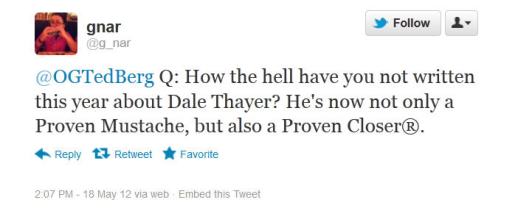
A massive oversight, that’s how! I meant to mention when Thayer re-emerged in the Majors last month, then got distracted. Now he’s closing games for the Padres and has yet to allow a run. Dale Thayer! Mustache hero Dale Thayer!

He’s also on my fantasy team. Look at this glorious man:

Here’s what someone who’s better than me at Photoshop needs to do: Take the most over-the-top gory-looking Slayer poster or t-shirt image you can find, add an awesome mustache to one of the skulls, then change the text from “SLAYER” to “THAYER.” I’d totally buy that t-shirt.

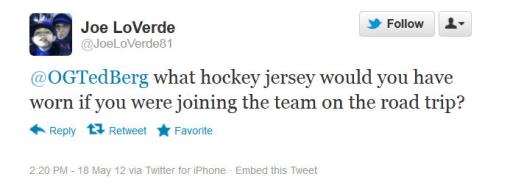
I’ve always been partial to the Quebec Nordiques’ jerseys, but if I were in the market for a hockey jersey I’m not sure I’d be able to resist the urge to buy one with “SATAN” on the back, for comic value. And in that case, it’d have to be Islanders.

Alternately, I might just also wear a No. 57 Minnesota Wild jersey with “SANTANA” on the back like Johan Santana did, because Johan Santana would probably be my favorite hockey player.

Man. Oh man.

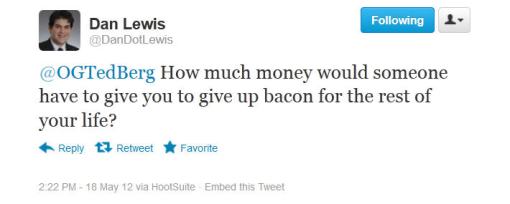
I think about stuff like this with some frequency, trying to assign monetary values to creature comforts. For example: I can’t wear jeans to work. This is a business environment, and up the chain someone decided everyone in my office needs to wear pants everyday except on very special occasions (i.e. the day after Christmas). I hate wearing pants and feel way more comfortable in jeans. I’ve thought about it, and determined that I’d probably give up about six to seven percent of my salary per year to be able to wear jeans to work. And I really need money, living in the city with my wife in school and all.

But giving up bacon? Man… man. It’d be a lot. It’d have to be at least enough to buy a house, and even then I’m not sure. What’s the point in owning a house if I have to live in it knowing I can’t ever wake up to the smell of delicious bacon?

Here’s the question: Is this a no-backsies situation? Because I’d be way more inclined to do it if I could just pay the other guy back at a later date and start eating bacon again — though I guess in that case it’s more like a loan in which the interest is just that I can’t eat bacon.

But I’m pretty confident in my awesomeness, and any price I name feels like undercutting my earning potential. What if I say $2 million right now? That seems like a reasonable price to get me to give up bacon forever. But what if you pay me $2 million to give up bacon for the rest of my life, and by some coincidence, shortly thereafter suckers finally recognize. And now all of a sudden I’ve got book deals and record contracts and a TV show and $2 million I made on my own, and I can’t spend any of it on bacon. Total monkey’s-paw scenario.

So I’m not settling for any less than $5 million. For $5 million, I’ll give up bacon for the rest of my life. Possibly.

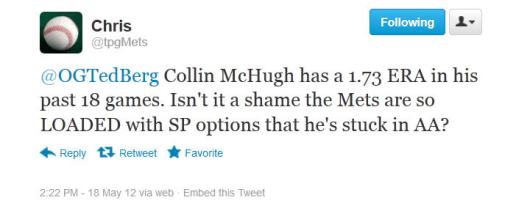
Yeah, it’s probably time to see what McHugh can do in Triple-A, huh? Toby says he’s waiting for an injury or an opening in the Triple-A rotation, and it always seems like there’s a lot more that goes into these decisions than I ever consider. But Garrett Olson hasn’t been spectacular in the Triple-A rotation and might have some value to the big-league club as a lefty in the bullpen. Maybe McHugh gets promoted to the Triple-A rotation and Olson transitions to a relief role?


Teenagers be teenagers

After a few minutes, I noticed that someone had drawn a bunch of d—s all over the grease board by the door. So I pointed at them and asked, “Hey, who drew all the d—s?” One of the sound engineers immediately jumped up, ran over, and erased them with his sleeve. This is the new and mature Bieber. We can’t have d—s being drawn all over the place. People might get the wrong idea about filthy-rich 18-year-old pop stars.

Drew Magary, GQ.

Magary’s profile of Bieber for GQ is good and worth reading for Beliebers and skeptics alike. I felt silly censoring it, but you have to pick your battles. Also, it reminded me of something:

It doesn’t matter where or when, but once, while I was waiting in a dugout to interview a particularly young Mets Minor Leaguer, a chagrined media-relations dude emerged from the clubhouse.

“Yeah, ahh… I’m really sorry, this is going to take a minute,” he said. “He’s, ahh… he’s drawing d—ks on stuff.”

Later, I saw his handiwork. On a chalkboard in the clubhouse, a coach had drawn a stick figure. presumably as part of some demonstration. Once that drawing and the chalk were left behind for a group of college-aged guys, it was only a matter of time before someone added a huge cartoon wiener. From there, it appeared something of a wiener-drawing contest developed, with my interview subject and some of his teammates competing to draw the best or silliest one, or something. The payoff was a big chalkboard o’ wieners of all shapes and sizes, and, of course, a reminder that the prospects we track and follow and hype and debate and anticipate are still, in many cases, in their prime wiener-drawing years.

Kids.

This is a theme I hit on with some frequency, and there’s no strong conclusion here except to say that when you’re pouring over the stats of guys in their late teens and early 20s, it’s probably worth considering that they’re still very much guys in their late teens and early 20s, and there’s a lot of emotional and physical and mental development ahead of them. And it seems like, well, just a d–k thing to do to crap all over a guy with whatever platform you have when he’s still young enough to be drawing wieners on stuff without it seeming bizarre.

And I know some might point out that baseball players make the choice to play baseball professionally, and they sign up for the scrutiny when they do. And that’s definitely true. But they also make that choice at wiener-drawing age, right?