Angels of BABIP smile on San Francisco

Don’t mistake this for me suggesting the Giants won Game 7 of the NLCS by nine runs last night on account of sheer luck. That’s obviously not what happened. For one thing, they played way better defense than the Cardinals — a big factor in the following number. But check it out (allowing for my inevitable math hiccup):

Cardinals’ Game 7 batting average on balls in play: .269
Giants’ Game 7 batting average on balls in play: .419

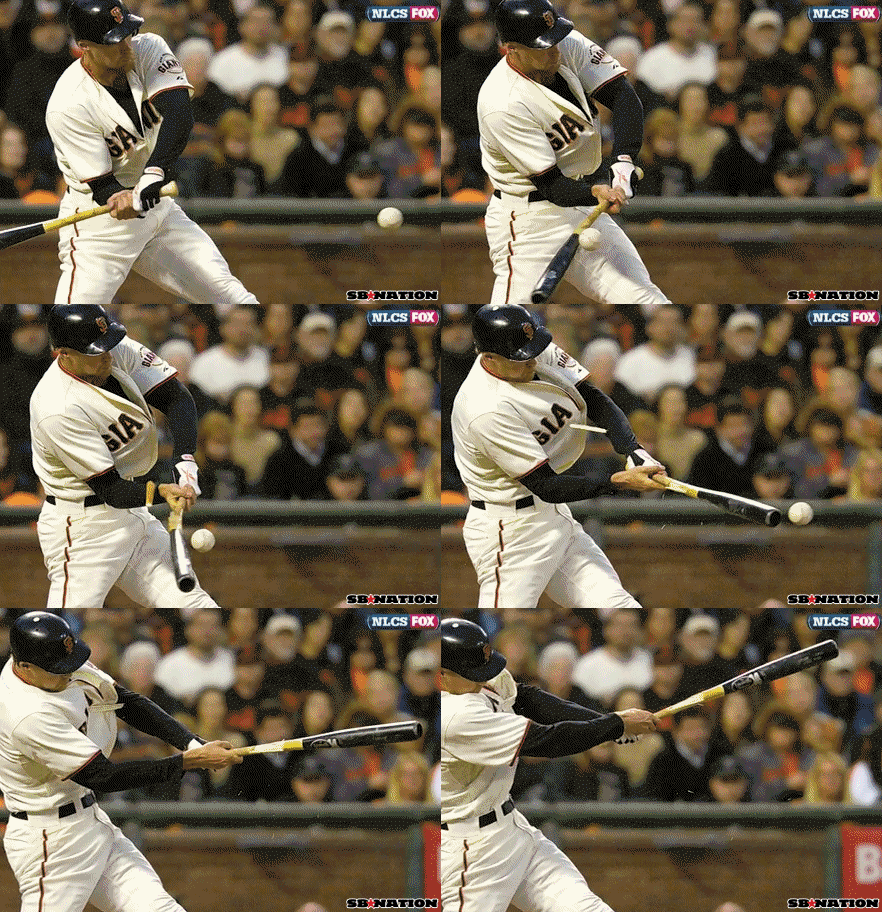
Such is baseball, and baseball rules. Really, outside of Brandon Belt’s homer when the game was more or less decided, how many balls did the Giants hit hard? Did Matt Cain actually look as dominant as the 5 2/3 shutout innings in the box score suggest? Certainly the Giants outplayed the Cardinals, but did they dominate them the way the final score says? And could anyone other than Hunter Pence have been responsible for this type of game-changing hit?
Our man Carlos Beltran exits another thunderous postseason with a whisper, earning a bloop single and a walk, with one late fly ball seemingly stifled by the San Francisco wind. Beltran’s 1.252 career postseason OPS, if you’re tracking at home, is still good for the best by anyone ever.


Dickey poll

Over at MetsBlog, Matt Cerrone weighs in on the Mets’ pending negotiations with R.A. Dickey and polls readers on how the club should approach them. Cerrone hears the Mets could expect “two top prospects” in a trade for Dickey this offseason, but, of course, that could mean a very broad range of things with varying implications for what the Mets should do with Dickey (i.e. depends on the deal).

If the two prospects are Major League ready position players that look likely to become franchise cornerstones, then peace out, R.A. and best of luck with the book and everything. That’s not likely to happen, though, since few teams have two Major League ready position-player prospects likely to become franchise cornerstones, and fewer still would be willing to deal them both if they did.

So I’m curious. Dickey is under the Mets’ control via a $5 million for 2013. And I’m not looking for what you’d hope to get for Dickey, since that would obviously be both the guaranteed championship and the power of invisibility. I’m looking for the least you’d be willing to accept in return for him:

Oh, right: Cole Hamels was on Life After Top Chef

I went away for a few days and got so buried in nonsense this morning that I almost forgot: Cole Hamels continued his mission to bring back the old school baseball by learning to rissole scallops on Bravo’s Life After Top Chef on Wednesday. You can check out video from Hamels’ appearance here.

Predictably, Hamels embarrassed himself in his own lovably goofy way, but the show didn’t produce many overwhelmingly embarrassing images of Cole Hamels. This one, after he stumbled over chef Jen Carroll’s name for the second time, was pretty good:

And there’s this, a closeup of an apron-clad Cole Hamels smelling some cheese:

To Hamels’ credit, cheese is delicious and often smells so. And there’s nothing really embarrassing about cooking.

Plus, no screengrab I snatched of Hamels could possibly live up to the image of Jonathan Papelbon presented within the first few seconds of the above-linked clip. He appears absolutely terrified to be seen on Bravo, and it looks like his wife is consoling him. This is a dark day in the Papelbon household:

Anyway, what say you:

Do long at-bats benefit hitters?

Over at Beyond the Box Score, James Gentile dives into Retrosheet data to investigate whether 10+ pitch plate appearances ultimately pay off for the hitter more often than they do for the pitcher. It’s a very interesting read complete with handy tables, but as Gentile admits, there are some sample size issues. Also — and this would be impossible to do in any meaningful way given the sample of data we have — I’d love to see such a study broken down by starters and relievers and the innings in question; I wonder if a 12-pitch plate appearance against a starter in the 2nd inning less frequently benefits the hitter than one against a reliever less accustomed to throwing so many pitches, and so on (though I suppose fouling off six pitches three hours into a game can be pretty exhausting, too).

Anyway, I link it here for a couple reasons: First, the extra-long plate appearance is generally credited to the batter, even though it always means the pitcher has induced a ton of weak contact — a good thing, even if it’s all going out of play. It turns out maybe that’s right, likely to the chagrin of the Mets fans certain the team’s patient approach killed its offense in the second half of 2012.

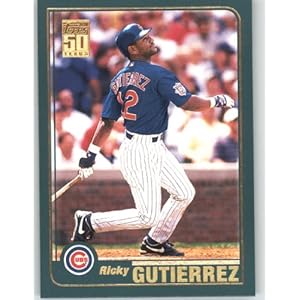
Second, the frivolities noted at the end of the post: The three longest plate appearances since 1988 belong to Adam Kennedy, Alex Cora and Ricky Gutierrez. (Remember Ricky Gutierrez?) None finished his career with an on-base percentage higher than .338 or an OPS above .711, and I suspect — hilariously tiny sample-size caveats noted — that’s not a massive coincidence. Albert Pujols probably doesn’t see a ton of pitches in a plate appearance very often because he doesn’t frequently swing at pitches out of the strike zone and doesn’t often see 10 pitches near the strike zone that he can’t hit fair.

Also, I’m sad I missed Gutierrez’s 20-pitch tilt against Bartolo Colon in 1998. That at-bat, culminating in a strikeout, came in an otherwise efficient eight-inning, 112-pitch outing for young Colon. The Astros got 28 plate appearances against Colon, and Gutierrez’s marathon occupied 17.9 percent of the righty’s effort.

Wait… what?

The New York Yankees have held discussions with the Miami Marlins about a trade involving their third baseman in crisis, Alex Rodriguez.

Sources close to both organizations confirm the Yankees would pay all – or virtually all – of the $114,000,000 Rodriguez is owed in a contract that runs through the rest of this season and the next five. One alternative scenario has also been discussed in which the Yankees would pay less of Rodriguez’s salary, but would obtain the  troubled Marlins’ reliever Heath Bell and pay what remains of the three-year, $27,000,000 deal Bell signed last winter.

None of the sources could give an indication as to how serious the discussions have already gotten, but one of them close to the Marlins’ ownership said he believed the trade made sense for both sides, and would eventually be made in some form.

Keith Olbermann, MLB.com.

That sounds pretty strongly worded for a rumor story, so maybe Olbermann — who’s not typically a scoops guy by any measure — either got something really juicy or isn’t accustomed to using the language needed to qualify these things.

Either way, it makes a hell of a lot of sense for the Marlins. They get a potential draw in a local guy pursuing a bunch of historic benchmarks, not to mention an upgrade to their woeful offense. And if A-Rod’s got a home in Miami he can’t get rid of, maybe it makes sense for him too.

What’s not really clear is how it works for the Yankees. Would they really pay all of the rest of his salary just to get rid of him? And if they were willing to do that, wouldn’t nearly every team in the Majors want him? Why only the Marlins — is that a function of his no-trade clause? Still, shouldn’t the Yanks hope to get something more than Heath Bell in return? Sure, A-Rod’s not the guy he was a few years ago, but he’s still a pretty good player. I mean, hell, if he’s free, let him play left field for the Mets.

As a Mets fan, I’m not opposed to A-Rod being sent south, no matter the deal. Though he would certainly make the Marlins better, he’d also make them indisputably more hilarious. Jose Reyes stealing bases, Giancarlo Stanton mashing home runs and making that ridiculous thing light up, and A-Rod sending clubbies into the Clevelander with “Do you like me? Check yes or no” notes for the dancers. I’m on board.


Playing the international market

Over at Amazin’ Avenue, Steve Sypa kicks off a three-part series on potential Japanese imports to help the Mets with a look at shortstop Hiroyuki Nakajima. Though, as Sypa concludes, Nakajima doesn’t seem the most logical fit for the Mets’ offseason needs, the team needs to bring in productive players on the cheap and should be exploring every possible angle from which it might do so.

To that end, I nearly made a post yesterday suggesting the Mets bring back old friend Lastings Milledge, who finished third in the Japanese Central League in OPS in 2012. L Millz will turn 28 in April. He bats right-handed and he plays the outfield, so he would appear a nice match for the Mets. Unfortunately, the Tokyo Yakult Swallows hold an option on his contract for 2013, and given his offensive success there, I’d guess they pick it up.

But here’s a dude: Former Mariners and Reds outfielder Wladimir Balentien finished second in the Japanese Central League in OPS this season and led the league in home runs for the second straight year.

Balentien, a native of Curacao, turned 28 in July. He plays the outfield and hits for power from the right side. The first 511 at-bats of his big-league career didn’t go so well, but he was younger then, plus playing in an awful offensive environment in Seattle. And he’s got a career .283/.351/.535 line in Triple-A and as far as I can tell his contract in Japan should expire after the season.

Presumably the Mets wouldn’t be the only team interested in giving Balentien another shot after his success overseas, but they might be the team most desperate for outfield help. So there’s that.

Who is Major League Baseball’s most likely ocelot defender?

If you told me a baseball player was involved in a legal dispute over the protection of ocelot habitats, I’d — and this is prejudice, I know — assume he was one of Major League Baseball’s legions of avid hunters and decidedly not on the same side as the ocelots in court.

If you next told me he was indeed acting on behalf of the ocelots and told me to guess who it was, I’d probably start with Prince Fielder. That’s mostly based on appearances, since Fielder looks cuddly as anything and once almost deked me into hugging him. But we also know that Prince Fielder at least dabbled in vegetarianism for a while, plus he plays on a team named for another endangered cat.

I’d round out the top five most likely ocelot defenders as: Cole Hamels, Brian Wilson, Albert Pujols and Mariano Rivera. That’s not based on much, just educated guesswork.

Then, if I had to go through all thousand-something guys on every team’s 40-man roster and rank them in order of the likelihood with which I’d expect them to go to court on behalf of ocelot habitats, I imagine I’d put Josh Beckett right down near the bottom of the list.

But alas, Beckett’s the guy. It turns out said ocelot habitat happens to be on his 7,000-acre Texas ranch, and Beckett is suing a pipeline company for bulldozing in an area where he has observed ocelots. Which is kind of nuts, if you think about it, since there are believed to be only 50 ocelots left living in the entire United States and ocelots are nocturnal and known for “reclusive behavior.” What are the chances that Josh Beckett, of all people, has seen them, and what are the chances they happened to be in the same spot on Beckett’s 7,000-acre ranch that this pipeline company needs to bulldoze?

I vote “pretty good.” As much as we might want to vilify Beckett for his purported roles in various Red Sox clubhouse meltdowns in the past couple of years, I’m just going to go ahead and guess he purchased the ranch specifically because of his interest in ocelots and his knowledge of the area as a potential ocelot breeding ground.

Also of particular note: The linked article features the headline, “Pipeline work leads to an ocelot of legal woe.” Also, both Beckett and Nolan Ryan have won a deer-hunting contest called the “Muy Grande,” which is Spanish for “very large.”

Finally (language NSFW):

Via Deadspin.

Holdzing pattern

I know from responses to posts like this one that many of you don’t have much sympathy for the plight of the Minor Leaguer. And logically, I get that: These guys get paid to play a kid’s game, and even if that game can commodify them and dehumanize them and ultimately release them back into the real world often unprepared to do anything but the one thing they have just proven they cannot actually do, it’s all part of what they’ve signed up for.

Plus, no matter who told them what, when they were dominating in high school or college, about how much they’d eventually achieve and make in baseball, they should understand going into it that playing baseball professionally comes with a hell of a lot of risk, and do everything they can to set themselves up for life after baseball whenever that day comes. Pay attention in class, save your money.

And certainly, all due respect to the guys that do that, the players with the wherewithal or acuity or plain-old common sense to realize at 16 or 18 or 20 that no one can ever count on a career in baseball and prepare themselves in some way — mentally, emotionally, financially — for eventual failure. There are plenty of them, and if they get short-shrifted here it’s only because I’m a sucker for the sad sacks.

Which is to say that if you’ve got no compassion for a guy like John Holdzkom, a 24-year-old former fireballing fourth-round draft pick during the Omar Minaya era who recently called comedian Chelsea Peretti’s podcast to tell her about blowing his entire signing bonus on sushi and alcohol before blowing out his elbow, well, then we don’t have that in common. The transcript is worth reading, if only as your weekly or monthly or biannual reminder that baseball produces a lot more washed-up 24-year-olds looking for opportunities to play anywhere that’ll have them than it does millionaire superstars.