The greatest trick Mark Sanchez ever pulled was convincing the world he can’t complete a 20-yard out

Before New York’s 23-17 loss to the Houston Texans in Week 5, backup quarterback Tim Tebow tweeted, “Looking forward to giving God all the glory in tonight’s 666th Monday Night Football game. Romans 8:37-39.”

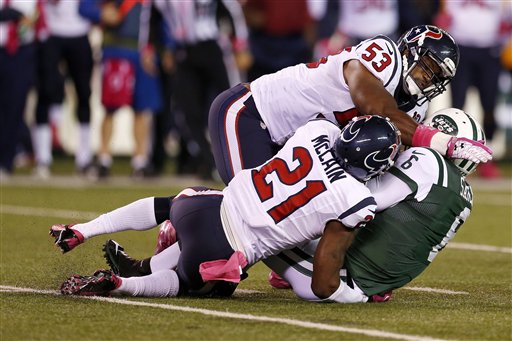
With the No. 6 jersey on his back, starter Mark Sanchez connected on 14 of 31 passes, had one touchdown and two interceptions.

File this under “You can’t make it up”: Sanchez’s line means — drumroll please — on the season, he now has a 66.6 passer rating, 6.6 yards per attempt, six touchdowns, six interceptions, and his longest completion of the season was good for 66 yards.

CBS New York.

And — as I pointed out when Josh noted the same series of stats in the comments section yesterday — don’t forget that Sanchez is devilishly handsome.

I’d love to dismiss this as a series of coincidences with a joke about how Tebow’s secretary is named Sanchez and Sanchez’s secretary is named Tebow, and obviously I do think it’s a series of coincidences and I don’t think Mark Sanchez is actually Damien from the Omen or anything. But it’s a pretty amazing series of coincidences.

Or maybe — maybe! — Mark Sanchez is unbelievably good at football and he’s just trolling Tim Tebow something fierce, Dawson in Varsity Blues style.

The Jets will finish 8-8 this year because they are the Jets

The Jets will finish 8-8 this year. I can practically guarantee that. Don’t come at me with facts: The Jets finish 8-8 every single year, just bad enough to miss the playoffs but just good enough to ensure they’ll miss out on a premium draft pick.

Last night, the Jets nearly defeated an undefeated team. Hell, you might even argue that the Jets would have defeated an undefeated team were it not for classically Jetsish hiccups and nonsense in clock management and communication.

They somehow actually moved the ball! Their offense, which looked as bad as any I’d ever seen as of just last week when it had its best receiver, somehow moved the ball down the field against the Texans’ strong defense even though they still have no running game to speak of, most of their receivers still can’t really catch and Mark Sanchez can’t find a way to throw the ball over the line unimpeded. I don’t know how that happened. Tim Tebow willed it from the sidelines, maybe.

But too much Jets stuff happened. They had to call timeouts when they shouldn’t have because there were 40 guys in the huddle who then all panicked and left the field at the sight of each other. Tipped balls and dropped passes wound up in the hands of Texans defenders.

From what I’ve seen so far this morning, everyone’s crediting Arian Foster for the Texans’ win. And Foster’s a great back who had a great game, no doubt. But did you see the holes he had to run through? Massive. That happens because the Texans have a line that can protect their quarterback, a quarterback who can throw the ball downfield, and receivers that can catch the ball when he does. The Jets did a good job containing the Texans’ passing game, but — especially with Revis out — that means making concessions somewhere.

Look: I don’t think Shonn Greene’s a very good running back either. But do you really think it’s going to make a difference of more than a couple of feet per carry if the Jets give his touches to Bilal Powell, or, hell, to Tebow? There’s no place for the guy to go. Fantasy football and human nature combine to credit the individuals always in a football team’s success, but it is almost always the team.

Wouldn’t it be cool to root for a good one?

Also, that J.J. Watt guy looked awesome. CALL FOR HELP MARK SANCHEZ!

Tim Tebow captured biting the hand that feeds him tons and tons of attention

Deadspin’s got an investigation and subsequent conclusion on some photos Tweeted by a girl who wound up in a hotel room with Mark Sanchez and Tim Tebow, which it turned out was a totally innocent meet-up related to a charity event. What’s more interesting is the shirt on Tim Tebow:

That is presumably to mock ESPN’s East Coast bias, which has now pretty decidedly been replaced by its Tim Tebow bias. But then I guess you could argue Tebow doesn’t want all the coverage and has a right to wear whatever funny t-shirt he wants, or you could just say screw it and join the rest of society in admiring the way he fills it out.

The Jets’ offense… oof

Without delving too deeply into glory-days stuff, I’ll say that the last time I saw a football team’s offense look so utterly inept and overmatched, I was in high school. Our first two quarterbacks and two of our starting offensive linemen were hurt and our starting tailback was suspended, and every kid on the opposing New Hyde Park team looked like he was 27 years old and on steroids. We tried to resort to mind games, up to and including having the entire line set up in our stances singing “I’m a Little Teapot” before the snap, but their body games consistently defeated us.

Everything I wrote last week about the pervasive uncertainty and sample-size issues that should dominate football analysis still applies, and I understand that the Niners’ defense appears legit. But yesterday we got 50 more plays’ worth of evidence with which to judge this Jets’ offense, and just about every one them suggested it is awful.

But then they’re still 2-2.


So the replacement refs are not good. What now?

The scab NFL refs, you might have noticed, are awful at officiating football games. This leads to some awful football events like those that occurred at the end of last night’s Seahawks-Packers game, awful calls at a seemingly higher rate than they came last year, and an awful lurching pace to games as the fill-in guys run around trying to figure out what happens next.

Speaking of: If you’ve determined that the NFL’s replacement refs suck to the point that they are impacting the quality of NFL football — as they obviously did last night — what recourse do you have, as a football fan, to encourage the NFL and its officials to squash the beef?

That’s not rhetorical, really.

The best I can think of is for everyone to stop watching NFL football until its settled. But since the NFL has a monopoly on professional football and professional football is a juggernaut, that doesn’t seem likely to happen. Maybe we’re all just going to abide the scab refs until they improve or are replaced by better scab refs because we just can’t get enough football.

A more palatable but certainly less effective alternative is for everyone to whine and moan about it so much that the public-relations hit forces the league to flinch. That’s sort of what this post is about. But it’s going to take a hell of a lot more than this to do that. The NFL mints money off a bloodsport that we plan our weeks around and tune our flatscreens to every Sunday, Monday and Thursday like we’re the brainwashed populous of some dystopian future. The NFL is Big Brother and we have always been at war with the NFL Referees Association. Or something. The NFL can take its knocks without breaking.

The players present a wild card in the process. Clearly the replacement officials jeopardize player safety, and the players taking a unified stand against the league’s position could help the process along. But while the NFLPA is sympathetic to the refs’ cause, it insists there’s nothing it can do beyond writing strongly worded letters as “they’re not permitted to strike under any terms other than the security of their union.”

But if they’re claiming that the league “failed in [its] obligation to provide as safe a working environment as possible,” isn’t that a pretty legit gripe? Some football players die from the long-term effects of the head injuries they suffer. The NFL will make more than $9 billion in revenue this year off football players playing football. Who really holds the cards? No one wants to see Roger Goodell play football, right? No one wants to see Jerry Jones in a three-point stance across the line of scrimmage from Jim Irsay, at least not for more than a quarter.

What if in all the 1 o’clock games this Sunday, the players called the coin toss, returned to their sidelines, then just stayed there for a few extra minutes to remind everyone who actually does the football playing in football? No macho b.s., just a group of men who risk their health for their jobs so that they can make some money (and some other guys can make way, way more money) standing up for themselves to demand the safest possible incredibly dangerous workplace? Would anyone blame them for that? Would the league really sue?

Is anyone really ready for some football?

In April, with the help of SNY promos man Brett, I published to YouTube a video of myself singing lyrics I “wrote” to the tune of a Bizet aria. Those lyrics are as follows:

Small sample size, small sample sample size
Small sample size
Small sample size
Small, small sample size, small sample size
Small sample size, sample size!
It’s a small sample size
Small sample size
It’s a small sample size.

There’s nothing worse than explaining a joke, but the song is nominally about baseball. Its premise is that baseball, like many pursuits, is subject to a hell of a lot of randomness, that our eyes and hearts are gullible, and that the fluctuations in performance from teams and players over small parts of seasons that lure us into believing they indicate something meaningful almost always prove otherwise with more evidence. And if you were to tell me that some baseball player I believed to be very good sucked very hard for 16 baseball games — or vice versa — I would certainly sing to you these words:

Small sample size, small sample sample size
Small sample size
Small sample size…

Etc.

So it seems strange to me that the sample-size specter is so infrequently cited in football, a sport that operates in tiny samples and that is, due to the money culture surrounding it, subject to such thorough scouring and forecasting from every barking pregame analyst and bright-eyed online gambler and sniveling office fantasy guru and everyone in between.

Why should we spare the NFL’s players and prognosticators the prudence we know is required in baseball? Is the game any less subject to randomness? Maybe, but then individual player performances are far more dependent on those of their teammates and opponents, and, in many cases, the officiating. We can see when a player consistently performs well in a system and with a certain set of players around him, but can we ever know for certain he is a great player that will perform as well in another system with other or lesser players around him?

And it strikes me that for a player to establish as much, he must be playing frequently enough to deny the opportunities to his replacements, so it is impossible to know for sure that any run-of-the-mill NFL-caliber player at the position couldn’t step in to the role and, with enough reps, enjoy similar success. Plus, it seems that given the short arcs upon which NFL players necessarily exist, by the time a player can establish beyond all doubt that he is excellent, that may very well no longer be the case.

We strongly suspect Peyton Manning is good. We know he played extraordinarily well for more than a decade as the quarterback of the Indianapolis Colts, and based on what we’ve seen from other quarterbacks and from — in brief spurts — Manning’s replacements, we believe few others would have performed as well as Manning in the same situation.

But does anyone think Peyton Manning circa 2004 would have played like Peyton Manning circa 2004 were he under center for the New York Jets this week and last? And does no one imagine Mark Sanchez — the suddenly gun-shy, inaccurate, altogether not-poised Sanchez — could look a bit better than he has recently (football-wise, at least) if the players around him were as good as the players around Manning back then?

And Peyton Manning is the outlier. Manning’s is the first name that comes to mind to counter any argument suggesting NFL players are more or less fungible products of their systems because Manning is one of the very few dudes who presented ample evidence over plenty of time that he was in fact something more. Manning’s the guy who started 208 straight games. The sample size seems adequate.

Sanchez? We don’t know. Sanchez has started 50 games, sure, but nearly half of them were also started by Wayne Hunter. He has at times been hampered by poor play calling, an awful running game, and receivers that look like they’d drop hand-offs and appeal to the refs for pass interference.

Which is all to note my growing concern that most purported NFL expertise is rooted either in sheer obliviousness or some sort of wink-nod agreement that no one really knows a damned thing about who’s better than whom, and we’re all pretty much full of it but we’re going to keep blustering forward because a) everybody’s watching football anyway, b) it’s a hell of a lot of fun, and c) there’s no actual accountability beyond 50 bucks to the office fantasy guru when our bold predictions go awry.

When I first watched Sanchez play quarterback for the Jets, I identified what I believed to be precocious and intangible presence and judgment at the position, and thought that he would prove great with time. Those qualities faded that season but returned in the playoffs, and then again in the first half of 2010. Now, he looks timid in the pocket, afraid to throw downfield but also afraid of oncoming rushers and afraid to tuck and run. But I know this represents merely a six-game stretch of mostly lousy play for the man, that he has played even worse in the past and recovered, that he’s cast into the spotlight — for better or worse — because of his position, and that, again, he’s getting little help from his supporting cast.

I want Mark Sanchez to be good and I’m not sure he is. I think he has looked worse than he actually is these last two weeks because of some poor play around him, but I am pretty certain he is not as good as vintage Peyton Manning. And I fear none of it will matter all that much as it pertains to this season if the Jets are forced to carry on without Darrelle Revis, whom I can say confidently is almost inexplicably awesome despite all the requisite caveats for his environment, sample size and confirmation bias.

The black unicorn explained

Asked in training camp about his speed downfield, Bennett described himself to reporters as a “black unicorn.” Predictably, the name stuck.

Many assumed the label was just another example of Bennett’s eccentricity. In truth, fictitious animals are a staple for Bennett and his wife. The black unicorn is a character in Bennett’s novel — which also includes talking walls and a plot that Bennett will describe only as amazing — while Siggi, originally from California, has a healthy affection for mermaids. This year, Bennett even had a birthday cake made for his wife that featured a likeness of her, complete with a mermaid’s green tail, atop the icing.

Bennett’s den contains a collection of other unusual beings — he recently ordered a Mickey Mouse toy wearing a gas mask.

Sam Borden, N.Y. Times.

Ahhh… every single thing about Martellus Bennett. Please go read this article.

Via Josh.